What if the document showing you can use an address still doesn’t prove it meets Companies House requirements? If you’re asking how to prove your right to use a registered office address, start by separating two questions: do you have permission to use it, and is it suitable as a registered office?
It’s understandable to expect one document to settle the matter, but the right evidence depends on who’s asking and what they need to establish. Companies House doesn’t routinely require proof when you register a company. However, evidence may be relevant if an address is challenged, and a landlord or address provider may have its own checks. Since 4 March 2024, a registered office must be an appropriate physical UK address where documents can be delivered and acknowledged. Permission alone doesn’t establish that.
This guide explains what different requesters may need, which records could support your case and how to respond if your evidence is questioned. It also covers what to check before using a rented property or a third-party service, including a registered office address service, so you can handle an address query calmly and accurately.
Key Takeaways
- Start by clarifying who needs evidence and what they want to establish. A Companies House query differs from a landlord’s or provider’s request.
- Learn how to prove your right to use a registered office address by matching relevant records to your circumstances, rather than relying on one document for every situation.
- Check whether your tenancy, licence or service agreement permits the intended address use, and confirm any limits before sharing it as evidence.
- Treat permission and address suitability as separate checks, including whether the address is in the right UK jurisdiction for your company.
- Compare your home, rented or shared premises with a registered office address service. Check the service terms and available evidence before choosing an arrangement.
What does proving your right to use a registered office address mean?
A landlord, address provider, Companies House or another organisation may ask why your company uses a particular address. The question can sound as though you need to own the property, but you don’t. Proof of right means evidence that you have permission or another valid basis to use the address for the purpose in question. What the requester expects depends on the circumstances, so don’t assume one document will meet every request.
Permission to use an address is not the same as owning it
A tenant, licensee or company authorised by a property owner may be able to use an address without owning the property, subject to the relevant agreement and permissions. Ownership records show who owns a property, but they don’t necessarily show that your company has permission to register its office there. That authority might instead be supported by written consent, a contractual right or an address service arrangement.
Before relying on a tenancy, licence or service agreement, check the wording for the permitted use and any restrictions. The effect of specific terms depends on the agreement and your circumstances. If you’re unsure whether it allows company registration, seek qualified advice.
What makes an address suitable as a registered office?
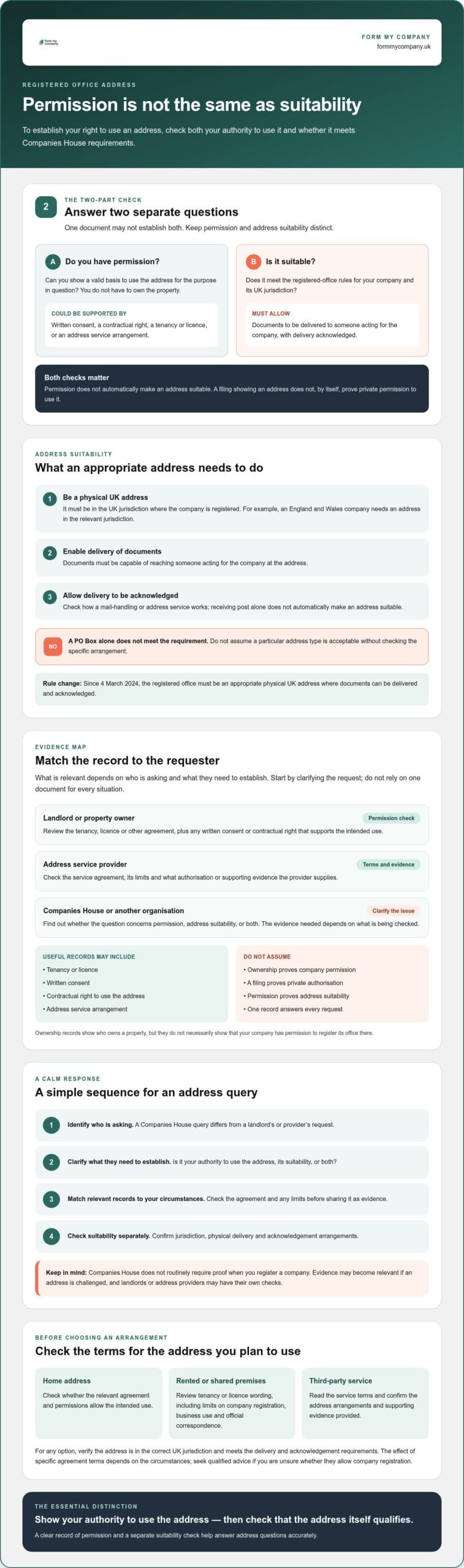
Permission is only one part of the check. Under Companies House rules, a registered office must be an appropriate address in the UK jurisdiction where the company is registered. In practice, it must be a physical address where documents can be delivered to someone acting for the company and where delivery can be acknowledged. A PO Box alone doesn’t meet this requirement.
This is separate from proving consent. An address appearing on a company filing doesn’t, by itself, show that a landlord or provider authorised its use. Likewise, permission to use a property doesn’t automatically mean it meets the registered office requirements. Consider both checks separately.
For background on the term, see Registered office; for the rules that apply to your company, check current Companies House guidance. If you’re considering a registered office address service, review its terms and confirm what authorisation or supporting evidence it provides before relying on the arrangement.
Keep this distinction in mind as you work out how to prove your right to use a registered office address: establish both that you’re authorised to use it and that it is suitable for your company’s registered office.
Which rules and permissions matter for a UK registered office address?
Two checks apply: the address must satisfy the statutory rules, and your company must have authority to use it. The Companies Act 2006 requires a company’s registered office to be an appropriate address in the part of the UK where it is registered. For example, an England and Wales company needs an address in the relevant jurisdiction, not simply any UK address.
What the appropriate-address requirement means in practice
Under current Companies House guidance, an appropriate address must be a physical address where documents delivered to the company can be brought to the attention of someone acting for it, and where delivery can be acknowledged. A mail-handling address is not automatically suitable just because a provider can receive post. Check how the specific arrangement works and whether it meets the requirements. Don’t assume any particular address type is acceptable.
Companies House may accept an address on a filing, but that doesn’t confirm you have private permission to use it. Filing details and property or service rights are separate matters. Keep that distinction clear as you consider how to prove your right to use a registered office address.
Who may grant permission to use an address?
Authority may come from a property owner, a landlord, a tenant who is entitled to authorise the use, or an address service provider. The right person depends on the property arrangements. Read the relevant lease, licence or service terms for restrictions on company registration, business use and receiving official correspondence. Companies House also notes that permissions may be required when choosing an address, including a home address.
A director’s authority to make decisions or filings for a company is not the same as permission from a property owner or service provider. If the director is a tenant, for instance, check whether their agreement lets them authorise the company’s use of the property. Don’t assume it does. If the wording is unclear, seek qualified advice rather than relying on a general interpretation.
If you’re considering an address arrangement through a provider, review its terms and ask what evidence of authorisation it supplies before relying on it. A registered office address service may be an option if your current premises aren’t suitable, but check that the service meets your needs and the applicable rules.
What documents can help prove your right to use a registered office address?
The most useful evidence connects your company to the address and explains the basis for using it. There’s no single document that every requester must accept. Match the evidence to your arrangement, then ask the organisation what it considers suitable before sending personal or commercially sensitive information.
Written consent, agreements and service records
If someone has given permission, written consent can help show who authorised the address, which property it covers and whether company registration or business correspondence is permitted. A relevant tenancy or licence may set out your rights, but check its wording for restrictions. For an address provider, review the service terms and any written confirmation of your arrangement. Don’t assume a general agreement covers every use.
What each document can and cannot prove
Different documents support different facts. A record may show occupancy or ownership without proving permission to register a company. Use the table as a guide, not a guarantee that a requester will accept a particular document.
| Evidence type | What it may help establish | Limitations or details to check |
|---|---|---|
| Written consent | That a named person or organisation has authorised use of a specific address. | Check the parties, address, permitted purpose and any conditions or expiry date. |
| Tenancy agreement or licence | Your right to occupy or use the premises under an agreement. | Check whether it allows company registration and business correspondence. The document may not give you authority to grant permission to the company. |
| Address service agreement | That you have an arrangement with a provider for use of the address. | Confirm the service covers registered office use and what written confirmation or evidence the provider can supply. |
| Utility bill or property title record | Details about occupancy, account responsibility or property ownership. | These records may support other facts, but don’t necessarily show consent for company use. |
| Companies House record or correspondence | That an address has been recorded or used in official correspondence. | A public register entry or letter doesn’t, by itself, establish permission from a landlord, owner or provider. |
Start by asking the requester what it needs to verify and whether a redacted copy is acceptable. This helps you provide relevant evidence without sharing unnecessary personal details. If you’re considering a registered office address service, check its terms and confirm what evidence or authorisation it provides. That’s a practical first step in working out how to prove your right to use a registered office address in your situation.
How to respond when someone asks for proof of registered office permission
A request for evidence doesn’t always mean there’s a problem. First identify who’s asking, then clarify exactly what they need to confirm. Companies House, a landlord, a service provider, a bank and another organisation may each have different reasons for asking. Don’t assume the same document will suit them all.
A simple evidence-checking process
Work through the request methodically. Ask whether the requester has a preferred document or format, and which fact it needs to verify. Then choose evidence that supports that specific point instead of sending a bundle of unrelated records.
- Identify the requester. Check whether this is an official Companies House query or a separate request from a landlord, provider, bank or other organisation.
- Clarify the question. Find out whether they need to see permission to use the address, the terms of your arrangement or information about the address itself.
- Check your authority. Review the relevant consent, tenancy, licence or service agreement, including any conditions on company registration or correspondence.
- Select and check your evidence. Match the document to the question. Check that company and personal names, address formatting, dates and the scope of permission are consistent.
- Share carefully and keep a record. Send only what’s relevant. Where appropriate, redact unrelated personal information, and retain a copy of what you sent and the requester’s response.
If Companies House has contacted you, follow the instructions and deadlines in its communication, and check its current guidance if anything is unclear. For a landlord or address provider, ask what evidence it will accept and whether there’s a specific process to follow. A bank or another organisation may be checking a different matter, so clarify its purpose before sharing documents.
If you cannot get permission or the evidence is challenged
Don’t assume you’re authorised to keep using an address if permission is unclear or disputed. Re-read the agreement and contact the person or organisation with the relevant authority, such as the landlord or service provider. Ask the requester what alternative evidence or correction it will accept before taking further action.
If you can’t confirm the current arrangement, an authorised address service may be an alternative. Review the registered office address service terms and ask what authorisation or evidence is supplied. If the disagreement concerns your rights under a lease, licence or other contract, seek qualified legal advice. For a starting point, explore address options for your company and check which arrangement fits your needs.
Choose a registered office address arrangement you can document
Before settling on an address, check three things: it meets the registered office requirements, you have authority to use it, and you can keep records that explain the arrangement. These checks help you choose an address you can rely on, rather than trying to assemble evidence after someone raises a query.
Your home, a rented property or shared premises may work, but only if the address is suitable and the relevant permissions are in place. If you have privacy concerns or can’t confirm that your current agreement allows company registration, consider whether a provider-based arrangement is a better fit.
When a registered office address service may help
A registered office address service can be an option if you don’t want to use your home publicly, or if permission to use rented or shared premises is uncertain. Don’t treat a service as automatic proof of suitability, or assume another organisation will accept its documents. Check the terms against your needs and the requirements that apply to your company.
What to confirm before relying on an address provider
Read the written terms before committing. Confirm that the permitted use includes a registered office, how official correspondence is handled and whether any limitations affect your company. Ask what written confirmation or other records the provider supplies, and make sure the information matches the address arrangement you intend to use.
A virtual office may be relevant for other business needs, but don’t assume every virtual office arrangement includes a registered office address. Check the service scope and terms carefully. The same principle applies to any address option: verify the arrangement rather than relying on its label.
Once you’ve chosen, keep the agreement, relevant consent and correspondence together, and review them if the arrangement changes. If you’re still weighing up how to prove your right to use a registered office address, Form My Company’s address service is one option to explore. Review the terms and ask any questions you have about permitted use and supporting records before deciding.
Make your address choice with confidence
Keep the key checks clear: confirm the address meets registered office requirements, make sure you’re authorised to use it and retain records that support the arrangement. The right evidence depends on who’s asking and what they need to verify, so clarify the request before sharing documents.
Understanding how to prove your right to use a registered office address can also help you decide whether your current home, rented or shared premises are the right fit. If you’d prefer another arrangement, Form My Company offers a Registered Office Address Service and Virtual Office Services. Check the service scope, permitted use, correspondence handling and supporting documents before choosing.
Explore your options with Form My Company’s registered office address options, and ask questions before you commit. With the right checks and records in place, you can move forward with greater confidence.
Frequently Asked Questions
Does Companies House require proof that I have permission to use a registered office address?
Generally, you don’t need to submit proof of permission when you first register the address. However, you should be able to show that you’re entitled to use it if Companies House questions the address or asks for evidence. Follow the instructions in any official correspondence and respond within the stated timeframe. This is separate from any checks a landlord, address provider, bank or other organisation may make.
What documents can prove I have permission to use a registered office address?
Documents that may support your case include written consent from someone with authority over the property, a tenancy agreement or licence that permits the intended use, or an address service agreement. The best evidence depends on your circumstances and the requester’s criteria. A utility bill may help confirm occupancy, for example, but may not establish permission. To prove your right to use a registered office address, ask what evidence the requester accepts before sending records.
Can I use my home as my company’s registered office address?
Yes, a home address can be used if it meets the registered office requirements for your company. It must be a physical address in the relevant UK jurisdiction where documents can be delivered to someone acting for the company and delivery can be acknowledged. Consider the privacy implications, as the registered office appears on the public register. If you rent or share the property, check your agreement and any relevant permissions first.
Do I need my landlord’s permission to use a rented property as a registered office?
Check your tenancy agreement and ask your landlord if the terms are unclear. Whether permission is needed depends on the agreement and the circumstances, including any restrictions on business use or company registration. Don’t assume that being allowed to live at the property automatically means you can register a company there. Keep any written consent or relevant agreement, and seek qualified advice if you’re unsure how a particular clause applies.
Is a Companies House listing proof that I am authorised to use the address?
No. A Companies House listing shows that an address has been filed for the company, but it doesn’t by itself confirm that a landlord, property owner or address provider authorised its use. Keep separate records of your permission or service arrangement. If someone asks you to prove authority, clarify what they need to establish and provide relevant evidence rather than relying only on the public register entry.
Can I use a virtual office as a registered office address?
It may be possible, but the label “virtual office” alone doesn’t show that an arrangement meets registered office requirements. Check that the service permits registered office use and that the address meets the requirements for your company’s UK jurisdiction, including how documents are received and delivery acknowledged. Read the provider’s terms and ask what written confirmation it supplies. Form My Company offers Virtual Office Services, but check the specific service scope before relying on it.
What should I do if I cannot prove permission to use my registered office address?
First, review your tenancy, licence, consent or service terms, then contact the landlord, property owner or provider to clarify your authority. Ask whoever requested evidence what alternative documents or correction they’ll accept. Don’t assume you can continue using the address if permission is disputed or unclear. If you can’t confirm the arrangement, consider another address that you’re authorised to use, and follow any instructions or deadlines in official Companies House correspondence.