
Setting up a compliant registered office with authorisation requires acquiring explicit legal permission from the property owner, filing official confirmation statements with Companies House, and maintaining verifiable proof of address rights to satisfy UK corporate compliance regulations and avoid statutory penalties.
Establishing a legally sound corporate presence in the United Kingdom demands strict adherence to regulatory statutes enforced by Companies House. Every corporate entity registered under the Companies Act 2006 must maintain an official address for statutory communications. Regulatory frameworks require absolute transparency regarding property occupation rights. Companies operating without documented property owner consent face severe administrative penalties, including compulsory company strikes and asset freezes. Understanding the exact statutory mechanisms prevents operational disruption.
What Constitutes a Legally Compliant Registered Office Address?
A compliant registered office address requires a physical location within the exact UK jurisdiction of incorporation, continuous accessibility for statutory mail delivery, and verifiable legal authorisation from the property owner or landlord.
UK corporate law mandates that every registered corporate entity maintains an official contact point. Companies House processes millions of statutory notices annually through designated geographic channels. The location must accept formal legal documents, court summons, and official government correspondence during standard business hours. Mail delivery failure results in immediate compliance flags. Property management agreements must explicitly state that the premises can serve as a corporate registration hub. Commercial landlords often restrict corporate registrations in residential leases or shared workspaces. Businesses must review property deeds before submitting incorporation documents. Verification officers audit corporate records to ensure physical accessibility matches public registry entries.
Why Is Official Authorisation Mandatory for Office Registration?
Official property authorisation protects corporate integrity, prevents fraudulent business registrations, and satisfies strict Companies House mandates requiring undeniable proof of legal occupation rights.
Unauthorised address usage triggers immediate regulatory investigations by government agencies. Companies House cross-references property data with land registry archives to detect fraudulent incorporations. Three primary verification safeguards protect the registry: landlord consent letters, signed commercial lease agreements, and explicit property owner declarations. Directors submitting false location data violate statutory disclosure rules. Regulatory bodies impose personal fines up to five thousand pounds for intentional misrepresentation. Legitimate enterprises secure proper documentation before filing incorporation forms. Clear legal authorization eliminates the risk of sudden administrative dissolution.
How Do You Obtain Proper Authorisation From Property Owners?
Obtaining property authorisation requires drafting a formal commercial agreement, securing explicit landlord written consent, and procuring a dedicated Letter of Authority confirming legal occupation rights.
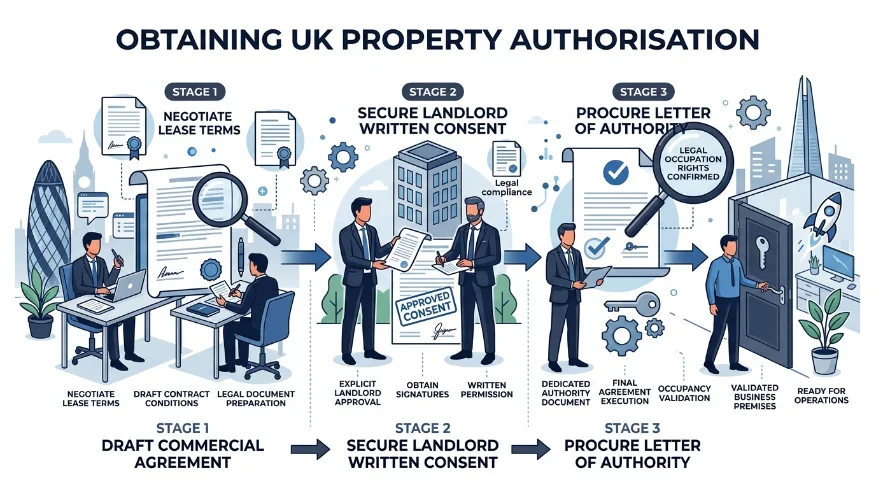
Property owners must sign specific legal waivers permitting corporate registration at their premises. Commercial leases outline precise terms regarding mail receipt and statutory notice display. Three essential documentation steps secure compliance: drafting explicit lease clauses, obtaining a countersigned landlord consent form, and securing a formal Letter of Authority. Landlords must acknowledge that Companies House inspectors may visit the premises. Shared office providers and virtual address vendors issue standard authorization certificates upon contract execution. Companies utilizing Supplementary Company Documents streamline this acquisition process efficiently. Official documentation must remain accessible for corporate audits.
| Authorisation Step | Required Document | Regulatory Purpose |
| Lease Verification | Commercial Lease Agreement | Establishes legal tenure and operational rights |
| Landlord Approval | Signed Consent Form | Proves property owner grants registration permission |
| Official Notice | Letter of Authority | Satisfies statutory proof requirements for Companies House |
What Statutory Documents Are Required During the Setup Process?
Statutory setup requires submitting Articles of Association, completing Form IN01 for incorporation, and maintaining supplementary compliance documents verifying office address rights.
Corporate formation relies on standardized legal paperwork processed through digital or physical filing channels. Companies House reviews every submission against statutory criteria within 24 to 48 hours. Three primary filing elements complete the setup: Articles of Association, Form IN01 detailing officer appointments, and proof of registered office location. Directors must archive all compliance receipts and property permissions in the statutory registers. Missing paperwork delays corporate activation and freezes banking application procedures. Maintaining comprehensive records ensures seamless navigation during annual compliance reviews.
How Can Businesses Prevent Registered Office Compliance Failures?
Businesses prevent compliance failures by conducting rigorous property audits, updating Companies House within 14 days of any address change, and maintaining valid occupation documentation.
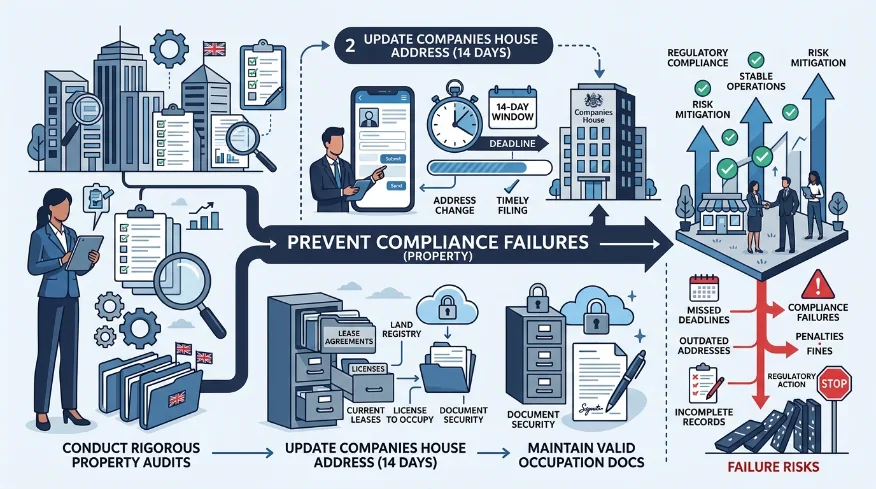
Corporate transparency regulations require proactive management of official registry details. Address relocations demand immediate statutory notification to avoid legal default notices. Three proactive prevention strategies protect corporate standing: auditing lease expiration dates, updating public registers promptly, and archiving current landlord permissions. Form My Company assists business owners in navigating these complex statutory requirements. Ensuring continuous compliance safeguards corporate reputation and maintains uninterrupted operational authority across all commercial sectors.
Explore our Supplementary Company Documents guide,
Want to Buy Bank-Ready Company Certificates From Form My Company?
Want to Get Official Share Certificates From Form My Company?
Frequently Asked Questions
What are supplementary company documents in the UK?
Supplementary company documents are official records such as certificates of incorporation, letters of authority, and memorandum changes that validate a business’s legal standing. Form My Company provides these essential corporate records to help businesses verify their registered office and administrative compliance.
Why do I need a letter of authority for my registered office?
A letter of authority proves to regulatory bodies and landlords that your business holds explicit legal permission to use a specific address as its official registered office. Form My Company supplies these verification papers to ensure your corporate setup satisfies UK compliance frameworks.
How do I update my registered office address with Companies House?
Updating a registered office address requires submitting a formal notification to Companies House within fourteen days of the relocation alongside proof of property occupation rights. Utilizing services from Form My Company ensures your statutory paperwork is accurately processed and legally compliant.
What happens if a company cannot prove its registered office rights?
Companies unable to prove their registered office rights face severe administrative penalties, statutory warnings, and potential company strikes by Companies House. Securing official property owner consent and supplementary documentation through Form My Company prevents these legal disruptions.
Can I use a virtual office address as my official registered office?
Virtual office addresses are fully permissible as official registered offices in the UK provided the provider grants explicit legal authorisation and mail handling rights. Form My Company offers specialized documentation packages to validate virtual address compliance for corporate entities.