
Spreadsheets require manual data entry, creating compliance risks and version control issues for UK companies. Automated compliance software updates Companies House records instantly, tracks beneficial ownership, sends filing alerts, and protects corporate registers against human error and severe legal penalties.
Why Is PSC Register Compliance Critical for UK Companies?
Failing to maintain an accurate Persons with Significant Control (PSC) register breaches the Companies Act 2006. UK law enforces strict statutory obligations on companies to identify, record, and report individual beneficial owners who hold substantial corporate control.
UK corporate entity regulations require every private limited company to record beneficial ownership accurately. A Person with Significant Control holds more than 25% of company shares or voting rights. They can also exercise significant influence over corporate decisions. The legal duty to maintain this record remains continuous rather than annual.
Companies House requires updates within 14 days of any internal register change. Directors face unlimited fines and criminal prosecution for non-compliance. Manual oversight frequently leads to missed deadlines and inaccurate corporate filings. Using dedicated corporate tools ensures timely notifications and full legal alignment.
How Do Manual Spreadsheets Increase Compliance Risks?
Manual spreadsheets introduce human error, lack audit trails, risk data security breaches, and delay mandatory Companies House updates. These errors lead to incorrect beneficial ownership filings, financial penalties, and prosecution for corporate directors.
Spreadsheet software lacks built-in validation rules for UK corporate filings. Data entry operators often input inaccurate birth dates, incorrect control nature codes, or misspelled names. These small discrepancies invalidate official registers and trigger statutory compliance queries from authorities.
Spreadsheets do not provide native version control or secure multi-user management features. Multiple team members editing a single document causes conflicting records and data loss. Unencrypted file sharing across email channels violates basic GDPR principles and exposes sensitive officer details to external security threats.
Manual tracking lacks automated alerts for statutory reporting windows. Company secretaries must manually calculate the 14-day internal update window and the subsequent statutory filing timeline. Missing these deadlines invalidates public records, which halts corporate transactions during investor due diligence.
What Are the Main Advantages of Automated Compliance Software?
Automated compliance software provides real-time Companies House integration, automated filing workflows, centralized data storage, and strict permission controls. These features eliminate human error, secure sensitive information, and ensure full statutory adherence.
Automated systems connect directly to Companies House through secure API connections. Updating a director or shareholder profile automatically synchronizes changes across all internal statutory registers. This process removes duplicate data entry and ensures official records match statutory documentation perfectly.
Centralized software platforms automate deadline tracking for confirmation statements and register updates. The system generates automatic notification alerts when changes occur within corporate structures. This functionality allows governance teams to submit official updates before legal statutory deadlines expire.
Digital platforms maintain immutable audit logs for every system transaction. The software tracks user access, profile edits, and submission histories with precise timestamps. These verifiable logs simplify annual compliance audits and confirm operational transparency to investors and statutory regulators.
How Do Spreadsheets Compare to Automated Software?
Automated software outperforms spreadsheets by replacing manual calculations, unencrypted files, and fragmented tracking with instant validation, military-grade encryption, and direct regulatory API integrations.
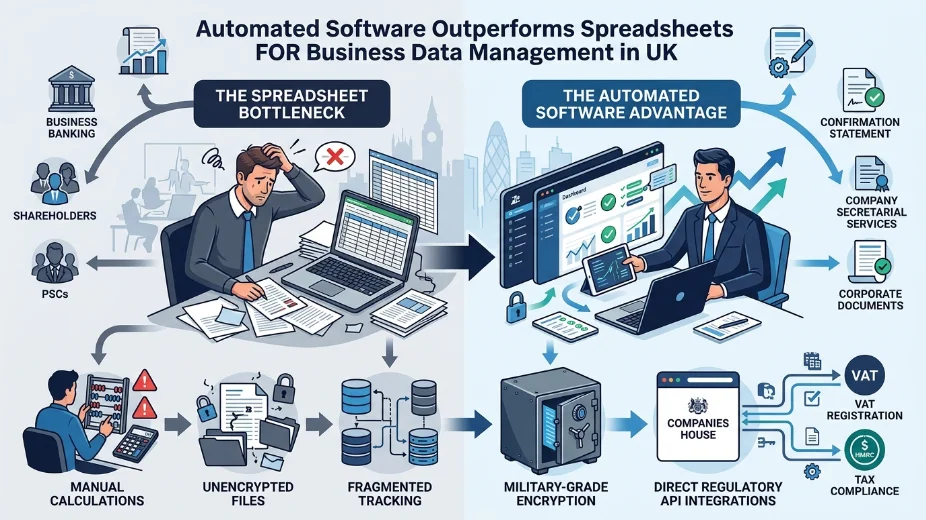
Evaluating management methods reveals structural differences between static spreadsheets and specialized software platforms. Static spreadsheets rely on human memory to cross-reference legal control conditions. Software applies automated business logic to categorize control percentages accurately.
Operational risk increases as company ownership structures grow more complex. Managing multiple corporate entities on spreadsheets creates administrative bottlenecks and data fragmentation. Automated platforms scale across complex corporate groups, keeping corporate structures clear for internal review.
Cost analysis extends beyond initial software subscription prices. Manual spreadsheet management consumes staff hours through verification and corrections. Software automation reduces administrative overhead while eliminating financial fines associated with statutory non-compliance.
When Should Your Business Transition to Automated Software?
Growing businesses must transition to automated software when managing multiple beneficial owners, handling corporate restructuring, preparing for investment, or experiencing frequent changes in share ownership.
Adding investors or issuing new share classes complicates beneficial control calculations. When shareholders cross the 25% control threshold, statutory records require immediate updates. Automated tools detect control shifts during share transfers and generate corresponding PSC notices automatically.
Preparing a corporate entity for fundraising or acquisition requires audit-ready legal registers. Investors review corporate registers to confirm clean title ownership and regulatory compliance. Using automated compliance platforms demonstrates structured governance and speeds up corporate due diligence.
Transitioning software early prevents administrative liabilities during company growth phases. Implementing digital controls establishes structured governance processes across business departments. Companies gain reliable corporate oversight while reducing reliance on fragile manual tracking methods.
How Does Automated Software Prevent Corporate Identity Fraud?
Automated software prevents corporate fraud by monitoring statutory registers, alerting officers to unauthorized filings, verifying director details, and restricting unauthorized changes to official corporate records.
Identity theft targets public corporate registers to alter director records or registered office addresses. Criminals modify records through public filing portals to secure unauthorized commercial loans. Automated platforms track public registers and notify officers immediately when external changes occur.
Integrating identity verification tools validates director identities before updating statutory books. Platforms cross-reference identity documents with official registers to confirm credentials. Secure verification workflows ensure that authorized corporate personnel make official changes.
Protecting official corporate filings requires dedicated corporate security services. Organizations can protect their corporate registers by implementing Fraud Protection to block unauthorized modifications and defend business identity assets against malicious corporate filings.
How Do You Select the Right Compliance Platform for Your Business?
Selecting a compliance platform requires evaluating direct API connectivity, group management capabilities, regulatory compliance frameworks, security certifications, and automated notification systems.
Ensure the platform integrates directly with official registry databases. Direct synchronization allows rapid updates without manual data entry on external portals. Look for platforms that support multiple legal structures, including limited companies, partnerships, and offshore entities.
Review user security features and access controls within the software. Ensure the platform offers role-based permissions to protect sensitive personal identification data. ISO-certified cloud encryption guarantees that shareholder records remain secure against unauthorized digital access.
Evaluate how the platform manages multi-company corporate portfolios. Scaling businesses require software that handles group structures, parent entities, and subsidiary relationships easily. For broader context on standardizing administrative assets, read The All-in-One Company Pack: Why Standardisation Matters for Growth.
Manual spreadsheets create unnecessary compliance risks for UK businesses. Modern regulatory requirements demand precision, audit trails, and strict data security protocols. Automated compliance software mitigates these risks by streamlining registry management and ensuring real-time alignment with official statutory standards.
Transitioning to automated software reduces human error, protects corporate identity, and maintains investor confidence. Modern corporate platforms provide real-time visibility, allowing leadership teams to focus on strategic execution rather than manual administration.
Organizations seeking structured administrative management can Get Your Professional Company Pack Managed by Form My Company to secure statutory compliance, protect business credentials, and maintain clear corporate registers.
Explore our Fraud Prtection guide,
Why a UK Company Helps Cambodian Founders Unlock Stripe, PayPal, and Global Payments
When It Makes Sense for Canadians to Open a UK Company Instead of a Local Corporation
Frequently Asked Questions
How does corporate identity theft happen at Companies House?
Corporate identity theft occurs when unauthorized individuals submit fraudulent filings to change a company’s registered office address, directors, or share capital on the public register. Fraudsters use these falsified public records to secure commercial lines of credit, order goods, or open fraudulent business bank accounts in the company’s name. Integrating 24/7 Fraud Protection with Form My Company continuously monitors public filings to catch unauthorized changes before financial damage occurs.
What is the difference between Companies House PROOF and Fraud Protection services?
The Companies House PROOF (Protected Online Filing) scheme prevents unauthorized changes by blocking paper submissions and requiring all updates to occur digitally. In contrast, the Fraud Protection service from Form My Company provides active monitoring and instant digital notifications for all filings, including electronic updates. Combining paper-filing restrictions with real-time electronic monitoring ensures complete defense against corporate identity hijacking.
How do real-time email alerts protect a UK limited company from corporate hijacking?
Real-time email alerts notify business officers immediately whenever a statutory document or update is submitted against their company registration number. Early detection allows company directors to dispute fraudulent filings instantly with Companies House and law enforcement before unauthorized parties execute fraudulent transactions. Form My Company connects corporate registers directly to continuous monitoring queues through its automated Fraud Protection service.
Can existing UK limited companies sign up for corporate fraud protection?
Yes, any existing UK Limited Company or Limited Liability Partnership (LLP) can enroll in Fraud Protection regardless of when or where it was incorporated. Form My Company synchronizes the entity’s official company registration number with automated surveillance software to monitor public record modifications 24/7. This continuous tracking delivers immediate alerts whenever changes occur to officers, registered office addresses, or PSC registers.
What should directors do if an unauthorized change is filed at Companies House?
If an unauthorized filing occurs, directors must gather the alert documentation immediately and report the breach to the Companies House fraud team and law enforcement. Rapid notification helps reverse invalid register entries, block fraudulently opened accounts, and safeguard corporate credit ratings. Utilizing Form My Company’s Fraud Protection provides the early warning required to initiate swift legal and administrative remedies.