
From My Company’s VAT Registration Assistance helps UK businesses register for VAT and prepare for Making Tax Digital (MTD) by completing HMRC VAT registration forms, setting up MTD-compatible software, and ensuring registration deadlines and turnover thresholds are met.
What is Making Tax Digital (MTD) for VAT?
Making Tax Digital for VAT mandates digital record-keeping and submission of VAT returns using compatible software for VAT-registered UK businesses above the threshold.
MTD for VAT requires businesses with taxable turnover above £85,000 to keep digital records and submit VAT returns through MTD-compatible software. HMRC enforces digital submission formats, periodic reporting, and digital links between records. This replaces manual spreadsheets and paper filing.
How does MTD change VAT registration and record-keeping?
MTD changes require digital record creation, digital links between records, and electronic VAT return submission using approved software.
Businesses must record sales, purchases, VAT charged, and VAT reclaimed digitally. They must ensure digital links exist between transaction records and the VAT return. Examples of accepted digital links: API transfer from accounting software, CSV exports with automated concatenation, or direct integration between apps. Manual copy-and-paste breaks the digital link requirement.
MTD also requires preserving digital records for six years. Records include invoice details, VAT accounting, and adjustments. Failure to maintain digital links or records can trigger compliance checks and potential penalties.
Read our articles, How MTD Impacts VAT and Income Tax Filing and Making Tax Digital Explained for UK Businesses.
Who must register for VAT under MTD rules?
Businesses with taxable turnover over £85,000 per 12 months must register and follow MTD for VAT rules; voluntary registrants below the threshold may opt in.
HMRC sets the £85,000 VAT threshold for compulsory registration. Businesses that exceed that threshold within a rolling 12-month period must register for VAT and join MTD for VAT. Small businesses with a turnover under £85,000 may register voluntarily and choose whether to join MTD. Exemptions apply for certain traders, for example, those using the VAT Margin Scheme in specific circumstances; confirm eligibility with HMRC guidance.
When should a business register for VAT to meet MTD deadlines?
Register before the next VAT return period after crossing the £85,000 threshold and allow time to set up MTD software before the return submission.
HMRC uses rolling 12-month turnover to determine the registration trigger. After turnover exceeds £85,000, businesses must register and join MTD by the date the next VAT return is due. Allow at least 2–4 weeks to order, configure, and test MTD-compatible software and to migrate historical records. From My Company recommends starting the setup immediately when turnover approaches the threshold.
How does VAT Registration Assistance support MTD compliance?
VAT Registration Assistance completes HMRC registration, configures MTD software, and validates digital records to ensure compliant submissions.
From My Company’s VAT Registration Assistance registers the business for VAT using HMRC’s platform. The service configures MTD-compatible accounting software and maps chart-of-accounts fields to HMRC requirements. It validates that digital records include required data fields: invoice date, invoice number, supply value, VAT amount, customer VAT status, and supply type. The service also sets retention policies to preserve records for six years.
What is the step-by-step MTD onboarding process?
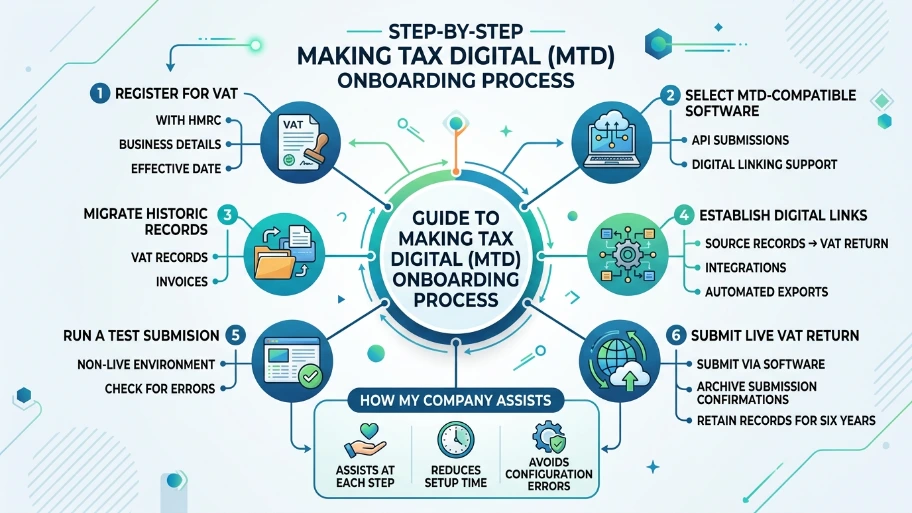
Register for VAT, choose MTD-compatible software, migrate records, set digital links, test submissions, and retain records for six years.
- Register for VAT with HMRC using business details and the effective date of registration.
- Select MTD-compatible software that supports API submissions and digital linking.
- Migrate historic VAT records and invoices into the chosen software.
- Establish digital links between source records and the VAT return using integrations or automated exports.
- Run a test submission to HMRC in a non-live environment where available.
- Submit the live VAT return via the software and archive submission confirmations.
From My Company assists at each step, reducing setup time and avoiding common configuration errors.
What data and documents are required to register and join MTD?
Provide company name, UTR, business bank details, VAT turnover figures, director details, and digital record exports for migration.
Required items include: Unique Taxpayer Reference (UTR), company registration number (if applicable), VAT turnover for the past 12 months, bank account details, and the principal contact for HMRC. For software migration, supply digital copies of invoices, purchase receipts, and prior VAT returns in CSV or accounting-export formats. From My Company reviews these documents and prepares them for upload to the MTD software.
How does software selection affect MTD compliance?
Choosing software with HMRC-compatible APIs, digital linking, and secure data export ensures compliant submissions and reduces manual errors.
Select accounting software that supports API integration to HMRC, automates VAT calculations, and preserves digital links. Verify the vendor’s MTD certification and data retention features. Confirm the software can export audit-ready records and produce submission confirmations for HMRC queries.
Examples: choose software that integrates bank feeds, invoice automation, and VAT reporting modules. From My Company evaluates software options based on business size, transaction volume, and existing systems.
What common implementation errors cause MTD failures?
Common errors: broken digital links, missing invoice fields, incorrect VAT codes, and incomplete retention of source records.
Broken digital links arise from manual copy-paste between files or using unlinked CSV files. Missing invoice fields include absent VAT numbers, supply descriptions, or invoice dates. Incorrect VAT codes lead to wrong VAT due calculations. Incomplete retention occurs when businesses delete or overwrite source files.
From My Company performs a pre-launch audit that detects these errors, corrects code mappings, and verifies a successful HMRC submission.
How do businesses handle complex VAT scenarios under MTD?
Handle complex scenarios by mapping special VAT schemes, reverse-charge supplies, and intra-EU adjustments in the software, and by documenting the tax logic.
Complex cases include reverse-charge transactions, flat-rate scheme participants, and partial exemptions. Map each scenario to the correct VAT code in the software and maintain documentation explaining the tax treatment. For reverse-charge supplies, configure the system to record liability without charging VAT, and to report the acquisition in the correct box on the VAT return.
From My Company configures these mappings and documents the logic for audit purposes.
How much does VAT Registration Assistance cost, and what is the ROI?
Costs vary by complexity; the service typically returns value by avoiding penalties, reducing setup time, and ensuring accurate VAT recovery.
A fixed fee applies for straightforward registrations. More complex businesses pay an additional configuration and migration fee. The ROI estimates include avoided late-submission penalties (up to £400 per default), reclaimed overclaimed VAT, and reduced accountant hours. From My Company provides a tailored quote after assessing turnover, transaction volume, and existing systems.
Explore our VAT Registration Assistance guides,
Secure Your UK VAT Number Quickly with Our Expert Online Registration Assistance
Buy Our Comprehensive VAT Registration Package for Total Peace of Mind
How does From My Company ensure ongoing MTD compliance?
From My Company provides configuration, staff training, periodic audits, and update monitoring to maintain MTD compatibility.
The service offers staff training on using MTD software, periodic compliance audits, and change monitoring for HMRC policy updates. It also provides documentation templates for record retention and digital linking. These measures help maintain accurate records and reduce regulatory risk.
MTD for VAT requires digital records, digital links, and API-based VAT submissions for businesses with a turnover of over £ 85,000. From My Company’s VAT Registration Assistance registers businesses with HMRC, configures approved software, migrates records, and validates digital links to ensure compliant returns. The service reduces technical risk, saves time, and helps avoid penalties while preserving audit-ready records.
Frequently Asked Questions
How long does VAT registration take with From My Company’s VAT Registration Assistance?
VAT registration typically takes 2–6 weeks from submission to HMRC, depending on verification checks. From My Company expedites document preparation and monitors HMRC progress to reduce delays.
What documents do I need for From My Company’s VAT Registration Assistance?
Provide your UTR, company registration number (if applicable), recent turnover figures, bank details, and digital invoice/receipt exports. From My Company uses these records to complete HMRC forms and prepare MTD-compatible data.
Can From My Company help businesses join Making Tax Digital when registering for VAT?
Yes. From My Company configures MTD-compatible accounting software, maps VAT codes, and verifies digital links so HMRC submissions comply with MTD for VAT. The service also tests submissions and document retention policies.
Will From My Company’s VAT Registration Assistance handle complex VAT cases like reverse charge or flat-rate scheme?
From My Company maps complex scenarios, reverse charge, flat-rate scheme, and partial exemption, to correct VAT codes and documents the tax logic for audits. The service ensures those transactions are reported in the right VAT return boxes.
How much does From My Company charge for VAT Registration Assistance and what is included?
Fees vary by complexity; standard VAT registration covers HMRC submission, software setup, and record migration. From My Company provides a tailored quote that itemises registration, MTD configuration, and any migration or advisory fees.