A limited company doesn’t automatically leave you with more take-home pay. In a sole trader vs limited company tax comparison for 2026, the key difference is how profits are taxed: sole traders pay tax on business profits, while a limited company is legally separate from its owners and pays Corporation Tax before money is taken out as salary or dividends. The better fit depends on your profits, how you plan to pay yourself and the extra administration you’re prepared to manage.
It’s understandable to focus on headline tax rates, but they don’t tell the whole story. You’ll also need to weigh National Insurance, dividend tax and Making Tax Digital requirements, alongside the practical steps involved in changing your business structure. This guide compares the options, explains what incorporation changes and offers a clear way to decide whether switching is worth considering.
Key Takeaways
- Compare how business profits are taxed under each structure, rather than relying on headline tax rates alone.
- See how salary, dividends and National Insurance can affect the money you take home from a limited company.
- Understand how Making Tax Digital may change record-keeping and reporting for sole traders.
- Weigh the administrative responsibilities of a limited company against the separation between the company and its owners.
- Follow the key considerations involved in moving from sole trader status to a limited company.
Dividend tax rates and allowance
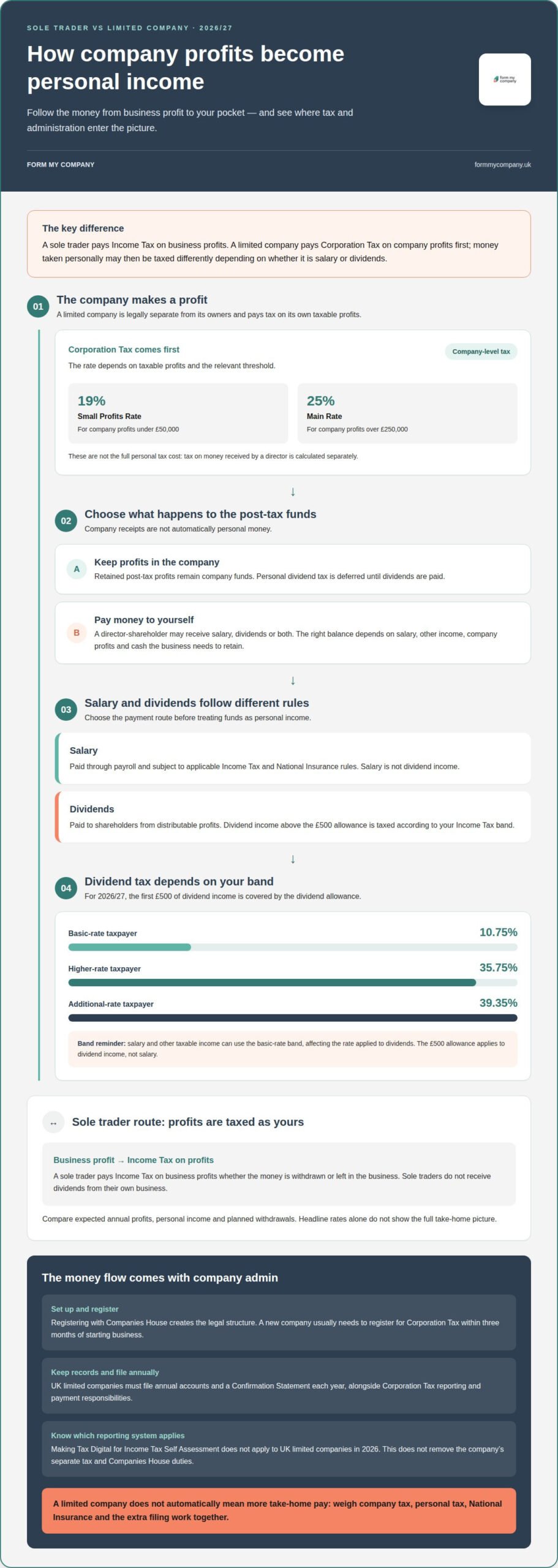
For a limited company owner, dividends are one way to take profits out after Corporation Tax. In 2026/27, the dividend allowance is £500. Dividend income above that allowance is taxed according to your Income Tax band: 10.75% for basic-rate taxpayers, 35.75% for higher-rate taxpayers and 39.35% for additional-rate taxpayers. The allowance applies to dividend income, not to salary.
A sole trader doesn’t receive dividends from their own business. They pay Income Tax on business profits, whether they withdraw the money or leave it in the business. A limited company can retain post-tax profits and distribute dividends later, provided it has sufficient distributable profits. Retaining profits can defer your personal dividend tax, but the money remains company funds until it is paid to you.
Timing matters because your other income affects the tax band applied to dividends. For example, a dividend may fall into a higher band if salary and other taxable income already use the basic-rate band. Before declaring a dividend, consider your expected income for the tax year and the company’s available profits. Smaller distributions at different times may help with cash flow, but they don’t change the annual tax bands or allowance.
Salary and dividends are treated differently. Salary is paid through payroll and is subject to applicable Income Tax and National Insurance rules. Dividends are paid to shareholders from distributable profits; they aren’t salary. A director-shareholder may receive both, but the right balance depends on salary, other income, company profits and how much cash the business needs to retain. Don’t treat company receipts as personal money until you’ve decided how they’ll be paid.
The dividend tax rates change from April 2026. For 2026/27, the basic-rate dividend tax rate is 10.75%, the higher-rate rate is 35.75%, and the additional-rate rate remains 39.35%. The £500 dividend allowance means only dividend income above that amount is taxed at the applicable rate. Factor these rates into annual take-home comparisons rather than relying on older estimates.
| Structure or approach | How money is taken | Dividend tax consideration |
|---|---|---|
| Sole trader | Withdraw business funds as needed | No dividends; Income Tax applies to profits |
| Limited company, salary | Pay salary through payroll | Salary is not dividend income |
| Limited company, dividends | Distribute available profits to shareholders | £500 allowance, then rates depend on tax band |
| Limited company, retained profits | Keep funds in the company | Personal dividend tax applies when dividends are paid |
Compare expected annual profits, personal income and planned withdrawals. Include the value of retaining funds in your take-home calculation, not just the dividend tax rate.
What is a limited company?
A limited company is a legal entity separate from its owners and managers. It earns profits, holds business assets and pays its own Corporation Tax. Shareholders own the company, while directors manage its operations. This separation changes how business money is taxed and reported compared with sole trader status.
Registering a company with Companies House creates the legal structure, but it doesn’t complete every tax step. A new company usually needs to register for Corporation Tax within three months of starting business. Keep the company’s financial records organised from the outset so its taxable profits can be calculated separately from directors’ personal income.
Corporation Tax applies to company profits, not the owner’s total personal income. According to HM Revenue & Customs, the UK Corporation Tax Small Profits Rate is 19% for company profits under £50,000. According to HM Revenue & Customs, the UK Corporation Tax Main Rate is 25% for company profits over £250,000. The applicable rate depends on taxable profits and the relevant threshold.
Corporation Tax rates don’t represent the full tax cost of running a company. A director may receive a salary, which brings personal Income Tax and National Insurance considerations. The company’s Corporation Tax and the director’s personal tax are separate calculations. Compare both when estimating take-home pay, rather than treating company profits as money automatically available to the owner.
Companies House filing responsibilities are also part of running a limited company. UK limited companies must file annual accounts and a Confirmation Statement each year, even if the business has only one director or shareholder. Include these filing dates in your annual administration, alongside Corporation Tax reporting and payment responsibilities.
Late compliance can have financial consequences. Late Corporation Tax returns or payments can lead to penalties or interest, while late Companies House filings can also result in penalties. Keep reporting and payment deadlines visible, and maintain records that support the figures in each submission.
Making Tax Digital for Income Tax Self Assessment does not apply to UK limited companies in 2026. That distinction can matter to a self-employed person weighing digital reporting requirements against incorporation. It doesn’t remove a company’s separate tax and Companies House duties; it changes which reporting system applies to the business structure.
Compare the whole arrangement: company-level Corporation Tax, personal tax on money received, National Insurance on employment income and annual filing work. A limited company can suit owners who want a distinct legal structure, but its reporting responsibilities are part of the decision. Focus on taxable profits and how you’ll take income before choosing a structure.
The MTD Factor: The End of “Simple” Sole Trading?
Making Tax Digital (MTD) changes the reporting workload for some sole traders, but it doesn’t remove their personal liability. From April 2026, a UK self-employed business or landlord with business turnover above £50,000 must join MTD for Income Tax, according to HM Revenue & Customs. Some sole traders may have digital record-keeping and reporting requirements. The article’s stated requirement is five filings a year.
Limited companies don’t fall under MTD for Income Tax Self Assessment in 2026. That doesn’t mean no digital or annual administration: the company still has its own tax and filing responsibilities. Compare the MTD reporting workload with those company duties, rather than treating incorporation as an escape from record-keeping.
The legal distinction affects personal assets. A sole trader and their business are treated as one legal entity, so business debts can expose the owner’s personal finances. A limited company is separate from its shareholders, who have limited liability for company liabilities. That separation doesn’t remove directors’ responsibility to manage the company properly.
The Personal Allowance also matters when comparing the structures. For 2026/27, the Personal Allowance for England, Wales and Northern Ireland is £12,570, according to HM Revenue & Customs. Sole traders pay tax on business profits, while a company owner’s personal tax depends on income received from the company. For businesses with profits below £30,000, sole trader status may be simpler unless limited liability protection is needed.
Pension arrangements differ, too. A limited company can pay contributions directly into its owner’s pension, and those contributions are described as an allowable expense. For a sole trader, pension saving is personal rather than a company payment. Compare the funding route and its effect on business cash before choosing a structure.
Expenses and benefits also need separate treatment. A sole trader records allowable business expenses against business income; a company records its own expenses and handles payments to directors through its accounts. Don’t treat personal spending as a business expense simply because you control the company. The distinction affects record-keeping and the company’s financial position.
Contractors using a personal service company should also consider IR35. It concerns the tax treatment of work through an intermediary, so forming a company alone doesn’t settle how a particular engagement is treated. Review each contract and working arrangement as part of the structure decision.
Weigh Making Tax Digital reporting, personal financial exposure, pension contributions and expenses together. A sole trader may value simpler administration; a limited company may suit someone who prioritises separation between personal and company assets.
Sole trader income tax and National Insurance
A sole trader pays Income Tax on business profits, not simply on money withdrawn. For 2026/27, the Personal Allowance for England, Wales and Northern Ireland is £12,570, according to HM Revenue & Customs. Profits above the allowance are taxed at the applicable Income Tax rate. The UK rates are 20% at basic rate, 40% at higher rate and 45% at additional rate.
Class 4 National Insurance is calculated separately from Income Tax. In 2026/27, sole traders pay Class 4 National Insurance at 6% on profits between £12,570 and £50,270, according to HM Revenue & Customs. According to HM Revenue & Customs, they pay 2% on profits above £50,270. These bands mean the NI calculation changes as profits rise, even when the business keeps cash in its account.
The Personal Allowance tapers at higher income levels. For 2026/27, it is withdrawn by £1 for every £2 of adjusted net income above £100,000 in England, Wales and Northern Ireland. This can increase the effective tax burden as earnings rise: the allowance shrinks while more income falls within taxable calculations. Include other income when estimating adjusted net income, rather than assessing business profits in isolation.
Self Assessment brings its own registration and payment steps. A UK sole trader must register with HMRC if they make more than £1,000 in a tax year. The tax return reports income and allowable expenses, helping establish taxable profit. Sole traders may also need to plan for payments on account, which are made in January and July. Set aside cash as profits come in, so tax dates don’t disrupt business spending.
Making Tax Digital for Income Tax adds digital reporting for qualifying businesses. A UK self-employed business or landlord with business turnover above £50,000 must join Making Tax Digital for Income Tax from April 2026, according to HM Revenue & Customs. Covered sole traders must keep digital records and send quarterly income and expense updates. They also complete an End of Period Statement, making record-keeping a regular task rather than something left until the tax return.
Making Tax Digital doesn’t replace Income Tax assessment or remove National Insurance calculations. It changes how records and updates are sent to HMRC. Organise income and expense records throughout the year, separating business transactions from personal spending. For a sole trader with variable earnings, this also makes it easier to track profit, plan tax payments and understand how savings may be affected by upcoming liabilities.
Class 2 National Insurance Contributions were abolished from 6 April 2024. That means sole traders don’t pay mandatory Class 2 simply because profits exceed the lower profits limit. The key annual calculations are now taxable profit, Income Tax and Class 4 contributions, alongside any MTD reporting duties that apply.
Changing from sole trader to limited company
Incorporation can make sense when profits grow, but there isn’t one universal tipping point. For 2026, £45,000-£50,000 is a level at which incorporation may be worth considering. Businesses below £30,000 will generally find sole trader status leaner unless limited liability protection is needed. Take-home comparisons also show a limited-company advantage around £55,000 to £60,000, while sole traders often regain the lead significantly past £60,000. These differing thresholds show why profit alone cannot settle the decision.
Start by comparing your expected profits with your personal withdrawals. A company can retain profits, but that money stays in the company until paid out. Include the costs and time involved in company administration, alongside the tax rates applying to salary, dividends and company profits. For a sole trader vs limited company tax 2026 comparison, account for whether you need to withdraw nearly all profits for living costs or can leave some funds in the company.
Plan the transition in stages. First, decide when the company will begin trading and who will own and manage it. Then incorporate through Companies House and set up separate company records and finances. Choose a trading start date that lets you distinguish the sole trader’s transactions from the company’s. The new company is a separate legal entity, so don’t assume existing business arrangements transfer automatically.
Next, map out what the business uses to trade: customer contracts, equipment, stock, supplier arrangements and business records. Decide how each item or agreement will be handled, and tell customers and suppliers which entity they’ll be dealing with. Update invoices and payment details for the new structure. A clear handover helps prevent company transactions from getting mixed up with personal or former sole-trader finances.
Tax planning needs to cover both sides of the change. The sole-trader period and company period have different reporting and tax treatment, so keep clear records of income and expenses around the transition date. Company profits are not automatically the director’s personal income. Build a salary and dividend plan around your cash needs, the company’s available profits and your other income. Revisit your sole trader vs limited company tax 2026 comparison if those plans change.
Finally, compare the protection and administration you want with the financial result. A limited company’s separate legal identity can help protect personal assets from company liabilities, while directors take on company responsibilities. Incorporate because the structure fits your trading plans, risk and reporting capacity, not simply because one headline tax rate appears lower.
If you’ve decided a company structure fits your plans, explore company formation packages as the next step.
Form My Company
Form My Company helps entrepreneurs take the next step when they’ve decided to incorporate rather than continue as sole traders. Its company formation packages support the move to a limited company, with options including the Digital Package, Digital & Print Package and Entrepreneurs Choice Package. The right structure still depends on your plans, expected profits, income needs and willingness to manage company responsibilities.
Use the tax and take-home comparison in this guide to clarify your decision, then consider the formation support that fits your requirements. If you’re still weighing sole trader status against incorporation, contact Form My Company to discuss your company formation options.
Make your next move with confidence
Choose a structure that supports the business you want to build, not just the way it operates today. Your plans for growth, investment, personal income and risk can change, so review your decision when your circumstances shift. A practical next step is to set out how much money the business needs to retain and how you expect to draw income. This gives you a clear basis for discussing your options.
The right choice in the sole trader vs limited company tax position for 2026 depends on how the tax treatment fits your wider plans. If incorporation is the route you’re considering, Form My Company can help you take the company formation step. Contact Form My Company about your options and move forward with a structure that fits your ambitions.
Frequently Asked Questions
Summary: Which Structure Is Better in 2026?
Neither structure is automatically better; the right choice depends on profit, personal risk and how you use business income. Sole trader status can mean less company administration, while incorporation creates a separate legal entity and limited liability for shareholders. Compare the tax on profits and withdrawals with the reporting work you’ll take on. If protecting personal assets matters, weigh that alongside take-home pay rather than treating tax as the only deciding factor.
The “Sweet Spot”: Where Is the Tipping Point?
There isn’t one tipping point because tax savings and take-home pay comparisons measure different things. The article’s estimates place lower-tax potential around £35,000-£40,000 profits, with incorporation worth considering around £45,000-£50,000. A limited-company take-home advantage is identified around £55,000-£60,000, while sole traders may regain the lead significantly above £60,000. Use these as comparison points, not a universal rule; withdrawal plans and administration also affect the decision.
The Admin Burden: Who Does the Paperwork?
Both structures require tax records and reporting, but the tasks differ. Sole traders report through Self Assessment, and qualifying businesses also handle digital records and quarterly Making Tax Digital updates. A limited company files accounts and a Confirmation Statement with Companies House, alongside its Corporation Tax reporting. Directors remain responsible for company compliance, even if they use support with formation or filings. Decide who will manage each deadline before choosing a structure.
The Tax Breakdown: Where Does Your Money Go?
A sole trader pays Income Tax and applicable National Insurance on business profits, whether withdrawn or left in the business. A company pays Corporation Tax on its profits; salary and dividends can then create separate personal tax considerations for its owner. Retained company profits remain company money, not personal take-home pay. For a fair comparison, model the same trading profit and personal cash needs under each structure, including administration.
What Is a Sole Trader?
A sole trader is a self-employed person whose business and personal finances aren’t separated by a company structure. The owner keeps the profits after tax but is personally responsible for business debts. A sole trader doesn’t register the business with Companies House. For example, someone working independently and invoicing customers may trade this way, then report business income and expenses through Self Assessment when required.
Which Path Should You Take?
Choose sole trader status if straightforward ownership and lighter company filing duties matter most, and you’re comfortable with personal responsibility for business liabilities. Consider a limited company if separating personal and company assets is important or your plans suit a formal company structure. Before deciding, compare expected profit, how much cash you’ll withdraw, whether you can retain funds and the time available for administration. Revisit your choice if your trading plans change.
What Are the UK Income Tax Rates and Personal Allowances for 2026/27?
The Income Tax rates listed for basic-, higher- and additional-rate bands are 20%, 40% and 45%. The allowance is tapered for adjusted net income above £100,000, falling by £1 for every £2 above that level. Scotland has different Income Tax bands, so those rates shouldn’t be assumed to apply there.
What Are the UK Dividend Tax Rates and Allowances for 2026/27?
The dividend allowance for 2026/27 is £500. Above it, dividend income is taxed at 10.75% for basic-rate taxpayers, 35.75% for higher-rate taxpayers and 39.35% for additional-rate taxpayers. Your tax band depends on your taxable income, including other income sources. Dividends are company distributions to shareholders, not a sole trader’s way of withdrawing business profits. Include the allowance and your other income when estimating personal tax on company dividends.