

Supplementary company documents are official records that support your primary incorporation files. They include register books, shareholder certificates, and compliance logs. These records validate your operational legitimacy, ensure regulatory compliance, and protect business ownership.
Maintaining accurate corporate records forms the foundation of legal business operations in the UK. Companies House requires every registered entity to store up-to-date statutory registers alongside their initial certificate of incorporation. These records demonstrate clear ownership structures and document internal governance decisions during formal audits.
Legal authorities, financial institutions, and investors demand secondary documentation during official reviews. Lenders verify beneficial ownership through statutory registers before approving commercial financing applications. Failing to produce complete documentation leads to legal delays, regulatory fines, and administrative disruptions.
Why Are Supplementary Company Documents Essential for UK Businesses?
Supplementary company documents validate your legal structure and operational compliance. They provide verified proof of ownership, satisfy statutory audit requirements, and protect directors from personal liability during corporate disputes.
UK law mandates that corporate entities maintain statutory registers under the Companies Act 2006. These files record the legal ownership of shares, director appointments, and register of Persons with Significant Control (PSC). Missing records trigger regulatory investigation from Companies House and result in financial penalties for company officers.
Financial institutions inspect these supporting files during standard due diligence processes. Corporate banks request updated share certificates and statutory registers before opening commercial accounts or approving credit lines. Clear documentation accelerates transaction processing and prevents operational freezes caused by compliance failures.
Corporate transactions depend entirely on verified internal records during commercial negotiations. Buyers inspect historical board minutes and voting records to confirm legal title to company assets. Maintaining complete files preserves enterprise value and prevents disputes during acquisition proceedings.
Which Supplementary Company Documents Must You Maintain?
UK businesses must maintain six core statutory registers: members, directors, director addresses, secretaries, PSCs, and mortgages or charges. Companies must also issue formal share certificates and store official board minutes.
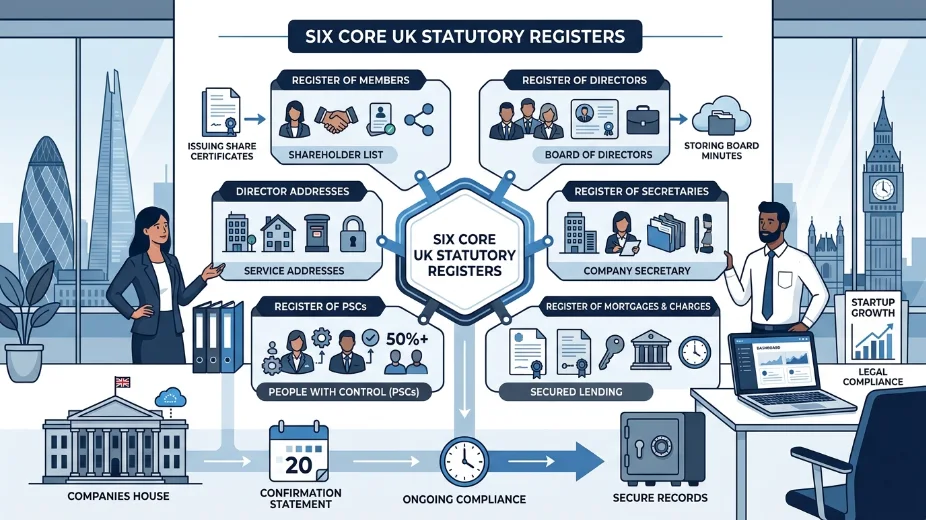
The register of members establishes legal equity ownership within a registered company. This ledger records shareholder names, registered addresses, share classes, and exact acquisition dates. Courts recognize this register as the primary legal proof of share ownership above any external document.
The Persons with Significant Control (PSC) register identifies individuals who hold substantial voting power or control over 25% of company shares. UK legislation requires businesses to update this log within 14 days of any internal ownership modification. Corporate entities must file these changes with central registers within 28 days to remain compliant.
Official share certificates grant formal legal ownership rights to active equity holders. Directors must issue these documents within two months of share allotment or transfer. Additional documentation includes formal board minutes, which record key operational decisions, director appointments, and annual general meeting resolutions.
How Do Digital and Physical Company Packs Compare for Accessibility and Security?
Digital company packs provide instant cloud access and automated compliance updates. Physical company packs deliver tangible security and offline legal presentation for formal corporate proceedings.
Modern corporate management relies heavily on secure cloud repositories for immediate file retrieval. Digital storage enables company officers to access legal records securely across multiple geographic locations. Automated backup systems prevent record loss caused by local hardware failures or physical site disasters.
When evaluating administrative workflows, businesses often weigh
Digital vs. Physical Company Packs: Comparing Accessibility and Security to determine the optimal storage strategy. Physical hard-copy registers provide an unalterable offline record for legal proceedings and formal signings. Storing physical original documents in fireproof safes protects sensitive corporate data from remote cyber intrusions.
| Features | Digital Company Packs | Physical Company Packs |
| Accessibility Speed | Instant multi-user access | Local physical access only |
| Security Risk | Requires strong cyber defense | Subject to physical damage |
| Compliance Updating | Automated real-time logs | Manual entry required |
| Verification Format | Secure PDF or portal | Original paper documents |
Combining both storage formats creates a resilient document management framework. Electronic records streamline day-to-day corporate governance, while hard-copy archives provide secure physical redundancy. This dual approach ensures immediate accessibility alongside permanent legal record preservation.
How Do Incomplete Company Records Expose Your Business to Fraud?
Incomplete company records create legal vulnerabilities that unauthorized actors exploit to hijack corporate identities. Missing statutory registers prevent directors from verifying official ownership and reporting unauthorized corporate changes.
Identity thieves target corporate entities with outdated or poorly managed statutory registers. Fraudsters submit false filings to Companies House to alter registered office addresses or register false director appointments. Unmonitored companies lose control over official filings, enabling criminals to secure fraudulent loans using corporate assets.
When corporate records lack clear audit trails, unauthorized parties can forge share transfers or alter beneficial ownership data. Legitimate directors face lengthy legal challenges to restore correct company structures. Implementing robust internal controls prevents corporate identity theft and maintains legal ownership integrity.
Comprehensive oversight protocols shield corporate assets from unlawful administrative manipulation. Deploying proactive business services helps corporate boards monitor public registers and detect unauthorized modifications immediately. Professional monitoring tools prevent corporate identity hijacking by flagging unapproved filings before damage occurs.
How Do You Audit and Update Your Corporate Records?
Audit your corporate records by cross-referencing internal statutory registers against active Companies House filings. Correct discrepancies immediately through standard legal filings and issue updated share certificates.
Begin the audit process by retrieving current public filings from the official UK registry. Compare registered director listings, PSC entries, and address records against internal company logs. Document every discrepancy to establish an accurate baseline for administrative remediation.
Execute necessary corrections by filing official statutory forms with Companies House. Use form AP01 for director appointments, form TM01 for resignations, and form PSC01 for control notifications. Update internal statutory ledgers simultaneously to match the official public filings.
Maintain ongoing administrative accuracy by establishing an annual compliance calendar. Review statutory registers before submitting the annual confirmation statement to Companies House. Systematic record management ensures perpetual regulatory compliance and eliminates last-minute corporate filing errors.
What Steps Ensure Complete Protection for Corporate Documentation?
Protect corporate documentation by securing physical files in access-controlled storage, encrypting digital records, and implementing automated public register tracking. Conduct periodic internal reviews to maintain compliance.
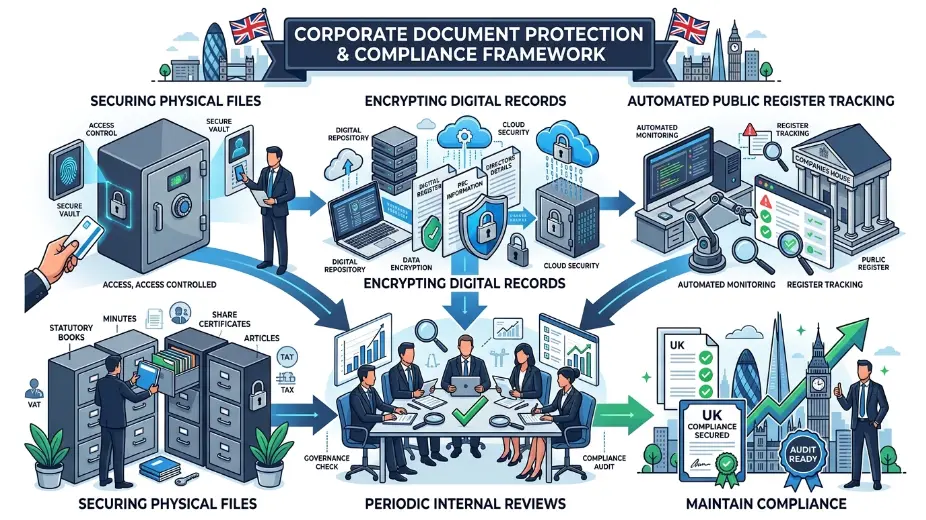
Physical corporate records require secure storage in fireproof and water-resistant safes. Limit physical access to authorized company secretaries and executive directors to prevent unauthorized document tampering. Maintain a formal check-out log when retrieving physical statutory registers for corporate audits.
Digital company archives require high-grade encryption and secure multi-factor authentication protocols. Assign specific user permissions to restrict confidential corporate filings to authorized administrative staff. Store redundant digital backups across separate secure cloud environments to ensure disaster recovery readiness.
To permanently secure your corporate structure, Complete Your Supplementary Company Documents with Our Experts through structured corporate secretarial workflows. Professional legal administrative support ensures your statutory registers remain fully accurate and legally binding. Expert management removes administrative burdens while maintaining full regulatory alignment under UK company law.
Securing Corporate Governance with Form My Company
Maintaining accurate supplementary company documents protects your business from administrative fines, identity fraud, and operational delays. Form My Company delivers comprehensive corporate secretarial support and legal document management tailored to UK business standards. By combining statutory register maintenance with proactive monitoring, Form My Company ensures your corporate records remain fully compliant, secure, and ready for official verification.
What is corporate fraud protection and why is it necessary for UK businesses?
Corporate fraud protection from Form My Company monitors public registers and internal records to prevent identity theft and legal hijacking. Unauthorized actors can submit false filings to Companies House to alter registered addresses or director details without consent. Utilizing dedicated Fraud Protection services ensures immediate detection of unapproved modifications, safeguarding corporate assets and credit standing.
How does company record monitoring prevent corporate identity theft?
Company record monitoring continuously tracks central filing registries for any changes made to statutory registers, director lists, or registered office addresses. By alerting company officers to unauthorized submission attempts in real time, Form My Company enables businesses to block fraudulent administrative updates before legal ownership is compromised. This proactive protection preserves corporate integrity and prevents fraudulent credit applications under the business name.
Explore our Fraud Protection guides,
Why Every New UK Director Needs a Fraud Prevention Strategy
Why Growing Businesses are Targets for UK Corporate Identity Theft
What are the main signs that a business has been targeted by corporate fraud?
Common indicators of corporate fraud include unexpected correspondence from regulatory bodies, unfamiliar change-of-address notifications, or sudden rejections on business credit applications. A business may also discover unapproved filings on its public profile, such as the resignation or appointment of directors without board approval. Implementing robust fraud protection services ensures these discrepancies are flagged and remediated immediately.
Who can make changes to a UK company’s official public register?
Under UK company law, authorized directors, company secretaries, or designated corporate agents can submit official administrative changes to Companies House. However, without secure filing controls, identity thieves can exploit administrative vulnerabilities to submit fraudulent forms. Utilizing comprehensive fraud protection frameworks through Form My Company ensures that only authenticated company representatives can execute official statutory updates.
How do missing supplementary company documents increase corporate fraud risk?
Incomplete statutory registers and missing share certificates create legal blind spots that hinder a director’s ability to verify true company ownership. Fraudsters exploit these documentation gaps to claim legal authority, forge share transfers, or register unauthorized charges against corporate assets. Maintaining complete supplementary records alongside active fraud protection guarantees full legal compliance and prevents unlawful corporate takeover attempts.