
Digital company packs offer superior accessibility through instant remote access, while physical company packs provide tangible legal records, but digital formats combined with robust security protocols deliver higher overall security and compliance efficiency for modern businesses.
What Is a Company Pack in Modern Business Administration?
A company pack is a structured collection of official corporate documents, including legal certificates, registers, and articles of association, required for legal compliance and operational governance in business setup.
Companies require official documentation to establish legal entity status, verify corporate ownership, and demonstrate compliance to external stakeholders. Physical company packs traditionally include hard-copy documents printed on official stationery, bound in corporate binders, and delivered via postal mail. Digital company packs contain electronic versions of the same legal records, formatted as secure PDF files and stored in cloud repositories.
Modern corporate governance relies on these documents to execute banking applications, complete commercial lease agreements, and onboard major clients. The choice between digital and physical formats impacts how quickly directors retrieve critical files during regulatory audits. Digital formats eliminate shipping delays, whereas physical packs provide traditional physical artifacts that some legacy banking institutions occasionally request during manual verification procedures.
How Do Digital and Physical Packs Compare in Terms of Accessibility?
Digital company packs provide instant global access across multi-user networks, whereas physical company packs limit document retrieval to a single geographic location and require manual physical handling.
Accessibility determines how efficiently company directors, legal advisors, and administrative teams retrieve official business documents. Digital company packs store records in secure cloud environments accessible from any location with an internet connection. 68% of UK SMEs utilize cloud-based document platforms to enable simultaneous access for distributed management teams.
Physical company packs reside in secure office storage, filing cabinets, or offsite archival facilities. Retaining physical records restricts access to personnel present at the physical location. When remote stakeholders require immediate documentation, physical records demand manual scanning, physical copying, or courier transport.
Digital formats streamline corporate workflows by enabling rapid search functions across hundreds of pages. Directors locate specific administrative clauses, shareholder percentages, or filing dates in seconds. Physical document retrieval requires manual searching through paper indexes, increasing operational downtime during urgent commercial transactions.
Which Document Format Delivers Superior Business Data Security?
Digital company packs provide superior data security through encryption, access logs, and automated backups, while physical packs remain vulnerable to theft, loss, and physical damage.
Security risks differ substantially between electronic files and paper records. Physical company packs face continuous environmental threats, including water damage, fire destruction, and accidental disposal. Reissuing official paper certificates requires formal applications to corporate registries and incurs administrative processing fees.
Digital company packs mitigate environmental hazards through automated offsite backups across redundant server networks. Advanced electronic access controls permit administrators to restrict viewing permissions based on organizational roles. Digital security protocols create audit trails, recording every instance of document access, download, or modification.
Unprotected digital files introduce cybersecurity vulnerabilities if businesses store sensitive legal records on unencrypted local drives. Organization managers must implement robust cybersecurity measures to safeguard corporate assets. Securing corporate identity details requires proactive management, and businesses often implement professional Fraud Protection services to prevent unauthorized alterations to legal filings and official corporate registers.
What Are the Storage and Environmental Differences Between Formats?
Digital company packs require zero physical storage space and generate minimal carbon emissions, whereas physical company packs require physical archival facilities and ongoing paper consumption.
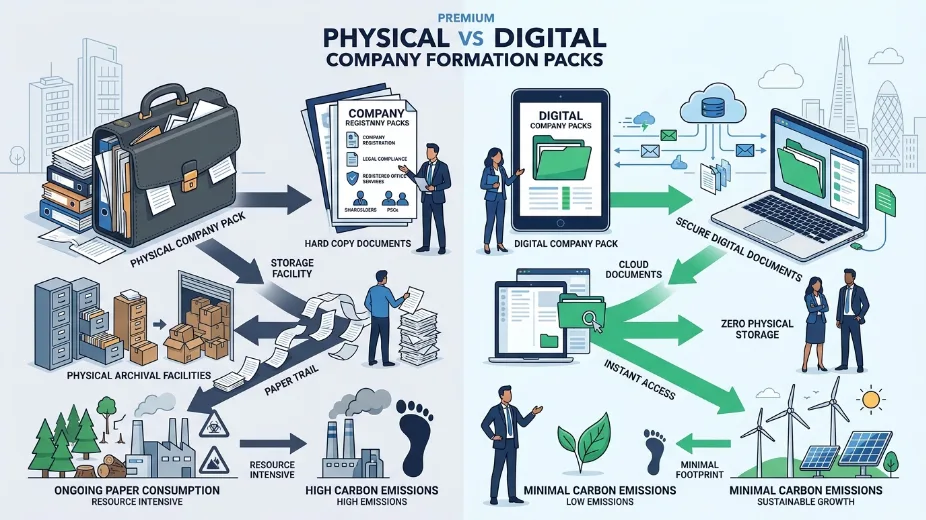
Physical company packs generate ongoing administrative costs associated with physical file retention. Growing enterprises accumulate extensive paper records over time, requiring dedicated office space or external archival services. Physical storage incurs fixed overhead expenses through secure filing cabinets, offsite storage rentals, and manual organization systems.
Digital company packs eliminate physical spatial constraints entirely. Enterprise systems organize thousands of corporate records within compact, structured cloud environments without expanding overhead costs. Digital document retention reduces physical footprint and simplifies long-term record management for scaling enterprises.
Environmental sustainability initiatives increasingly dictate corporate procurement policies. Paper production, printing processes, ink usage, and physical shipping generate measurable carbon emissions. Adopting electronic document workflows aligns company operations with modern sustainability standards by reducing corporate paper consumption.
How Do Verification Requirements Affect Document Choice?
Official regulatory bodies accept digital company documents for legal verification, although legacy third-party entities sometimes demand physical paper certificates.
Corporate registries like Companies House issue digital incorporation certificates bearing electronic authentication markers. Regulatory authorities validate these digital assets directly against official government databases, eliminating the need for physical paper proof. Government frameworks validate director credentials using automated compliance systems.
Financial institutions and international agencies occasionally operate under legacy verification policies. Overseas regulatory bodies, foreign banks, and legal entities in non-digitized jurisdictions sometimes request apostilled paper certificates with physical ink signatures. Businesses expanding internationally must evaluate foreign compliance expectations before selecting their primary document delivery format.
Hybrid management strategies address these dual requirements effectively. Companies utilize digital packs for daily operations, internal compliance, and fast electronic verification, while maintaining a single certified physical set for specialized legal procedures. For comprehensive governance guidelines, reading Supplementary Company Documents: Ensuring Your Business Records are Complete helps clarify which secondary records require long-term physical retention.
What Are the Cost Implications of Digital vs. Physical Packs?
Digital company packs eliminate printing, binding, and shipping fees, making them significantly more cost-effective than physical company packs over the business lifecycle.
Initial acquisition costs favor digital documentation structures. Preparing paper company packs involves high-grade paper stock, professional legal binding, embossed seal applications, and secure trackable postal delivery services. These physical manufacturing and transport steps add substantial upfront expenses to company formation processes.
Ongoing administrative maintenance further increases the cost differential. Updating physical company registers requires reprinting official pages, replacing binder contents, and physically mailing updated records to legal representatives. Digital company packs update seamlessly through centralized software systems, eliminating recurring material and distribution expenses.
Long-term cost savings extend to operational speed and administrative time. Processing digital documents reduces hours spent scanning, filing, and retrieving physical paper. Faster document submission speeds up commercial contract approvals, banking setups, and investor onboarding timelines, directly impacting revenue generation capacity.
How Does Form My Company Help Businesses Secure Their Governance?
Form My Company provides secure document management solutions, incorporating high-level digital delivery options paired with robust corporate governance support.
Form My Company delivers corporate documentation packages tailored to modern regulatory standards. Transitioning corporate administration to high-security electronic platforms protects businesses against identity theft and unauthorized corporate registry filings. Implementing structured document management ensures all corporate records remain accurate, compliant, and accessible.
Maintaining precise corporate records safeguards business operations against fraudulent filings and unauthorized director changes. Form My Company offers specialized oversight to protect legal registries, secure corporate files, and maintain seamless compliance protocols. When businesses decide to Complete Your Supplementary Company Documents with Our Experts, they secure tailored assistance designed to keep all legal records up to date.
Choosing the right partner for corporate administration streamlines document storage and enhances long-term operational resilience. Form My Company balances modern digital accessibility with comprehensive identity protection, giving business owners full control over their official corporate identity.
Explore our Fraud Protection guide,
Certificate of Good Standing vs. Company Extract: Which do you need?
DIY Director Appointment vs. Professional Filing: A Risk Comparison
Frequently Asked Questions
How does company fraud protection protect UK businesses from identity theft?
Company fraud protection monitors official corporate registers to prevent unauthorized alterations to company details, director appointments, or registered office addresses. Services provided by Form My Company alert business owners immediately when changes are submitted to Companies House, enabling swift intervention before fraudulent activity impacts corporate credit ratings or banking arrangements.
What is Companies House fraud protection and why is it necessary?
Companies House fraud protection safeguards corporate records against unauthorized filings, such as fraudulent director resignations or fake share allocations. Without active register monitoring and identity verification safeguards, bad actors can alter official business filings to hijack a company’s identity for illegal financial gain.
Who can access and modify official company details on the public register?
Anyone with a company’s authentication code can submit updates to the public register, making strict credential management essential for corporate governance. Form My Company assists business owners in securing these access credentials and setting up electronic filing protocols to ensure only authorized company officers can execute official filings.
What happens if a business falls victim to corporate identity fraud?
If corporate identity fraud occurs, unauthorized filings can damage a business’s reputation, disrupt banking operations, and expose the company to illicit liabilities. Restoring accurate legal registers requires formal administrative applications to regulatory authorities, highlighting the necessity of proactive fraud protection services to stop fraudulent filings at the point of submission.
How do I secure my registered office address against unauthorized corporate filings?
Securing a registered office address involves restricting public access code distribution and implementing automated change monitoring across all corporate filings. Form My Company offers fraud protection solutions that combine address verification with real-time filing alerts to ensure corporate records remain protected against unauthorized address changes.