These five communication habits commonly stunt startup growth by reducing lead conversion, harming team clarity, and weakening customer trust; fixing them quickly improves sales responsiveness and investor confidence.
What is the most damaging communication habit for new startups?
Ineffective response timing is the most damaging habit because delayed replies lose customers, hamper conversions, and lower credibility with partners and investors.
Slow or inconsistent response times convert fewer leads and increase churn. A 2023 UK small-business survey found that 48% of prospects choose suppliers that respond faster. Fast replies directly improve conversion rates and perceived professionalism.
Which habits reduce lead conversion in early-stage companies?
Five habits reduce lead conversion: slow response, unclear messaging, fragmented channels, inconsistent brand voice, and poor qualification.
Slow response loses prospects before qualification. Unclear messaging confuses buyer intent. Fragmented channels (email, phone, chat) create gaps where leads fall through. Inconsistent brand voice reduces trust. Poor qualification wastes sales time on low-value leads. Each habit directly translates to fewer closed deals and inefficient use of limited sales resources.
Read our articles, Why Outsourced Receptionists Outperform In-House Staff and Professional Call Handling: The Scalable Standard for UK Startups.
How does slow response timing harm customer experience?
Slow response times increase drop-off, reduce conversion, and reduce referral likelihood.
When a prospect waits over 24 hours, perceived interest falls. Immediate or same-day replies raise conversion probability by up to 3x for sales-qualified leads. Startups that reply within one hour close a greater share of inbound enquiries. Slow replies also worsen first impressions with investors during diligence calls.
How does unclear messaging affect sales conversations?
Unclear messaging prevents prospects from understanding value, resulting in longer sales cycles and lost deals.
If product benefits and pricing are vague, buyers delay decisions. Clear, concise value propositions speed evaluation. Provide three tangible outcomes: cost savings, revenue uplift, and time saved. For service pages, list features, benefits, and a single call-to-action to reduce confusion.
How do fragmented channels create operational risk?
Fragmented channels create information gaps that block lead handoffs and duplicate work.
When teams use separate tools without integration, customer history fragments. Sales miss prior interactions, support duplicates tasks, and managers cannot measure response metrics accurately. Consolidate contact records into a single CRM and forward calls to a central receptionist or answering service to preserve context and speed.
How does an inconsistent brand voice damage trust?
Inconsistent brand voice undermines perceived reliability because customers expect uniformity across touchpoints.
Different tones across phone, email, and chat signal disorganisation. Align phone scripts, email templates, and website copy around one brand promise. Train staff and outsourced reception teams to use standard phrases for pricing, timeframes, and escalation to maintain cohesion.
How does poor lead qualification waste startup resources?
Poor qualification consumes sales time on low-fit prospects and delays follow-up for high-value leads.
Define three qualification criteria: budget range, decision timeframe, and primary decision-maker. Use these in initial phone and web intake forms. Route high-fit leads to senior reps and low-fit leads to automated nurture sequences to maximise conversion efficiency.
What practical steps fix these five habits fast?
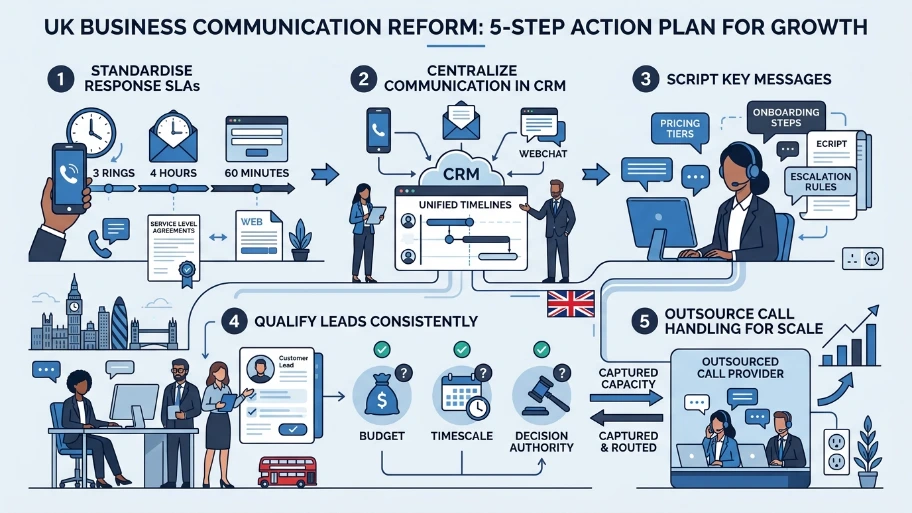
Standardise response SLAs, centralise communication, script key messages, qualify consistently, and outsource call handling for scale.
Set SLAs: answer calls within 3 rings, reply to inbound email within 4 business hours, and acknowledge web leads within 60 minutes. Consolidate channels into a CRM with unified timelines. Create short scripts covering pricing tiers, onboarding steps, and escalation rules. Implement a three-question qualification form: budget, timescale, and decision authority. For immediate capacity, partner with an outsourced call answering provider to capture and route leads without hiring.
How does outsourced call answering solve these problems?
Outsourced call answering captures every inbound opportunity, enforces response SLAs, and maintains a consistent brand voice across calls.
A professional answering team answers calls 24/7 or during set hours, logs caller details into your CRM, and follows bespoke scripts. This removes missed calls, shortens lead response time, and preserves conversation notes for sales follow-up. Outsourced reception reduces hiring costs and lets founders focus on product-market fit.
What metrics should startups track to measure improvement?
Track lead response time, call answer rate, qualified leads percentage, conversion rate, and average time-to-close.
Set targets: answer rate > 95%, web-lead acknowledgement < 60 minutes, and qualified leads conversion increase of 20% within 90 days. Monitor call-to-conversion ratio and customer satisfaction scores from post-call surveys. Use CRM dashboards and weekly review meetings to adjust scripts and routing.
How do these changes impact investor and partner perceptions?
Faster, consistent communication signals operational maturity, raising investor confidence and partnership opportunities.
Investors assess founder bandwidth and customer responsiveness during diligence. Startups with documented SLAs and consistent outreach show better go-to-market discipline. Partners prefer suppliers with reliable communication processes because integration and joint customer support require predictability.
What process changes support lasting improvement?
Document response policies, train staff and vendors, integrate systems, and run weekly quality audits.
Write a one-page Response Playbook with SLAs, scripts, and an escalation matrix. Train internal staff and outsourced receptionists on three key messages and CRM logging standards. Integrate phone, chat, and email into CRM with automatic ticket creation. Audit 10 random interactions weekly to identify script gaps and compliance issues.
Example playbook checklist to fix five habits (compact)
- Implement SLA: answer calls within three rings.
- Centralise records: log all interactions into your CRM.
- Script messages: prepare three short value statements.
- Qualify leads: ask budget, timeframe, and decision-maker.
- Outsource calls: enable 24/7 capture and routing.
What short-term gains can startups expect within 90 days?
Within 90 days, expect higher answer rates, faster lead follow-up, and a measurable rise in qualified opportunities.
Most startups see a 15–30% increase in qualified lead volume after enforcing SLAs and adding professional call handling. Sales cycles shorten because reps work warmer leads. Customer satisfaction improves with fewer dropped calls and clearer onboarding instructions.
Explore our Call Answering guides,
Hidden Costs of Handling Your Own Business Calls Every Day
Why Modern Customers Refuse to Leave a Voicemail in 2026
How should a founder decide between hiring staff and outsourcing?
Choose outsourcing when call volume is variable, hiring costs are high, or you need immediate SLAs; choose hiring when calls require deep product expertise and predictable volume.
Outsourcing offers rapid coverage and consistent training for standard queries. In-house teams provide deep technical support but require recruitment, payroll, and management overhead. Many startups use a hybrid model: outsourced reception for first-line capture, internal specialists for technical callbacks.
Fixing the five communication habits, slow response, unclear messaging, fragmented channels, inconsistent voice, and poor qualification directly increases lead conversion and operational resilience. From My Company delivers professional call answering that enforces SLAs, logs interactions, and preserves brand voice to help startups scale communications without heavy hiring. Implement the playbook, measure the five key metrics, and re-evaluate in 90 days.
Frequently Asked Questions
What is a call answering service and how does it work for UK businesses?
A call answering service professionally handles inbound phone calls for businesses by greeting callers, taking messages, scheduling appointments, and routing urgent calls. From My Company provides this service using trained agents who follow your custom scripts and integrate with your CRM to ensure every caller gets a consistent, professional response.
How much does professional call answering cost for small startups in the UK?
Call answering pricing typically ranges from £15–£45 per month for basic message-taking, with higher tiers for 24/7 coverage, live transfers, and CRM integration. From My Company offers flexible plans tailored to startup budgets, so you pay only for the call volume and features you need without hiring full-time staff.
Can I keep my existing phone number when using a call answering service?
Yes, you retain your existing business number; the service forwards calls to their agents when you’re unavailable or busy. From My Company sets up seamless call forwarding with your current carrier, so callers reach your brand without noticing the switch to an outsourced answering team.
What features should I expect from a reliable call answering provider?
Key features include professional greetings, detailed message taking with caller name and reason, urgent call transfers, appointment scheduling, and CRM integration. From My Company delivers all these features plus custom scripts, multilingual support options, and searchable call recordings for quality assurance.
Is call answering better than hiring an in-house receptionist for new startups?
Call answering is more cost-effective for startups because it eliminates recruitment, payroll, and training costs while providing immediate 24/7 coverage. From My Company’s outsourced receptionists outperform in-house staff by handling overflow calls, maintaining consistent brand voice, and scaling up or down as your call volume changes.