
Outsourced receptionists achieve faster response times by using pooled staffing, priority routing, and strict SLAs.
Third-party providers deploy multiple agents across shifts. They route high-priority calls instantly. They measure average speed to answer and meet Service Level Agreements. Typical providers hit sub-20-second answer times. Faster response reduces missed leads and improves customer satisfaction metrics.
How do outsourced teams reduce cost per call?
Outsourced teams lower cost per call through shared staffing, predictable pricing, and avoiding employment overhead.
Hiring one in-house receptionist incurs salary, National Insurance, pensions, training, and equipment costs. Outsourced providers spread those costs across clients. This yields transparent per-call or per-minute rates. A UK startup can cut fixed payroll costs by 30–60%, depending on call volume and contract terms.
When do outsourced receptionists scale better than internal hires?
Outsourced receptionists scale rapidly by adjusting agent numbers and hours to match call volume.
Providers add agents in blocks within days. They expand coverage for campaigns, seasonal spikes, and business growth. In contrast, in-house recruitment often takes 4–8 weeks to hire and train a receptionist. Scaling externally prevents dropped calls during demand surges and reduces overtime expenses.
Read our articles, 5 Communication Habits Holding Back Your New Startup and Professional Call Handling: The Scalable Standard for UK Startups.
Why do outsourced receptionists improve lead conversion?
Outsourced receptionists improve lead conversion by following scripts, qualifying quickly, and routing prospects to the right team.
Trained receptionists confirm caller intent, capture contact details, and prioritise sales-ready leads. They pass structured lead notes or book calls into calendars. When combined with CRM integration, call handlers log interactions in real time, allowing sales teams to follow up within specified SLAs.
How do outsourced providers ensure quality and consistency?
Providers ensure quality using monitoring, scorecards, and ongoing agent coaching.
They record calls and audit samples against performance metrics such as greeting compliance, verification steps, and resolution accuracy. Scorecards target measurable behaviours. Regular feedback sessions and refresher training keep scripts and processes current. These controls reduce errors and maintain a consistent customer experience.
What security and compliance safeguards do outsourced services use?
Reputable outsourced teams deploy encryption, access controls, and UK-compliant data handling processes.
Providers use TLS/SRTP for call encryption and role-based access for recorded files. They anonymise or redact sensitive fields when storing transcripts. Many follow UK GDPR requirements and maintain data processing agreements. For regulated sectors, they implement additional verification and audit trails.
How does integration with business systems work?
Integrations connect call handling to CRMs, calendars, and ticketing platforms through APIs and webhooks.
Providers push call data to CRMs like HubSpot or Salesforce using standardised fields. They create calendar events for booked appointments and open tickets in helpdesk systems. These integrations automate workflows and reduce manual data entry, improving response speed and record accuracy.
Why do startups prefer outsourced receptionists for flexibility?
Startups prefer outsourced receptionists for flexible hours, variable costs, and rapid deployment.
Startups often lack predictable call volumes and strict budgets. Outsourced services permit paying for actual usage and adjusting coverage weekly. This flexibility preserves capital and provides professional call handling from day one. Startups maintain responsiveness without committing to long-term payroll.
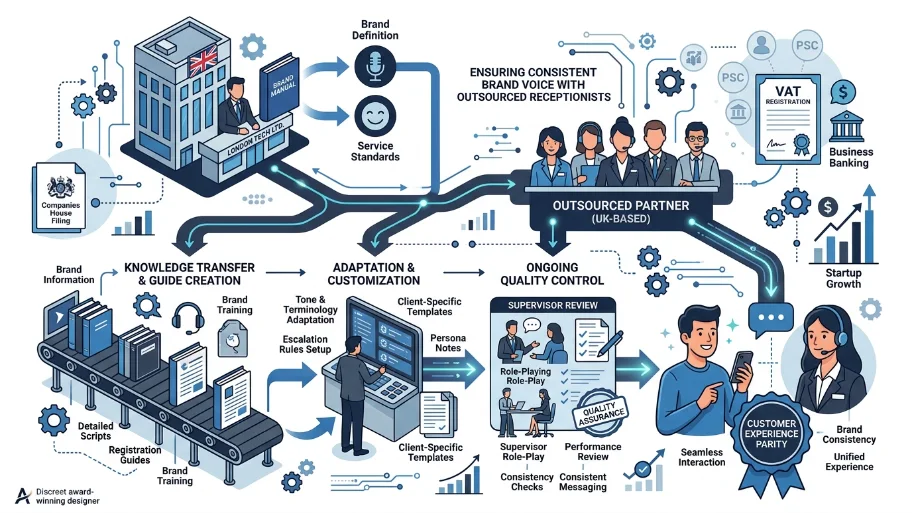
How do outsourced receptionists handle brand voice and customer experience?
Outsourced receptionists maintain brand voice through detailed scripts, registration guides, and brand training.
Providers adapt scripts to reflect tone, terminology, and escalation rules. They use call templates and persona notes to match brand expectations. Supervisors conduct role-play and review to ensure consistent messaging. This process maintains customer experience parity with in-house teams.
What metrics should businesses track to compare outsourced vs in-house performance?
Track answer time, abandonment rate, lead qualification rate, cost per call, and customer satisfaction (CSAT).
Answer time measures responsiveness in seconds. Abandonment rate shows missed connections as a percentage. Lead qualification rate tracks percent of calls that convert to defined leads. Cost per call calculates total spend divided by handled calls. CSAT collects customer feedback after interactions. These metrics inform supplier reviews and staffing adjustments.
How does outsourcing affect employee focus and internal efficiency?
Outsourcing frees internal teams to focus on core tasks like sales, product, and strategy.
Reception tasks consume administrative time. Delegating call answering reduces interruptions for founders and sales staff. Teams regain productive hours for revenue-generating work. This separation improves role clarity and speeds decision-making.
When is in-house still the better option?
In-house works better when calls require deep product knowledge, high-security clearance, or constant face-to-face coordination.
If calls involve complex technical troubleshooting or sensitive case management, dedicated internal staff may provide faster, specialist responses. Similarly, some regulated environments require staff with specific clearances. Evaluate call complexity, regulatory requirements, and volume volatility before deciding.
What is the implementation process for switching to outsourced call answering?
Implementing outsourced call answering follows assessment, onboarding, integration, and review phases.
Assessment maps call types, call volume, and peak hours. Onboarding sets scripts, routing rules, and escalation paths. Integration connects CRM and calendar systems via APIs. Review schedules, SLA checks, and performance reports during the first 30–90 days. Providers typically complete setup in 3–10 business days for standard configurations.
How do pricing models compare between outsourced and in-house options?
Pricing models include per-minute, per-call, and subscription tiers offering mixed allocation and priority handling.
Per-minute suits low-duration interactions. Per-call suits predictable call lengths. Subscriptions provide blocks of minutes or calls with rollover features. Some providers add surcharges for after-hours or multilingual agents. Compare all-in costs including setup, monthly fees, and escalation charges.
Read our Call Answering guides,
Call Answering vs. Virtual Receptionist: Which is Best for You?
Is a Pay-As-You-Go Call Service Right for Your Growing Business?
Why is measuring ROI straightforward with outsourced receptionists?
ROI is straightforward because providers report granular usage and outcomes tied to conversion metrics.
Providers deliver usage dashboards showing handled calls, qualified leads, and cost metrics. Combine those numbers with conversion rates to calculate revenue attributed to answered calls. Clear reporting enables rapid ROI calculation versus the fixed costs of a salaried receptionist.
Outsourced receptionists deliver measurable advantages in speed, cost-efficiency, scalability, and lead handling. They integrate with business systems, maintain compliance, and preserve brand voice through scripting and coaching. For UK startups and SMEs focused on growth and cost control, outsourced call answering offers a practical, data-driven alternative to hiring in-house reception staff.
From My Company provides call answering that meets evaluation needs. The service integrates with CRMs, follows UK compliance practices, and scales to campaign demands. It reports answer times, qualification rates, and cost metrics to support decision-making.
Frequently Asked Questions
What is a call answering service and how does it work?
A call answering service is a professional third-party provider that handles incoming business calls on your behalf. From My company provides call answering where trained receptionists answer calls, follow your scripts, and route messages or appointments directly to your team.
How much does a professional call answering service cost for small businesses?
Most providers offer per-minute, per-call, or monthly subscription pricing tailored to call volume. From My company’s call answering service uses transparent pricing models that help UK small businesses avoid fixed payroll costs while maintaining professional call coverage.
What should I look for when choosing a call answering provider?
Key factors include operator training, call handling speed, integration with your CRM or calendar, and data security standards. From My company’s call answering service ensures agents follow detailed scripts, match your tone of voice, and integrate with tools like Microsoft Teams and popular CRM platforms.
Can call answering services handle urgent inquiries and appointment bookings?
Yes, professional call answering services can qualify urgent inquiries, capture caller details, and book appointments into your calendar. From My company provides call answering with real-time appointment scheduling and lead routing to ensure time-sensitive calls reach the right person quickly.
Is my business data secure with a call answering service provider?
Reputable providers use encrypted call systems, role-based access controls, and comply with UK GDPR data protection requirements. From My company’s call answering service maintains secure data handling practices, including encrypted storage of call notes and transcripts to protect your business and customer information.