

Chinese residents forming a UK company must register the company with Companies House, appoint at least one director, provide a UK service address or agent, comply with UK anti-money laundering (AML) checks, and file confirmation statements and annual accounts.
What registration steps must a Chinese resident complete to set up a UK company?
Register the company with Companies House, provide director details, a registered office, and file initial confirmation documents. To form a private limited company (Ltd) in the UK, register online or by post with Companies House. Provide the company name, business SIC code, details for at least one director, and a registered office address in the UK. Submit the memorandum and articles of association and pay the registration fee (currently £12 online, £40 by post). Use form IN01 for paper applications. Companies House validates the application and issues a Certificate of Incorporation when accepted.
What identity and AML checks apply to Chinese residents?
Under UK law, register persons of significant control (PSC) and complete identity verification under the UK’s AML regime. Anti-money laundering rules require verification of beneficial owners and directors. Verify identity using a passport, a national ID, and a recent utility bill or bank statement for the address. Two verification methods are common: certified document checks, electronic identity verification, and in-person verification by a regulated agent. Firms offering company formation must maintain AML records and report suspicious activity to the UK authorities.
How must a Chinese resident provide a UK-registered office or service address?
Provide a UK-registered office address or appoint a service address provider to receive statutory mail. Every UK company requires a registered office within England and Wales, Scotland, or Northern Ireland. Use a physical address; PO boxes alone are insufficient. Appoint a commercial registered office provider or use an agent’s address to receive legal notices and Companies House correspondence. Ensure the address is monitored daily to meet statutory deadlines for filings and legal documents.
Read our articles, China to UK Company Formation: What Most Guides Miss, and Start Your UK Company from China with Form My Company.
What director and officer requirements apply to non-UK residents?
Appoint at least one natural person director; corporate directors are restricted in some jurisdictions. A UK private company must have at least one director who is a natural person. There is no UK residency requirement for directors. Directors’ records include full name, service address, usual residential address (kept for Companies House as a private record if requested), date of birth, and nationality. Provide proof of identity during AML checks. Consider appointing a UK-based company secretary or local representative for administrative ease.
How do tax registration and VAT work for a company owned by Chinese residents?
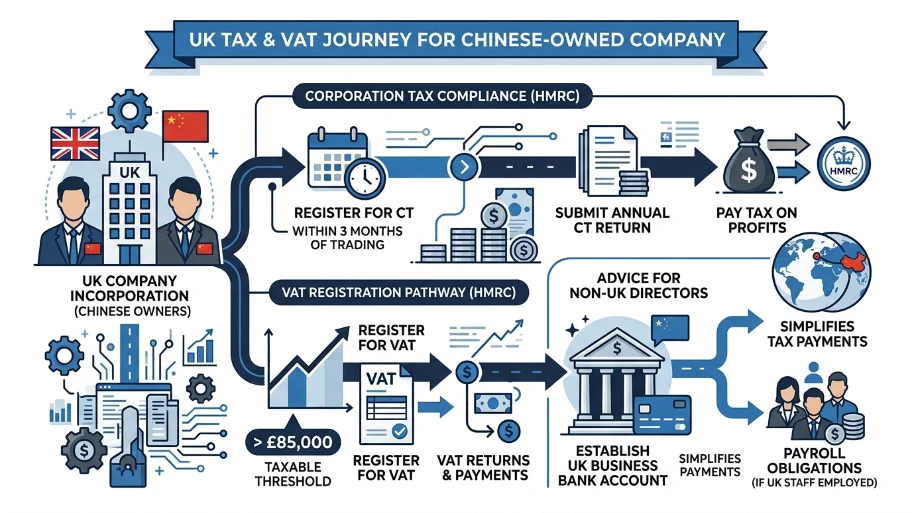
Register for Corporation Tax within three months of starting a business and register for VAT when taxable turnover exceeds £85,000 per year. After incorporation, register the company for Corporation Tax with HMRC within three months of trading. Submit annual Corporation Tax returns and pay tax on profits. Register for VAT when turnover is expected to exceed £85,000 in 12 months. For non-UK directors, establish a UK business bank account to simplify tax payments and payroll obligations if employing staff in the UK.
How can Chinese residents open a UK business bank account remotely?
Use specialist international banks or fintech providers that accept non-UK residents and provide digital onboarding with AML verification. Banks require proof of identity, proof of address, company incorporation documents, and evidence of business activity. Three common approaches: open with a UK high-street bank with in-person verification, use an international bank with a presence in China and the UK, or use regulated fintech providers offering business accounts (digital onboarding). Prepare certified translations of documents when originals are not in English.
What reporting and compliance filings must be maintained after formation?
File annual confirmation statements, annual accounts, and Corporation Tax returns to remain compliant. Submit a confirmation statement (previously the annual return) to Companies House at least once every 12 months. File statutory annual accounts per accounting standards and submit Corporation Tax returns to HMRC. Maintain statutory registers: register of members, registers of directors, and PSC register. Retain accounting records for six years for tax audits and statutory inspections.
How do intellectual property and contracts work across China and the UK?
Register trademarks and protect IP separately in the UK and in China, and use clear UK-governed contracts for UK operations.IP rights are territorial. Register trademarks with the UK Intellectual Property Office for UK markets and with China’s CNIPA for China. Use contracts governed by English law for UK activities and specify jurisdiction and dispute resolution methods. Translate contracts professionally and authenticate signatures if required by Chinese authorities or for notarisation.
What immigration or work restrictions apply to Chinese owners or directors who want to work in the UK?
Company ownership does not grant entry rights; obtain the correct visa to work or live in the UK.Non-UK residents who wish to work in the UK must obtain the relevant work or entrepreneur visa. Common routes include the Skilled Worker visa (requires sponsorship) or the Innovator/Start-up visas (subject to endorsement). Owners who plan to manage UK operations onsite should apply for the appropriate visa before commencing work in the UK.
Explore our Chad guide,
What Stops Chad Residents from Successfully Registering a UK Company—and How to Overcome It
What are the common pitfalls Chinese residents encounter when forming a UK company?
Using a non-UK registered office, failing AML checks, and not registering for tax promptly are frequent mistakes. Failing to provide an accepted UK-registered address delays incorporation. Incomplete AML documentation causes account opening and formation delays. Neglecting to register for Corporation Tax within three months triggers penalties. Relying on non-compliant service providers increases regulatory risk. Engage regulated formation agents and tax advisers to avoid these pitfalls.
How does From My Company support Chinese residents forming UK companies?
From My Company provides company formation, registered office services, and AML-compliant identity verification for China-based clients. From My Company assists with Companies House registration, appoints a UK-registered office, manages statutory filings, and offers AML-compliant onboarding tailored for Chinese residents. The service streamlines document preparation, certified translations, and bank account introductions. Use this pathway to reduce delays and ensure regulatory compliance.
Chinese residents can legally form and run a UK company by following Companies House registration, completing AML verification, securing a UK-registered office, and meeting tax obligations. From My Company offers formation, registered office, and compliance support to simplify the process for clients in China.
Frequently Asked Questions
Can Chinese residents form a UK private limited company remotely?
Yes. Chinese residents can form a UK private limited company remotely by registering with Companies House, appointing at least one director, and providing a UK-registered office or service address. From My Company’s China service supports remote incorporation and AML-compliant identity verification.
What ID and AML checks will Chinese directors face when using From My Company — China?
Directors must verify identity and address using a passport or national ID plus a recent utility bill or bank statement, and provide details of beneficial owners (PSC). From My Company follows UK AML frameworks to validate documents and retain verification records for auditability.
Do Chinese owners need a UK visa to run the day-to-day operations of a UK company?
No, company ownership alone does not grant permission to work in the UK; owners who plan to operate onsite must obtain an appropriate visa (for example, Skilled Worker, Innovator, or Start-up). From My Company’s China guidance clarifies immigration requirements relative to UK business activities.
How do Chinese residents open a UK business bank account after incorporation?
Banks require company incorporation documents, director ID, proof of address, and evidence of trading activity; many non-UK residents use international banks or regulated fintech providers with digital onboarding. From My Company’s China package can assist with document preparation and bank introductions.
What ongoing filings and tax obligations should Chinese-owned UK companies expect?
Expect to file a confirmation statement to Companies House annually, submit statutory accounts, and register for Corporation Tax within three months of trading; register for VAT when taxable turnover exceeds £85,000 per year. From My Company’s China service outlines filing deadlines and compliance duties for UK-registered companies.