
Chad residents face four main barriers when registering a UK company: lack of UK-compliant identity verification, limited UK business address access, misunderstanding of UK director/residency rules, and banking restrictions for non-UK entities. These issues create delays, rejections, and extra costs unless addressed with compliant services.
What stops Chad residents from verifying their identity for UK formation?
Chad residents often fail UK identity checks because UK providers require certified passports, proof of address in Latin script, and digital verification compatible with UK databases.UK company formation uses identity verification tied to UK compliance frameworks. Providers require government-issued passport scans, secondary documents (utility bill or bank statement dated within 3 months), and sometimes biometric or video checks. Chad passports sometimes lack machine-readable zones or verified civil registries accessible to UK agents. Postal addresses in Chad often use non-standard formats, which automated systems flag. As a result, formation agents mark applications as “unverified” and halt registration.
Practical fixes include using certified translation and notarisation, obtaining an international utility or bank statement, and using accredited electronic identity services that accept Chad-issued documents. Use three verification methods when possible: passport checks, address validation, and video identity verification. These steps validate director credentials under UK anti-money-laundering rules.
Why do Chad residents struggle to supply a UK business address?
Chad residents lack a physical UK business address, and registrar rules require a registered office in the UK for legal services and statutory records. A UK registered office must accept legal mail and provide public record access via Companies House. Foreign founders who list an address outside the UK trigger compliance reviews. Without a UK address, formation agents reject filings or request proof of local presence. This delays incorporation by weeks.
Use virtual office providers that offer a UK-registered office and mail-scanning services. Confirm the provider publishes a direct access policy and forwards original legal documents. Register a service address for directors where allowed by Companies House. Ensure the address provider supports Companies House requirements and offers retention of records for the statutory minimum.
Read our articles, UK Company Formation from Chad: What Actually Works in 2026 and Register Your UK Company from Chad with Form My Company.
How do residency and director rules block company registration?
Companies House requires at least one natural person director, and UK tax and corporate regimes use residency to determine obligations; misinterpreting these rules leads to incorrect filings. Applicants sometimes register nominee directors or corporate directors without understanding disclosure requirements. Companies House rejects incomplete statements about director nationality, service address, and consent. In addition, appointing a corporate director may trigger extra scrutiny under UK corporate governance rules. Incorrectly declaring a director’s residential address as overseas without providing a UK service address causes public record issues.
Follow exact registration fields: provide full legal name, date of birth, nationality, and a service address. File director consent forms and board resolutions in the company records. If founders want minimal public disclosure, they can appoint a professional service as a nominated officer, but they must record beneficial owners correctly in the People with Significant Control (PSC) register. Use entity-based language when completing forms to ensure compliance and avoid rejections.
What banking restrictions limit company operations after formation?
UK banks apply strict anti-money-laundering checks for non-UK beneficial owners, requiring enhanced due diligence, proof of local business activity, and sometimes UK-resident signatories.UK bank accounts need verification of directors and beneficial owners, plus business purpose evidence. Banks commonly ask for business plans, three months of transaction history, and proof of UK trading presence. Remote founders from Chad face refusals when they cannot provide UK sales contracts or local invoices. Banks also require face-to-face identification or regulated electronic ID channels that some Chad residents cannot access.
Workarounds include using fintech providers that onboard international businesses, opening accounts with banks offering international business services, and linking to UK payment processors that accept non-UK directors. Prepare a compliance pack: passports, director CVs, service provider contracts, customer invoices, and three-month cash flow forecasts. This pack accelerates bank due diligence and reduces account-opening refusals.
How does compliance documentation cause rejections for Chad applicants?
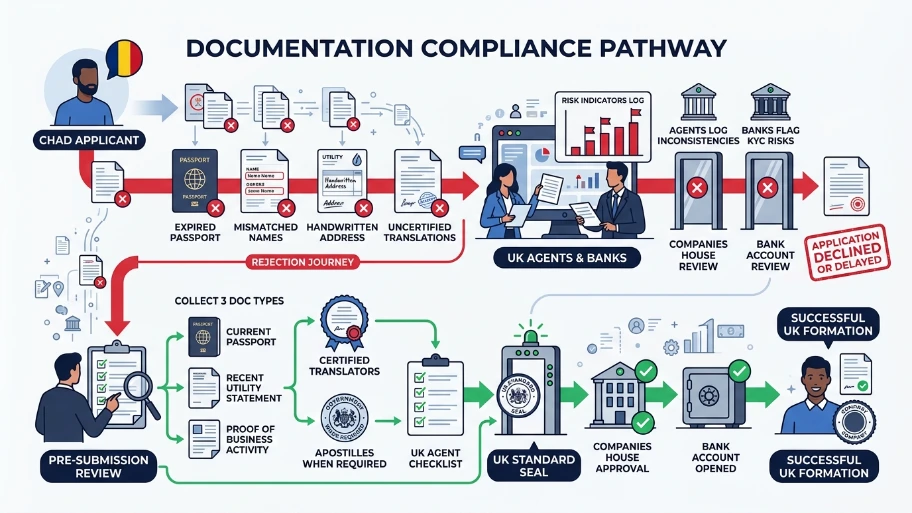
Incomplete or non-standard documentation, such as unverified translations or expired documents, increases rejection rates during Companies House and bank reviews.UK compliance frameworks require certified copies and accurate translations. Common failures include expired passports, mismatched names across documents, and handwritten address formats. Agents and banks log these inconsistencies as risk indicators and decline or delay applications. Companies House enforces document standards tied to UK identity verification services, and banks apply the same standards for KYC.
Address this by collecting three document types per person: a current passport, a recent utility/bank statement, and proof of business activity. Use certified translators for non-English documents and apostilles when required. Validate document formatting against UK agent checklists before submission to avoid back-and-forth requests.
What procedural mistakes during formation slow or stop registration?
Errors in the company application—incorrect SIC codes, inaccurate share allocations, and missing director consents—trigger formal rejections or manual reviews. Companies House validates key fields automatically. Mistakes in the memorandum of association, inconsistent share capital statements, or wrong Standard Industrial Classification (SIC) codes cause manual scrutiny. For foreign applicants, failing to declare PSCs (People with Significant Control) correctly leads to sanctions. Each manual check adds 7–21 days to the process on average.
Use stepwise checks: validate all registration fields, confirm shareholder identity, and submit signed director consent forms. Choose SIC codes that match the declared business model and attach supporting documents for unusual structures. Formation agents can pre-check filings against Companies House criteria to avoid rework.
How do communication and time-zone gaps affect the process?
Limited overlap between Chad and UK business hours delays document clarifications, verifications, and bank interviews, extending timelines by two to three weeks on average. Chad is often two hours ahead of UK time during the UK winter or three hours during summer, depending on daylight saving. This limits real-time communication windows for video ID, certified document pickup, or bank interviews. Formation agents report slower identity verification and bank onboarding due to missed live checks.
Schedule synchronous calls within overlapping hours and use appointment-based video verification. Use asynchronous secure document portals to submit documents outside business hours. Confirm deadlines in advance to prevent missed cutoffs for Companies House filings.
What cost barriers increase failure rates for Chad applicants?
High fees for certified translations, notarisation, apostilles, and international courier services create unexpected costs that stall or abandon registrations. Typical additional costs range between £150 and £600 per applicant for translations, notarisation, and apostilles, plus £50–£150 for international courier. Low-budget applicants omit steps or provide cheaper but non-compliant documents. Agents then reject filings for non-compliance.
Budget a full compliance package upfront. Expect typical third-party fees: passport notarisation £40–£80, certified translation £30–£120 per page, apostille £30–£50, and international courier £50–£120. Present this cost estimate to stakeholders before starting formation.
Explore our Canadians guide,
When It Makes Sense for Canadians to Open a UK Company Instead of a Local Corporation
How can Chad residents overcome these barriers and complete UK company formation?
Use accredited UK formation providers that offer UK-registered office services, multi-method identity verification, bank-introduction support, and document certification support. A compliant formation pathway combines four elements: verified identity, UK registered office, accurate statutory filings, and banking introductions. Verify identity using passport, address, and live-video checks. Secure a UK-registered office and mail-forwarding agreement. Prepare accurate company filings with correct SIC codes and PSC declarations. Assemble a banking pack that proves trading purpose and financial projections.
Practical steps: engage a UK-licensed formation agent, use an electronic identity provider that accepts Chad documents, hire a certified translator for non-English materials, and select a fintech or bank that supports international incorporations. This reduces average registration time to 5–10 working days for standard formations.
Chad applicants face predictable, solvable obstacles: identity verification, UK address requirements, director and banking rules, and document compliance. Address each issue with verified documents, a UK-registered office, accurate filings, and bank-ready evidence. Companies House and UK banks respond quickly when documentation meets UK compliance frameworks.
From My Company helps Chad residents through each step by validating Chad-issued documents, providing a UK-registered office, preparing Companies House filings, and delivering bank-introduction support. The service streamlines compliance and shortens typical formation times.
Frequently Asked Questions
Can Chad residents register a UK company without living in the UK?
Yes, Chad residents can register a UK company without living in the UK. From My Company helps non-UK residents from Chad complete UK company formation remotely by providing a UK-registered office and handling identity verification.
What documents do Chad residents need to form a UK company?
Chad residents need a valid passport, proof of address (like a bank statement or utility bill dated within 3 months), and certified translations if documents are not in English. From My Company guides applicants through document certification and verification for UK compliance.
How long does UK company formation take for applicants from Chad?
Standard UK company formation for applicants from Chad takes 5–10 working days when documents are verified correctly. From My Company accelerates the process by pre-checking filings against Companies House criteria and providing UK registered office services.
Do Chad residents need a UK bank account to run a UK company?
Chad residents do not legally need a UK bank account to run a UK company, but most UK payment processors and suppliers require one. From My Company offers bank-introduction support and connects Chad founders with fintechs that onboard international businesses.
What are the main barriers for Chad residents registering a UK company?
The main barriers are identity verification failures, lack of a UK registered address, misunderstanding director/residency rules, and banking restrictions for non-UK entities. From My Company solves these by verifying Chad-issued documents, providing a UK registered office, and preparing bank-ready compliance packs.