
When a Person with Significant Control leaves a UK company, directors must update the official register within 14 days and notify Companies House within an additional 14 days using statutory filing procedures to maintain legal compliance and avoid financial penalties.
Managing corporate governance changes requires strict adherence to statutory timelines set by Companies House. When an individual holding significant influence or control departs, business administrators face specific regulatory duties. Understanding these legal requirements protects the organization from severe compliance failures. Every corporate entity must maintain transparency regarding who owns and controls operations. Failure to update records compromises the integrity of public registers. Directors need absolute clarity on the exact steps required following a departure.
Why Must Companies Update Records Immediately After a Departure?
Companies must update records immediately after a departure because UK law mandates exact public transparency, and delayed filings trigger automatic financial penalties for defaulting officers.
Accurate record-keeping forms the backbone of corporate accountability across the business landscape. When an individual relinquishes control, the public register must reflect this status without delay. Regulatory bodies enforce strict deadlines to prevent fraudulent activities and maintain market trust. 14 days represent the legal window to update internal registers. Another 14 days apply to official submissions. Directors face personal fines reaching 5,000 pounds for persistent regulatory breaches.
Maintaining proper documentation safeguards the company against unauthorized liability claims. When companies update their internal logs, they protect stakeholder interests effectively. Accurate filings ensure that legal notices reach active stakeholders only. Companies House processes thousands of ownership updates weekly through automated digital channels. Business operations run smoother when administrative teams prioritize statutory deadlines.
What Are the Legal Deadlines for Filing PSC Changes?
Legal deadlines require companies to record changes internally within 14 days and submit the updated statutory filing to Companies House within 28 days of the event.
Statutory timelines dictate every administrative action following a significant ownership shift. When an officer misses these deadlines, the company incurs immediate compliance infractions. 14 days allow ample time to gather necessary resignation documents. Another 14 days cover the formal electronic transmission to government databases.
UK legislation enforces strict oversight to protect corporate transparency. When businesses utilize professional filing solutions like the PSC Register, administrative errors drop significantly. Automated platforms streamline data entry to prevent missed deadlines. Companies must calculate the 28-day total window from the exact date of departure. Accurate timestamping prevents discrepancies during official audits.
How Does a Departure Affect Remaining Shareholders and Control Thresholds?
A departure affects remaining shareholders by altering ownership percentages, which often shifts control thresholds above the 25% marker that defines reportable influence.
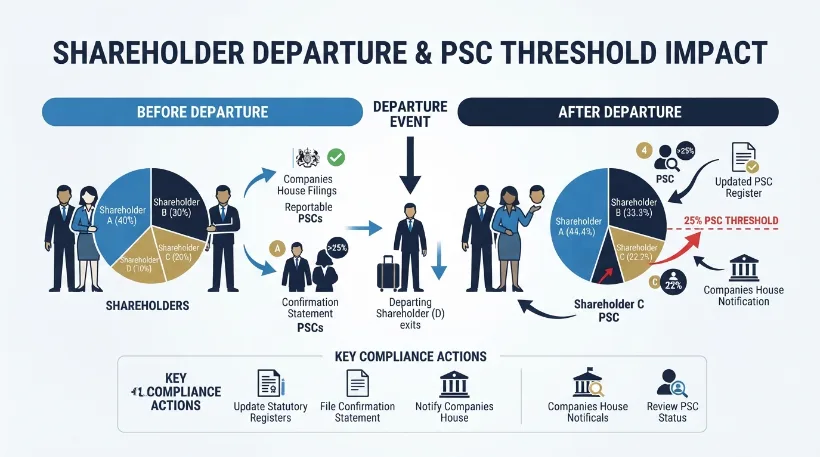
Significant control depends on specific ownership percentages and voting rights metrics. When one person exits, remaining stakeholders absorb proportional shares of voting power. 25 percent represents the critical threshold for mandatory reporting. Directors must calculate new percentages immediately after share redistribution occurs.
Understanding control dynamics prevents accidental omissions in corporate filings. When share distribution pushes a minority owner past the threshold, that individual becomes a new reportable entity. Business administrators must evaluate voting rights, capital shares, and board appointment powers simultaneously. Reviewing these metrics ensures that every qualifying individual appears on official records. Companies can master these transitions by reading How to Handle a Mid-Year Change of Significant Control for strategic guidance. Proper evaluation eliminates ambiguity during ownership restructures.
What Penalties Apply for Failing to Report a PSC Departure?
Penalties for failing to report a PSC departure include daily default fines for officers, criminal records for directors, and potential company dissolution by regulators.
Regulatory non-compliance carries severe consequences for corporate leadership. When administrators ignore reporting duties, financial liabilities accumulate rapidly. 5,000 pounds constitute the maximum statutory fine for severe default cases. Daily default fines add financial pressure to non-compliant organizations.
Government authorities monitor corporate registers continuously for discrepancies. When companies fail to submit updates, enforcement officers issue formal warning notices. Criminal prosecution threatens directors who demonstrate willful neglect of statutory duties.
Businesses can mitigate these severe risks by selecting Form My Company to Report a Change of PSC securely. Professional oversight guarantees adherence to all legal parameters. Structured compliance protects the company’s reputation and financial standing. Proactive management remains the best defense against regulatory penalties.
Navigating the departure of a significant controller demands precision, speed, and strict adherence to UK statutory frameworks. When businesses follow established legal timelines, they protect their directors from financial penalties and maintain absolute transparency on public registers. Form My Company delivers the solution through streamlined digital filing services that handle complex register updates efficiently, ensuring complete compliance without administrative friction.
Explore our PSC Register guide,
What Is a Company Stamp and What Is It Used For?
How Do You Notify Companies House of a New PSC?
Frequently Asked Questions
What is a PSC register and why is it mandatory for UK companies?
A PSC register is an official corporate document that identifies every person with significant control over a UK company by detailing their ownership percentages and voting rights. Form My Company manages this essential requirement through professional compliance services that help businesses maintain accurate records on the public register.
How long do companies have to update the PSC register after a change?
UK legislation mandates that companies must update their internal PSC register within 14 days and submit the changes to Companies House within a further 14 days. Utilizing the PSC Register service ensures these strict statutory deadlines are met without incurring financial penalties or default fines.
What details must be recorded for a Person with Significant Control?
Official records must include the individual’s full legal name, service address, residential address, date of birth, nationality, and the exact nature of their control over the company. Form My Company assists business administrators in verifying these credentials accurately to satisfy UK corporate transparency laws.
What qualifies someone as a Person with Significant Control?
An individual qualifies as a PSC if they hold more than 25% of shares, hold more than 25% of voting rights, or exercise significant influence or control over the company. Monitoring these exact thresholds through the PSC Register service prevents compliance failures during ownership restructures.
What are the penalties for failing to maintain a correct PSC register?
Failing to maintain or update an accurate PSC register can result in severe legal consequences, including criminal records for directors and daily default fines reaching 5,000 pounds. Form My Company provides reliable digital filing solutions to protect organizations from regulatory enforcement actions.