
UK employers must securely store candidate data, comply with data protection regulations, obtain explicit consent for data retention, enforce strict access controls, and delete applicant records after a designated timeframe to avoid severe regulatory penalties and protect personal privacy rights.
What Regulations Govern Candidate Data Storage in the UK?
UK data storage compliance relies on the Data Protection Act 2018 and the UK General Data Protection Regulation, which mandate lawful processing, transparency, security measures, and strict accountability for all personally identifiable information collected during recruitment.
Employers handle sensitive personal details during hiring cycles. This information includes employment histories, qualifications, right-to-work documents, and contact details. Legal frameworks require organizations to process this data fairly. Data controllers must register with the Information Commissioner Office when handling digital applicant records. Organizations face mandatory registration fees based on organizational size and turnover tiers. Compliance teams document processing activities in comprehensive records. These documents outline lawful bases for processing applicant details. Legitimate interest often serves as the legal basis for initial application reviews. Consent provides the legal basis for retaining data beyond standard vacancy timeframes.
Regulatory standards demand absolute transparency from hiring managers. Job advertisements must include privacy notices informing applicants about data collection practices. Notices state retention periods, third-party processors, and applicant rights. Candidates retain rights to access, rectify, and erase their stored records. Data protection officers process subject access requests within one calendar month. Failure to fulfill requests breaches statutory duties. Organizations maintain technical safeguards to prevent unauthorized access. Encryption standards protect digital databases containing candidate CVs and interview notes. Physical folders require secure locked storage inside restricted access rooms. Access rights restrict file viewing strictly to authorized recruitment personnel.
How Long Can Employers Legally Keep Candidate Information?
Employers can legally keep unsuccessful candidate information for six months to establish a defense against potential employment discrimination claims, unless applicants provide explicit written consent for extended talent pool retention.
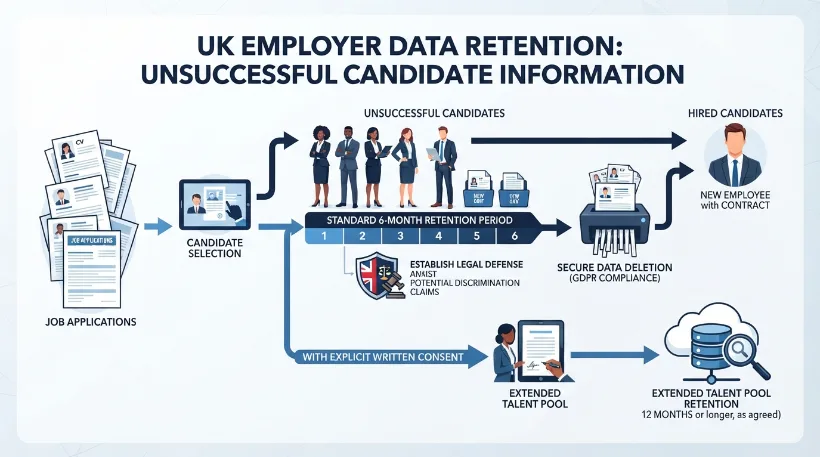
Retaining applicant data indefinitely violates storage limitation principles. Recruitment teams establish automated deletion protocols within applicant tracking software. Standard hiring cycles generate extensive paper and digital trails. Unsuccessful applications face systematic purging after 180 days. This timeframe aligns with statutory limitation periods for employment tribunal claims. Discrimination claims regarding recruitment decisions typically emerge within three months. Maintaining records for six months allows organizations to defend hiring practices. Extended retention requires explicit, documented consent from the individual. Talent pooling demands active renewal of consent every 12 months.
Specific roles require longer statutory retention periods under employment law. Regulated sectors mandate criminal record checks and verification logs. Employers retain right-to-work documentation for two years post-employment termination. Successful candidates transition from candidate files to permanent employee records. Employee records face retention schedules lasting six years after employment ends. Payroll details require extended storage for tax and audit compliance. HR administrators audit data repositories quarterly to identify expired records. Secure shredding services destroy physical candidate files on schedule. Permanent digital deletion protocols erase database entries completely. Unclaimed spontaneous CVs submitted without active vacancies face immediate deletion.
What Security Measures Protect Stored Candidate Information?
Protecting stored candidate information requires deploying multi-factor authentication, robust database encryption, role-based access permissions, and physically secure environments to prevent data breaches and unauthorized data exposure.
Digital security starts with encrypted databases and secure cloud storage infrastructure. Cyber security teams implement advanced threat protection tools across HR networks. Multi-factor authentication blocks unauthorized login attempts on recruitment platforms. Role-based access controls ensure hiring managers view only relevant candidate profiles. Administrative privileges restrict user export and bulk download capabilities. Regular vulnerability assessments identify potential security gaps in recruitment software. Audit logs track every interaction with applicant records. System administrators review logs weekly for suspicious access patterns.
Physical security remains equally critical for printed resumes and notes. Interview processes generate physical notes during face-to-face evaluations. Hiring teams must conduct sessions in private, secure environments. Businesses utilize professional Interview Rooms to safeguard physical confidentiality during assessments. These designated spaces prevent unauthorized eavesdropping and document theft. Interviewers store printed notes in locked filing cabinets immediately after sessions. Clean desk policies prohibit leaving candidate files unattended in open offices. Staff members shred physical notes securely upon completing hiring evaluations. Secure document disposal protects sensitive data from dumpster diving threats.
What Are the Consequences of Non-Compliance with Data Laws?
Non-compliance with UK data protection laws triggers severe financial penalties, statutory enforcement notices, reputational damage, and potential civil litigation from affected candidates whose privacy rights were breached.
Regulatory bodies enforce compliance through substantial financial sanctions. The Information Commissioner Office issues fines reaching seventeen million pounds or four percent of global turnover. Minor infractions incur standard monetary penalties of up to eight million pounds. Enforcement notices compel organizations to halt non-compliant data processing activities immediately. Public reprimands damage employer brands across competitive labor markets. Talented professionals avoid organizations with histories of data mismanagement. Reputational loss reduces candidate application rates significantly. Restoring trust requires costly public relations and technical remediation campaigns.
Affected candidates initiate civil litigation for compensation regarding distress. Individuals claim financial damages for emotional harm caused by data leaks. Courts award compensation when data controllers fail to secure personal information. Legal defense costs accumulate rapidly during data breach investigations. Insurance policies rarely cover fines issued for willful regulatory violations. Executive leadership assumes ultimate accountability for corporate data governance failures. Compliance audits become mandatory following significant data protection breaches. Organizations implement compulsory staff training to prevent recurrence. Continuous monitoring ensures adherence to updated statutory guidelines.
How Do Talent Pools Affect Data Storage Obligations?
Talent pools affect data storage obligations by requiring explicit, renewed applicant consent, transparent communication regarding future job alerts, and strict adherence to data minimization principles.
Talent pooling allows organizations to retain applicant data for future vacancies. Standard rejection notifications do not grant permission for talent pool retention. Recruiters must present an opt-in checkbox during the application process. Opt-in mechanisms require clear, affirmative action from the candidate. Pre-ticked boxes violate statutory consent requirements under data regulations. Talent pool databases require regular audits to verify active consent statuses. Organizations send annual notification emails to refresh candidate consent records. Inactive profiles without renewed consent face automatic deletion from systems.
Data minimization principles restrict the types of data stored in talent pools. Recruiters retain only essential professional contact details and core competencies. Excessive personal information like marital status or health details requires purging. Candidates retain rights to withdraw consent from talent pools at any time. Automated opt-out links inside communication emails streamline consent withdrawal processes. Privacy teams process withdrawal requests within ten business days. Database synchronization ensures removed profiles vanish across all connected platforms. Maintaining clean talent pools reduces storage costs and regulatory exposure. Effective data governance balances talent acquisition goals with strict statutory compliance.
Explore our Interview Rooms guide,
What Happens When a PSC Leaves the Company?
Why Do Some Institutions Require Certified Company Documents?
Frequently Asked Questions
Why do businesses need dedicated interview rooms for hiring processes?
Dedicated interview rooms provide a secure, professional environment that protects sensitive candidate information and complies with data privacy laws. Form My Company offers specialized interview spaces designed to prevent unauthorized eavesdropping, ensuring compliance with strict confidentiality standards during recruitment.
How do private interview rooms protect candidate data during recruitment?
Private interview rooms safeguard physical candidate documentation like CVs, right-to-work copies, and assessment notes from public exposure or unauthorized viewing. Utilizing compliant facilities through Form My Company allows hiring managers to maintain clean-desk protocols and secure printed records immediately after evaluations.
Are employers legally required to provide secure spaces for candidate interviews?
Data protection regulations require organizations to implement robust physical and technical safeguards when processing personally identifiable applicant information. Form My Company delivers secure interview rooms that help businesses meet these statutory duties by preventing data leaks and unauthorized access during face-to-face evaluations.
What features should a compliant interview room include for data protection?
A compliant interview room requires acoustic privacy, lockable storage facilities, restricted physical access controls, and secure document disposal systems. Form My Company equips hiring spaces with these essential features to protect sensitive candidate disclosures and maintain complete confidentiality throughout the interview cycle.
How can businesses book professional interview rooms for recruitment?
Businesses can secure professional interview spaces by reserving fully equipped rooms that meet corporate compliance and data security standards. Form My Company provides streamlined booking options for dedicated interview rooms directly via https://formmycompany.uk/services/interview-rooms/ to support secure, confidential hiring processes.