
Changing your registered office address updates your company’s official legal address on the Companies House public register. This action alters where statutory mail arrives, resets your legal jurisdiction, and requires official notice within 14 days to maintain compliance with UK corporate law.
Why Does a Business Change Its Registered Office Address?
Companies change their registered office address to protect personal privacy, reflect operational relocations, lower administrative costs, or maintain official compliance when changing corporate service providers. Updating this record ensures that statutory mail reaches the company promptly while maintaining public transparency.
Corporate entities in the UK require a physical location within their country of incorporation to receive official communications. Directors frequently substitute their residential addresses for commercial or virtual corporate locations. This modification keeps private residence details off the public register at Companies House.
Business expansions and physical office moves also necessitate official address updates. When operations transfer to a new city or region, the registered address must update to maintain accurate corporate records. Commercial lease terminations or transitions to remote work setups similarly prompt address modifications.
Service provider updates represent another primary catalyst for changing a corporate address. Businesses often switch corporate secretarial firms or legal providers to access better administrative support. Incorporating updated business documentation ensures that all statutory registers reflect the correct corporate location without operational delays.
What Are the Legal Requirements for Changing Your Registered Address?
UK corporate law requires companies to register a physical address in the same jurisdiction as incorporation, ensure public accessibility during business hours, and file official notification with Companies House within 14 days of making the operational change.
The Companies Act 2006 dictates strict parameters for valid registered office addresses. The chosen location must sit in the same UK jurisdiction where the business originally incorporated. A company registered in England and Wales cannot select an address located in Scotland or Northern Ireland.
The location must accept official postal service delivery and hand-delivered legal notices. P.O. Boxes are legally invalid unless paired with a full physical street address. Directors must ensure that authorized personnel can accept legal summonses, court orders, and government notices at the location during regular business hours.
Corporate officers must report the address change to Companies House using official filing protocols. The statutory deadline requires notice submission within 14 calendar days of the address change date. Statutory notices sent to the previous location remain legally valid for 14 days following the official filing date.
How Do You Notify Companies House of an Address Change?
Directors notify Companies House by submitting Form AD01 electronically or by post, specifying the new physical location details, and waiting for official registration approval to update the public corporate record.
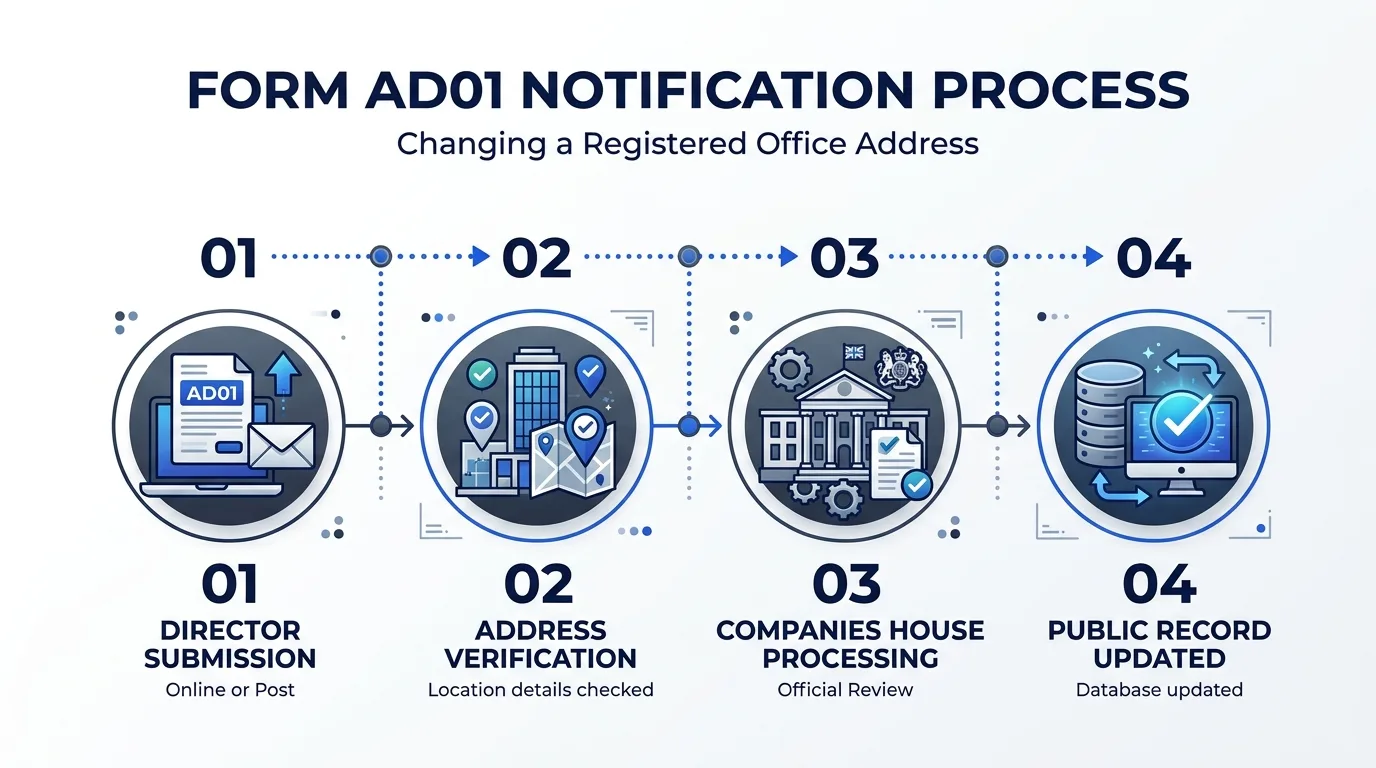
Submitting Form AD01 serves as the formal process for updating corporate location details. Directors access the Companies House online portal to input the new address details. Electronic submissions process within 24 hours, whereas paper forms sent by mail require up to 10 working days.
The filing payload requires exact street names, building numbers, town details, and postcodes. Form AD01 requires authentication by an active director, company secretary, or authorized corporate agent. Inaccurate entries trigger immediate rejection from the registrar, requiring complete resubmission of the statutory form.
Confirmation occurs once Companies House accepts the submission and updates the public register. The historic address remains visible in the filing history log, but the new location displays as the active official address. Directors should download the official filing confirmation to store alongside statutory company books.
What Happens to Statutory Mail After the Address Change?
Statutory mail transfers to the new registered location once Companies House processes Form AD01, making the company legally liable for reviewing official letters sent to the newly registered address.
Official agencies redirect statutory correspondence to the newly designated location immediately upon register updates. Government institutions using this database include HM Revenue and Customs, Companies House, the Courts Service, and the Insolvency Service. Operational correspondence from commercial clients or suppliers does not automatically transfer unless separately notified.
Failure to monitor statutory incoming mail creates severe legal exposure. Government notices, tax assessments, and legal claims sent to the updated location carry strict response windows. Missing an official court notice delivered to the registered address can result in default judgments against the business entity.
Companies using virtual office services rely on immediate mail scanning and physical forwarding. Service agreements must include prompt processing of statutory notices to prevent missed deadlines. Organizations requiring updated corporate records can secure updated company documentation to confirm their operational address details across external banking institutions and government registries.
Which Government Bodies and Organizations Must You Inform?
Companies must notify HM Revenue and Customs, financial institutions, insurance providers, commercial utility vendors, and licensing authorities immediately after Companies House approves the registered address change.
HM Revenue and Customs requires explicit notification across multiple tax departments. Updates made at Companies House do not automatically sync across all tax systems. Directors must log into the government gateway portal to update details across Corporation Tax, Value Added Tax (VAT), and Pay As You Earn (PAYE) accounts.
Financial institutions demand updated corporate verification following address modifications. Banks cross-reference business details against Companies House records during periodic compliance audits. Failure to update bank records leads to restricted account access or delayed financial transactions.
Commercial relationships require direct updates to maintain continuity. Insurance underwriters require current location details to uphold policy coverage validity. Trade suppliers, utility providers, statutory registers, and international trade bodies must receive written confirmation of the new address details.
How Does an Address Change Impact Your Statutory Registers and Corporate Documents?
An address change requires immediate updates to the company’s internal statutory books, official business stationary, corporate websites, email footers, and legal authorization documentation.
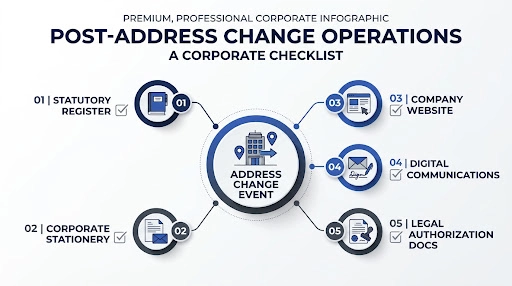
Corporate secretaries must update internal statutory registers kept by the business. The Register of Directors, Register of Secretaries, and Persons with Significant Control (PSC) register must reflect correct location details. Internal compliance audits review these registers to ensure full alignment with public filings.
Section 82 of the Companies Act 2006 commands that all commercial literature displays the current registered office address. Company websites, official emails, invoices, purchase orders, and letterheads require instant revisions. Non-compliant documentation subjects corporate officers to financial penalties.
Formal business transactions often require updated corporate legal proof following an address change. Third parties frequently request formal verification documents to confirm operational standing. Reviewing guides on how to update your letter of authority after an address change ensures that commercial partners accept your legal credentials.
When legal representatives require fresh documentation, ordering replacement records resolves verification hurdles. Corporate leaders can request a fresh letter of authority from Form My Company to maintain seamless authorization across commercial contracts and banking operations.
What Are the Risks of Failing to Update Your Registered Address?
Failing to update your registered office address results in financial penalties, missing legal summonses, regulatory strike-off warnings from Companies House, and potential loss of corporate limited liability status.
Missing official correspondence causes severe financial and operational damage. Statutory tax reminders, statutory demand notices, and court documents sent to obsolete locations go unanswered. Unanswered court proceedings produce default Judgment entries that permanently ruin corporate credit scores.
Companies House imposes administrative penalties for non-compliance with address reporting mandates. Continued failure to maintain an active, valid address leads the registrar to initiate strike-off procedures. This process dissolves the corporate entity and transfers remaining business assets to the Crown.
Directors risk personal liability when failing to adhere to statutory filing responsibilities. Regulatory breaches damage professional standing and can trigger director disqualification proceedings. Maintaining updated corporate records protects limited liability protections and preserves business operations.
Explore More Supplementary Company Documents Guide,
What Do Investors Look for in Your Articles of Association?
What Are the Share Transfer Rules in Articles of Association?
Frequently Asked Questions
What Are Supplementary Company Documents in the UK?
Supplementary Company Documents are official corporate records and legal certificates issued to verify a company’s registration details, standing, or internal structure beyond basic incorporation files. Business owners order these documents through Form My Company to provide third-party validation for banks, investors, or international authorities. Common examples include Certificates of Good Standing, Certified Copies of Incorporation, and official Letters of Authority.
When Does a Business Need Supplementary Company Documents?
A UK business requires Supplementary Company Documents when opening a corporate bank account, securing commercial loans, entering international trade agreements, or updating company ownership records. Lenders and financial institutions frequently request these verified legal records to fulfill Know Your Customer (KYC) and anti-money laundering compliance checks. Form My Company assists business owners in obtaining up-to-date documentation directly aligned with statutory requirements.
How Do I Obtain Official Supplementary Company Documents for My Business?
Official corporate documents can be requested online by submitting your registered company details and selecting the required certificate or legal confirmation. Form My Company retrieves and processes Supplementary Company Documents directly from official registrar records to ensure legal validity. Once generated, these documents are delivered digitally or physically based on your verification requirements.
What Is the Difference Between a Certificate of Incorporation and Supplementary Company Documents?
A Certificate of Incorporation is the initial legal document issued when a company is first registered at Companies House, proving its legal creation. Supplementary Company Documents include ongoing structural or verification records, such as status confirmations, statutory registers, or legal authority letters updated over time. Form My Company provides both foundational incorporation records and supplementary filings to maintain continuous corporate compliance.
How Long Are Supplementary Company Documents Valid for Legal and Banking Use?
Most financial institutions, legal entities, and regulatory bodies require Supplementary Company Documents to be issued within the last 30 to 90 days to ensure current operational standing. Outdated certificates may be rejected during compliance reviews or corporate transactions. Form My Company facilitates quick turnaround requests for freshly certified documents to satisfy urgent verification deadlines.