
Live call handling acts as a dedicated operational buffer that captures inbound customer demand, filters routine inquiries, and routes high-value prospects directly to internal teams. This systematic management prevents communication bottlenecks during rapid business growth.
Scaling operations requires business infrastructure that expands without breaking internal workflows. 42% of growing UK enterprises report that missed phone calls cause direct revenue loss during peak operational surges. Traditional in-house reception desks often fail when customer volume doubles within a single quarter. Professional live call handling introduces structured communication protocols that absorb sudden spikes in market demand.
Expanding companies face constant pressure to maintain rapid response times while reducing administrative overhead. Internal staff members lose 30% of their daily productivity when constant telephone interruptions fracture their core duties. External call management teams isolate core operational staff from repetitive inbound inquiries. This structural separation preserves deep-focus work blocks for product development and strategic business planning.
Advanced communication infrastructure transforms unpredictable customer interactions into structured data points. Modern call handling systems record inquiry types, peak calling hours, and geographic origin. Operations managers use these metrics to forecast staffing requirements and adjust resource allocation. Reliable call management ensures that growing enterprises maintain operational continuity across every developmental stage.
How Does Live Call Handling Eliminate Communication Bottlenecks?
Live call handling eliminates communication bottlenecks by deploying dedicated telephone agents who answer inbound inquiries simultaneously, process routine requests instantly, and distribute qualified leads directly to appropriate department extensions.
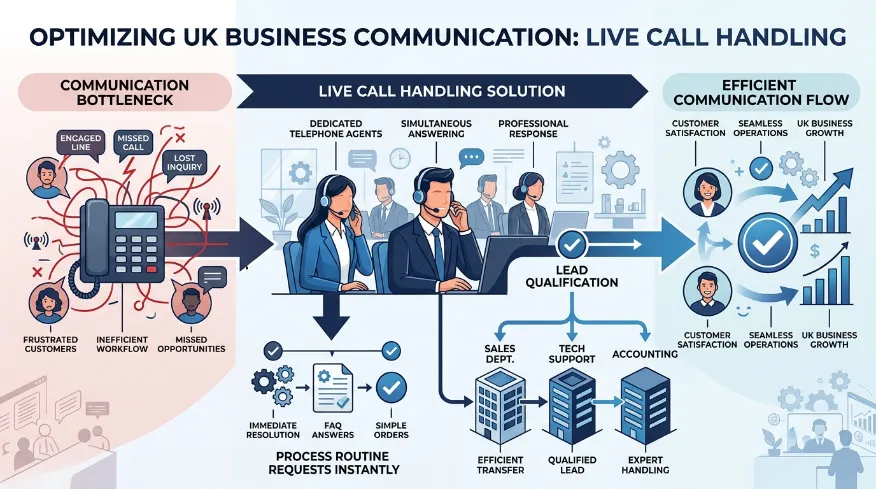
Growing companies experience severe operational friction when phone lines remain permanently engaged during marketing campaigns. 55% of callers hang up immediately when automated phone menus fail to connect them with a human operator. Professional live agents answer incoming calls within three rings to prevent customer abandonment. This immediate engagement protects brand reputation and preserves potential sales conversions.
Internal teams struggle to balance heavy project workloads with unpredictable telephone traffic patterns. When four customers call simultaneously, single-person reception desks miss three potential revenue opportunities. Live call handling providers deploy scalable agent pools that absorb sudden traffic spikes effortlessly. Three primary operational resources drive this efficiency: simultaneous call queuing, standardized script execution, and digital message dispatch.
Systematic call filtering protects technical departments from unnecessary administrative disruptions. Agents resolve standard questions regarding operating hours, pricing structures, and basic service availability. Complex technical queries receive priority tagging before routing to senior engineers. This precise triage system ensures that internal experts spend zero time managing repetitive inbound communication tasks.
Why Do Growing Businesses Outgrow Traditional In-House Reception?
Growing businesses outgrow traditional in-house reception because fixed staffing models cannot absorb unpredictable call volume surges, suffer from high employee turnover rates, and create unsustainable overhead costs.
Fixed in-house reception models rely on single employees or small administrative teams. When call volumes increase by 300% during seasonal campaigns, internal staff members experience severe operational overload. Staff fatigue leads to missed messages, incorrect data entry, and frustrated prospective clients. Maintaining redundant internal reception staff to cover rare traffic peaks creates massive financial inefficiency.
Employee absenteeism and annual leave expose critical vulnerabilities in internal communication structures. 78% of small businesses lack immediate backup coverage when a solo receptionist falls ill or resigns. This sudden absence creates immediate communication blackouts that disrupt ongoing sales pipelines. Outsourced live call handling guarantees continuous operational coverage without employment liability overhead.
Financial sustainability dictates that expanding firms minimize fixed overhead expenses. Employing full-time receptionists involves recruitment costs, pension contributions, workspace allocation, and hardware investments. Flexible external Call Answering solutions replace fixed payroll burdens with predictable operational expenses. This financial flexibility allows growing companies to redirect capital toward core product development and market expansion.
What Impact Does Response Speed Have on Lead Conversion?
Rapid response speed dramatically increases lead conversion rates because prospective buyers evaluate competing service providers based on initial contact velocity and professional attentiveness.
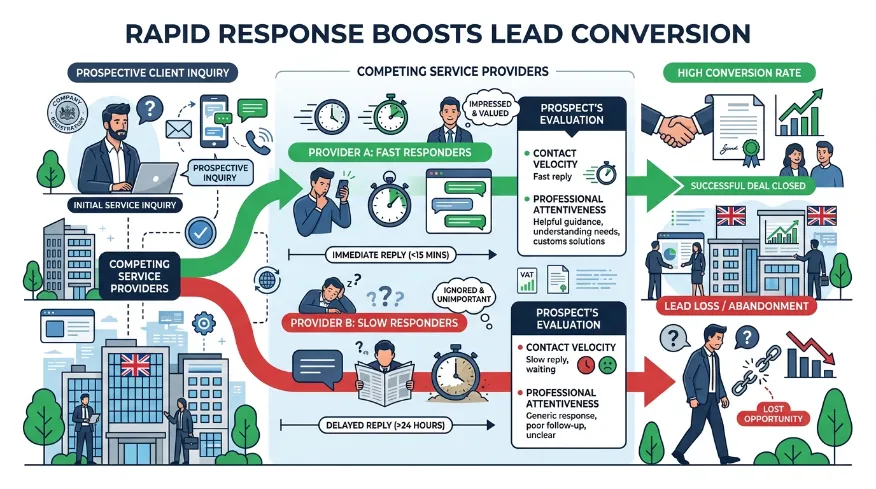
Modern consumers expect immediate answers when evaluating potential business partners or specialized service providers. 71% of B2B buyers award contracts to the vendor that responds to their initial inquiry first. When phone lines ring out continuously, prospective clients transfer their budgets to agile competitors. Live call handling secures high-value leads by capturing every single inbound opportunity without delay.
First impressions dictate the long-term value of client relationships in competitive commercial sectors. Professional call handlers project an established corporate image that reassures cautious investors and enterprise buyers. Inconsistent communication damages brand credibility during critical growth phases. Standardized greeting protocols ensure that every caller experiences consistent professionalism regardless of calling time.
Delayed follow-up procedures allow competitor firms to intercept motivated buyers mid-search. When inbound calls convert into structured digital tickets instantly, sales teams initiate follow-up calls within minutes. Speed transforms casual inquiries into confirmed commercial contracts. Effective communication management bridges the critical gap between initial market interest and final agreement execution.
How Does Outsourced Call Management Support Strategic Scaling?
Outsourced call management supports strategic scaling by freeing internal leadership from administrative distractions, protecting core profit margins, and providing scalable communication infrastructure for multi-region expansion.
Founders and senior executives must concentrate entirely on high-level strategy rather than routine customer inquiries. When executives spend two hours daily answering basic phone calls, strategic growth initiatives stall completely. Delegating communication management to specialized providers restores executive focus to corporate governance and capital acquisition. This operational shift accelerates overall business velocity significantly.
Regional expansion creates complex logistical challenges for centralized administrative departments. Expanding operations into new geographic territories requires localized telephone numbers and regional market knowledge. External communication partners deploy localized answering protocols that build immediate trust with regional consumer bases. Three distinct expansion strategies rely on this support: multi-region number routing, local time-zone coverage, and scalable infrastructure deployment.
Operational resilience determines whether an enterprise survives rapid market scaling. Businesses navigating early growth phases often explore insights outlined in Scaling Pains: Why Business Owners Hit a Service Ceiling? to identify structural vulnerabilities. Implementing robust communication frameworks prevents administrative failure during critical expansion periods. Form My Company delivers enterprise-grade communication systems that adapt seamlessly to fluctuating operational demands.
How to Integrate Live Call Handling into Existing Operations?
Integrating live call handling into existing operations requires defining precise escalation protocols, mapping inbound call routing paths, and connecting communication software directly with internal customer relationship databases.
Successful integration begins with a comprehensive audit of existing communication workflows and historical call volumes. Operations managers identify peak calling windows, recurring customer inquiries, and high-priority escalation triggers. This preparatory analysis ensures that external agents receive accurate instructions tailored to specific business requirements. Clear operational guidelines eliminate confusion during live customer interactions.
Technical synchronization bridges the gap between external call handlers and internal CRM platforms. Integration engineers establish secure data transfer pipelines that log call details, customer notes, and follow-up tasks instantly. When handling complex corporate inquiries, Form My Company utilizes secure communication channels to ensure complete data compliance and operational transparency. Real-time data synchronization empowers sales teams to execute rapid follow-up procedures without administrative delays.
Continuous performance monitoring guarantees long-term operational success following system deployment. Management teams review monthly analytics reports detailing call duration, resolution rates, and peak traffic distribution. Companies preparing for major operational surges utilize advanced strategies detailed in Scale Fast: How We Manage Your Business Surge Traffic? to maintain high performance standards. Regular protocol updates ensure that communication infrastructure scales efficiently alongside enterprise growth.
Live call handling removes critical communication barriers that constrain growing businesses during rapid expansion phases. By replacing fragile in-house reception models with scalable, professional communication infrastructure, enterprises protect core revenue streams and preserve executive focus. Form My Company provides reliable call management services that support sustainable business growth through structured processes and expert execution.
Explore our Call Answering guide,
Looking for Interview Room Features That Keep Candidate Data Safe?
How to Plan a Carbon-Conscious Conference Step by Step?
Frequently Asked Questions
How does a call answering service work for small businesses?
A professional call answering service works by routing your inbound telephone traffic to trained remote receptionists who answer using your company name. Form My Company manages these interactions according to your specific scripting guidelines, capturing caller details and instantly forwarding messages via email or SMS.
What is the difference between a virtual receptionist and call answering?
Standard call answering focuses primarily on greeting inbound callers, logging contact data, and taking concise messages during peak hours. In contrast, a virtual receptionist service provided by Form My Company offers advanced administrative support, including live call transfers, calendar management, and bespoke customer query resolution.
Can I keep my existing phone number with a call answering service?
Businesses can retain their existing landline or mobile telephone numbers by setting up a simple call diversion to the dedicated number assigned by Form My Company. This seamless redirection ensures your customers experience zero disruption while connecting with your outsourced call handling team.
How do outsourced call handling services prevent missed business opportunities?
Outsourced call handling prevents missed opportunities by ensuring that every inbound telephone inquiry is answered promptly by a live operator rather than rolling over to voicemail. Form My Company captures urgent prospect details in real-time, allowing your internal teams to execute rapid follow-ups and secure high-value commercial contracts.
Is a call answering service more cost-effective than hiring an in-house receptionist?
Utilizing a professional call answering service eliminates major overhead expenses such as recruitment fees, employee benefits, workspace allocation, and hardware investments. Form My Company delivers scalable monthly packages that replace fixed payroll burdens with flexible operational costs tailored to your exact call volume.