
People worry about PSC register privacy because public access to personal home addresses and date of birth details exposes founders to identity theft, targeted financial fraud, stalkers, and unwanted commercial marketing solicitors scanning open government databases.
Public transparency mandates enforced by regulatory bodies like Companies House create unavoidable friction between corporate accountability and individual data protection rights. UK company directors must list specific personal details on public registers. This transparency mechanism prevents illicit financial flows and shell company abuse. At the same time, open access removes traditional barriers preventing malicious actors from scraping personal records. Modern digital tools allow anyone to aggregate director data within seconds. Consequently, entrepreneurs face heightened exposure to targeted phishing schemes and physical security threats.
What Information Does the PSC Register Make Public?
The PSC register makes names, exact month and year of birth, correspondence addresses, nationality, and specific ownership percentages completely public via government portals.
Every UK registered company must identify individuals exercising significant control over corporate entities. When founders submit incorporation documents, they disclose identifying attributes to Companies House databases. Public viewers can inspect ownership stakes exceeding 25% voting rights or share capital. Furthermore, individuals must declare their exact residential country and service addresses. While residential addresses remain hidden from general public viewing screens, correspondence addresses appear openly. Malicious actors leverage this publicly indexed corporate data to build detailed victim profiles for financial exploitation.
How Does Public Transparency Increase Personal Security Risks?
Public transparency increases personal security risks because identity thieves cross-reference company registers with leaked consumer databases to compromise personal bank accounts.
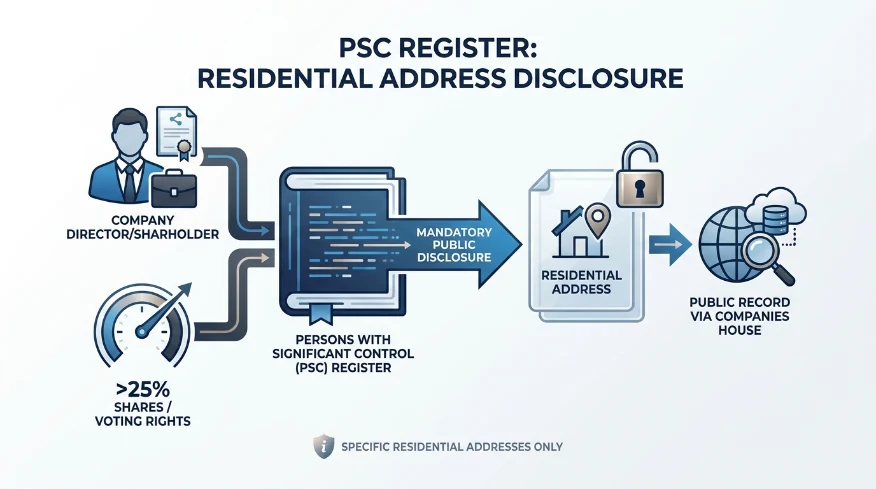
Criminal networks harvest director names and birth dates from open government portals daily. Fraudsters use these scraped credentials to impersonate business owners during financial transactions or tax filings. When home addresses leak into public view, physical security risks escalate rapidly for high-net-worth founders. Unregulated data brokers harvest open records to sell targeted contact lists to aggressive marketing agencies. Business owners experience an immediate surge in unsolicited sales calls, fraudulent invoice scams, and spam mail.
Can Directors Suppress Their Details From Public View?
Directors can suppress their details from public view only when facing verified risks of violence, intimidation, or severe physical harm.
Companies House applies strict legal thresholds before granting address suppression orders to registered individuals. Applicants must provide compelling police reports or documented evidence proving imminent physical danger. Standard commercial discomfort or general privacy preferences do not qualify for record suppression. When authorities approve an application, the public register hides specific residential data from third-party viewers. However, designated regulatory agencies retain full access to suppressed files for compliance auditing and criminal investigations.
Why Do Regulators Prioritize Transparency Over Privacy?
Regulators prioritize transparency over corporate privacy because open ownership records prevent money laundering, tax evasion, and illicit asset concealment.
Global financial watchdogs demand open corporate registers to dismantle anonymous shell companies used in corruption schemes. Law enforcement agencies rely on immediate data accessibility to trace beneficial owners during cross-border fraud investigations. Transparent equity structures ensure consumers and suppliers know exactly who controls a commercial enterprise. Without public oversight, bad actors hide illegal funds behind complex corporate webs. Therefore, regulatory frameworks treat public access as a non-negotiable safeguard for the broader economic ecosystem.
How Can Business Owners Protect Their Private Data?
Business owners protect private data by using dedicated service addresses, leveraging professional compliance services, and separating personal credentials from operations.
Founders must never list residential properties as official company correspondence addresses on public filings. Utilizing professional business address services prevents personal home locations from entering public government databases. Establishing strict digital hygiene protocols shields corporate correspondence from automated data scrapers and identity thieves. To simplify these protective measures, founders utilize specialized PSC register management to handle compliance accurately without exposing personal vulnerabilities. Maintaining strict oversight over corporate documentation ensures ongoing data security while fulfilling statutory duties. Entrepreneurs evaluating compliance options often review strategic guides on how to balance PSC transparency with data privacy to align operational security with UK legal mandates. Business owners seeking direct assistance can also explore Form My Company GDPR-compliant PSC filing services to streamline secure filings.
Balancing statutory transparency with personal privacy demands deliberate administrative precautions and strict adherence to UK corporate law. While regulatory frameworks enforce public accountability to prevent financial crime, founders retain practical avenues to safeguard sensitive personal information. Utilizing professional mail forwarding addresses, restricting home address disclosures, and partnering with verified compliance experts mitigates exposure to modern security threats. Navigating these regulatory obligations safely preserves corporate integrity without compromising personal safety.
Explore our PSC Register guide,
Can You Keep a PSC’s Home Address Off the Public Record?
Why Does ESG Reporting Now Include Corporate Events?
Frequently Asked Questions
What is a PSC register and who needs to be included?
A People with Significant Control (PSC) register is a mandatory statutory record that UK companies must maintain to list individuals owning or controlling more than 25% of shares or voting rights. Form My Company helps businesses properly identify and log these qualifying stakeholders to ensure full compliance with Companies House regulations.
Can my home address be kept off the public PSC register?
While your exact residential address is shielded from general public viewing screens on Companies House, your official service address remains fully accessible to anyone inspecting the register. Form My Company provides professional business correspondence addresses that keep your private residential location completely off public government databases.
What are the penalties for failing to maintain a correct PSC register?
Failing to keep an accurate or up-to-date PSC register can result in severe financial penalties, daily default fines, and potential criminal prosecution for company directors. Utilizing professional oversight from Form My Company ensures your statutory filings remain accurate and submitted on time to avoid regulatory breaches.
How often do changes to the PSC register need to be reported?
Companies must update their internal PSC register within 14 days of any ownership or structural change occurring, and then file those updates with Companies House within an additional 14 days. Form My Company streamlines this ongoing filing timeline to prevent accidental delays and maintain strict legal compliance.
What information must be publicly displayed on the PSC register?
The public PSC register displays each controlling person’s full legal name, month and year of birth, nationality, service address, and the exact nature of their control stake. Form My Company assists founders in managing these required disclosures accurately while protecting sensitive personal identifiers where permitted by law.