
A Certificate of Good Standing has an expiry date because corporate compliance statuses change rapidly. Regulatory bodies issue limited validity periods (typically 3 months) to ensure external parties rely solely on current data regarding a company’s legal and financial standing.
Regulatory authorities issue these documents to prove a corporation exists and operates lawfully on the official register. Third parties, such as international banks, foreign registries, and overseas business partners, require fresh proof of active status. If a document lacks an expiration date, stakeholders might accept outdated information for active legal entities. Company directors face dissolution risks or compliance failures if corporate filing dates lapse. Therefore, strict validity limits protect global commerce from fraudulent or dissolved corporate entities.
What Determines the Validity Period of a Certificate?
Registrar policies and international banking regulations determine the validity period by enforcing a strict 90-day acceptance window for corporate compliance documents.
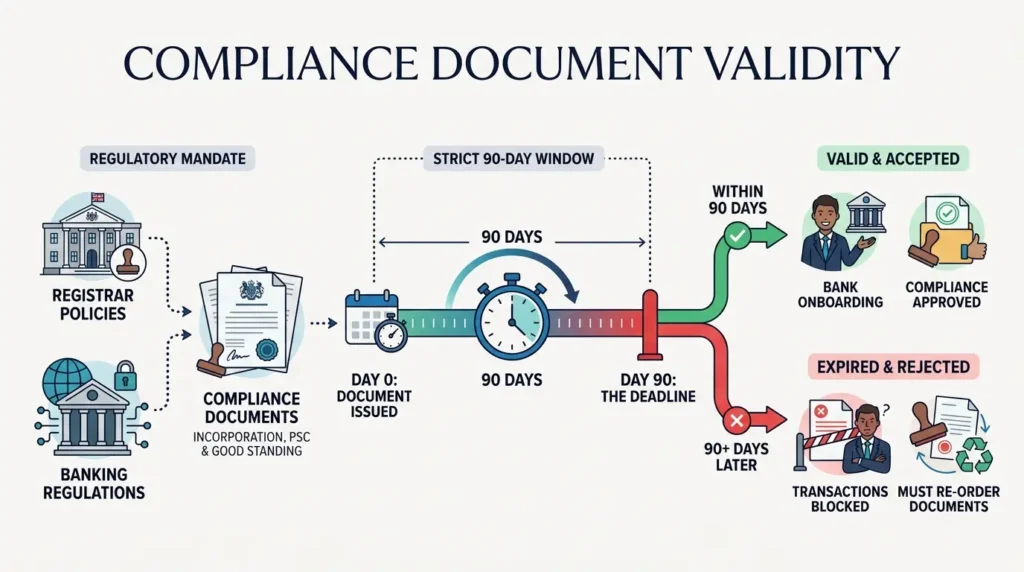
Government bodies like Companies House do not print formal expiration dates directly onto the physical document itself. Instead, receiving authorities impose arbitrary cutoff windows based on corporate risk management standards. 14 distinct financial institutions enforce a maximum 3-month threshold for foreign business verification. When businesses apply for overseas bank accounts, compliance departments reject documents older than 90 days. Because annual confirmation statements and accounts update yearly, registries limit document lifespan to prevent fraud. Directors must track exact issuance timestamps to maintain valid legal status across international borders.
How Do Corporate Status Changes Affect Document Validity?
Corporate status changes invalidate certificates immediately because late filing fees, missed confirmation statements, or director disqualifications alter official register records.
When Companies House updates a corporate profile, any previously issued proof of status becomes legally obsolete. Three common events trigger immediate status revocation: missed confirmation statement deadlines, overdue annual accounts, and voluntary strike-off applications. If a company incurs penalties or enters administration after issuance, the document no longer reflects reality. Global compliance officers cross-reference public registries instantly to confirm active status before approving transactions. Maintaining continuous compliance prevents unexpected invalidation during critical international expansion phases.
Why Do International Authorities Require Fresh Certificates?
International authorities require fresh certificates because foreign jurisdictions cannot verify real-time registry status without authenticated, recently issued government documents.
Cross-border trade relies on absolute transparency between separate legal systems and foreign business registries. Overseas authorities protect domestic markets by demanding proof issued within the last 30 to 90 days. Four distinct verification steps occur during foreign branch registration: document translation, notary authentication, apostille certification, and registry review. If an enterprise submits an expired document, foreign trade ministries halt expansion applications immediately. Fresh documentation guarantees that the corporate entity remains in good standing within its home jurisdiction.
How Can Businesses Manage Document Expiry for Global Expansion?
Businesses manage document expiry by aligning renewal schedules with annual compliance filing dates and ordering replacement documents proactively.
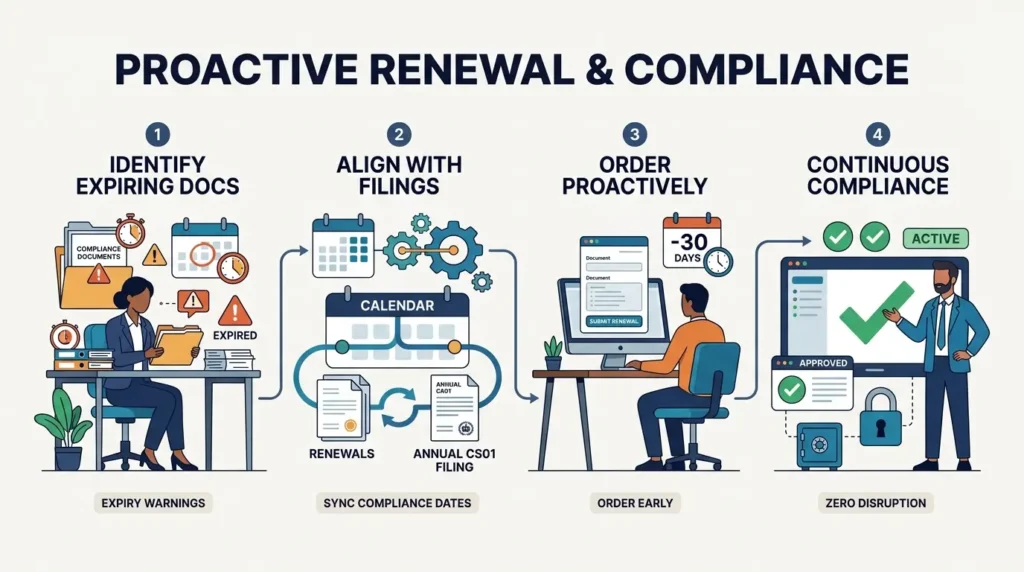
Strategic planning prevents operational bottlenecks during international contract negotiations and foreign subsidiary setups. Five proactive measures ensure continuous compliance: monitoring confirmation statement deadlines, establishing automated renewal reminders, storing digital authenticated copies securely, anticipating foreign bank requirements, and maintaining active corporate filings. When expanding operations into new markets, enterprises frequently require an official Certificate of Good Standing to satisfy overseas regulatory demands. Companies evaluating document renewal frequencies can review [Comparing Single-Use vs Regularly Renewed Certificates of Good Standing] to determine optimal ordering strategies for multi-jurisdictional compliance. Organizations ready to streamline their international paperwork can [Order a Fresh, In-Date Certificate of Good Standing From Form My Company] to secure immediate verification for global trade partners.
Certificates of Good Standing expire because corporate compliance, active filing statuses, and financial standing require constant regulatory monitoring. Government registries and international financial institutions enforce strict validity windows to eliminate risks associated with dissolved or non-compliant corporate entities. Form My Company delivers reliable corporate secretarial solutions, ensuring businesses maintain accurate records and secure valid documentation efficiently.
Explore More Certificate of Good Standing Guide,
How Long Is a Certificate of Good Standing Valid For?
When Should a Company Provide Proof of Good Standing to Investors?
Frequently Asked Questions
What is a Certificate of Good Standing in the UK?
A Certificate of Good Standing is an official government document issued by Companies House that confirms a corporate entity has been in continuous existence and has no pending dissolution actions. Form My Company assists businesses in obtaining this vital authentication to prove active compliance with UK company law. International partners and foreign banks routinely request this document to verify active legal status before entering into commercial contracts.
How long does it take to get a Certificate of Good Standing?
Standard processing through Companies House typically takes between 3 to 5 working days, while expedited digital or same-day options reduce turnaround times significantly. Form My Company streamlines this application process to ensure businesses receive their official compliance verification quickly. Timely issuance prevents operational delays when opening foreign bank accounts or establishing overseas subsidiaries.
Who can request a Certificate of Good Standing for a company?
Any interested party, including company directors, corporate secretaries, shareholders, or designated third-party agents, can request a Certificate of Good Standing for registered UK entities. Form My Company acts as a trusted corporate agent to handle official registry applications securely on behalf of business owners. The applicant must provide accurate company registration numbers and ensure all statutory filings remain up to date.
Does a Certificate of Good Standing list company directors?
A standard UK Certificate of Good Standing verifies the company’s active legal status, incorporation date, and registered office address rather than detailing current directors. Businesses requiring a comprehensive record of officers often need a companion document or a company history search alongside their certificate. Form My Company helps clients assemble the correct combination of official registry documents to satisfy rigorous international due diligence requirements.
Can a dissolved company obtain a Certificate of Good Standing?
A dissolved company cannot obtain a Certificate of Good Standing because the legal entity no longer exists on the active Companies House register. Form My Company advises businesses that maintaining annual confirmation statements and timely financial accounts prevents accidental strike-off or dissolution. Active compliance status is a mandatory prerequisite before any registry will issue verification documents.