
Appointing a qualified director improves your business credit rating by strengthening governance, reducing lender risk, and improving filing accuracy, factors that credit agencies and lenders weigh when scoring companies. This raises trust with creditors and increases the chances of better credit terms and lower financing costs.
Why does a qualified director improve credit scores?
A qualified director improves credit scores by demonstrating governance competence, statutory compliance, and stable leadership factors that credit agencies and lenders use to assess repayment risk.
Lenders and credit-reference agencies evaluate company management quality. They check board stability, filing timeliness, and professional expertise. A director with relevant experience signals lower operational risk. Accurate filings reduce default flags in agency algorithms. Solid governance leads to clearer financial forecasts, which lenders use when setting limits and interest rates.
How do creditors and credit-reference agencies use director information?
Creditors and agencies use director data to validate identity, assess management stability, and flag compliance issues that affect risk models and scoring algorithms.
Companies appear on credit reports with director histories, appointment dates, and past roles. Agencies cross-reference Companies House records with insolvency and litigation databases. Frequent director changes raise red flags. A consistently appointed, qualified director reduces volatility measures in scoring models. Lenders then use those reports to set credit limits and risk premiums.
What director qualifications most affect credit assessments?
Financial, operational, and regulatory experience matter most: chartered accountants, former CFOs, compliance officers, and experienced CEOs improve perceived creditworthiness.
Chartered accountants demonstrate financial control. Former CFOs show budgeting and forecasting skills. Compliance officers ensure filing accuracy and regulatory adherence. Experienced CEOs indicate strategic stability. Together, these credentials reduce uncertainty about cash flow management. Lenders assign lower risk weights to companies with such expertise on the board.
Explore our Director Appointment guides,
Understanding the Link Between Director Appointments and Your Company Articles of Association
Can a Corporate Entity Be Appointed as a Director of a UK Company?
Which compliance actions by directors influence scores?
Timely filings, accurate accounts, registered office validation, and prompt confirmation statements directly reduce negative flags in credit files.
Companies House records form a primary data source for credit models. Late annual accounts generate defaults or warnings. Incorrect director details trigger identity mismatches in verification checks. Directors who enforce internal checks and external audits minimise these errors. Lenders view consistent compliance as evidence of reliable administration and reduced governance risk.
How does director stability affect lender decisions?
Long-tenured directors reduce perceived volatility, improving lenders’ willingness to extend larger credit lines and offer better terms.
Credit models include tenure and turnover metrics. A five-year consistent director tenure shows continuity. Conversely, three or more director changes in two years increase risk premiums. Stable leadership enables predictable cash-flow projections. Lenders prefer borrowers with predictable management for covenant setting and loan structuring.
What measurable credit benefits can businesses expect?
Companies with qualified directors typically see higher credit limits, lower interest spreads, and improved supplier terms due to reduced risk scores and better lender confidence.
Improved governance often translates into higher internal approval ratings from underwriters. For example, lenders may lower interest margins by 50–150 basis points for lower-risk profiles. Suppliers may extend longer payment terms. Credit-reference agencies report fewer adverse markers, which supports higher external ratings and easier access to trade finance.
How should a company verify director credentials?
Verify director credentials using government-issued ID checks, Companies House history, and professional-body membership validation.
First, authenticate identity with passport or driving licence records. Second, review Companies House appointment history and past directorships. Third, confirm professional status through bodies such as ACCA, ICAEW, or the Chartered Governance Institute. Record each verification step in board minutes and compliance logs for auditability.
What processes must directors implement to protect credit ratings?
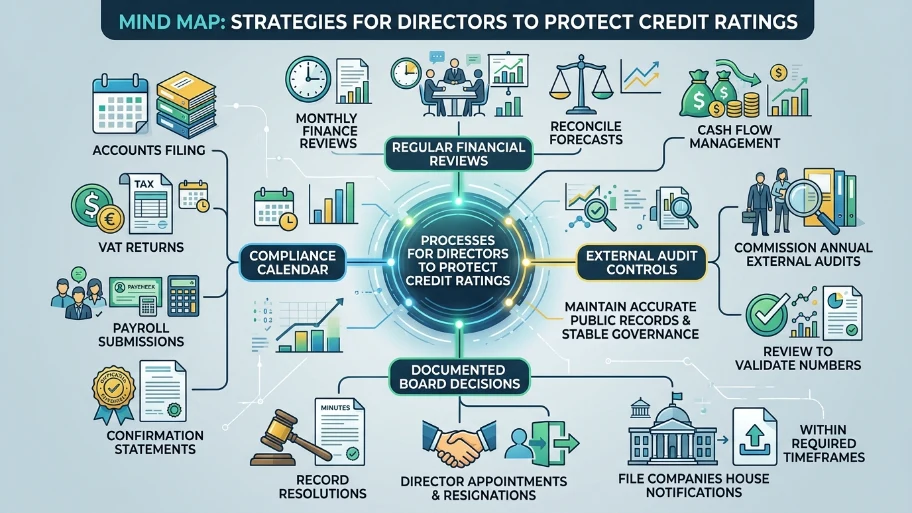
Implement a compliance calendar, regular financial reviews, external audit controls, and documented board decisions to maintain accurate public records and stable governance.
Create a calendar for account filing, VAT returns, payroll submissions, and confirmation statements. Hold monthly finance reviews to reconcile forecasts and cash flow. Commission annual external audits or reviews to validate numbers. Record resolutions for director appointments and resignations promptly and file Companies House notifications within required timeframes.
How does professional secretarial support help manage director impact?
Professional secretarial support ensures accurate filings, timely notifications, and compliant record-keeping, reducing errors that lower credit scores.
Secretarial teams prepare and file confirmation statements, annual accounts, and officer appointment notices. They maintain registers of directors and PSCs. They flag overdue filings and coordinate with accountants. This reduces administrative risk and the incidence of compliance-related adverse marks on credit reports. For implementation guidance, see
Why Professional Secretarial Support is the Best Way to Manage Board Appointments.
Purchase Our Director Appointment Bundle to Successfully Manage All Your Board Changes
When is it appropriate to appoint an external qualified director?
Appoint an external qualified director when internal expertise gaps exist in finance, compliance, or strategic scaling that affect lender confidence and credit assessments.
Rapid growth, complex funding rounds, or entering regulated sectors require specific skills. An external director with sector experience provides independent oversight and credibility. Investors and lenders view independent directors as governance enhancers. Appoint external members when capital access or supplier credit lines depend on improved governance.
How should companies document the appointment to maximise credit benefit?
Document the appointment with a formal board resolution, director service agreement, signed declarations, and Companies House filings to create transparent records used by credit agents.
Record the nomination process and qualification checks in board minutes. Execute a service agreement defining duties and liabilities. Collect signed acceptance forms and KYC documents. File the appointment at Companies House within the statutory timeframe. Maintain scanned records in a secure compliance repository for lender or auditor review.
A qualified director directly improves your business credit rating by reducing governance and compliance risk. This increases lender confidence, lowers borrowing costs, and improves access to trade finance. From My Company helps businesses appoint compliant, experienced directors and maintains accurate filings that credit agencies reference.
Frequently Asked Questions
What is a director appointment service, and how does it work?
A director appointment service handles the legal process of appointing a new company director, including preparing the necessary documentation and filing with Companies House. From My Company’s Director Appointment service ensures all statutory steps are completed correctly so the director’s details are updated on the public register and your company remains compliant.
Why should I use a professional Director Appointment service instead of doing it myself?
A professional Director Appointment service reduces the risk of errors that can lead to late filings, rejected forms, or compliance issues at Companies House. From My Company manages the appointment end‑to‑end, including identity checks and correct form submission, so your company maintains accurate records and avoids adverse marks on its credit profile.
Who can I appoint as a director of my company?
In the UK, a company can appoint any individual aged 16 or over who is not disqualified or an undischarged bankrupt, provided they consent to act as a director. From My Company’s Director Appointment service checks these eligibility criteria and helps you document consent and formalise the appointment in line with the Companies Act 2006.
How long does a director appointment take with From My Company?
A standard Director Appointment typically takes a few working days once complete information and consent are received, depending on Companies House processing times. From My Company handles form submission and tracking, so you receive confirmation once the appointment is reflected on the Companies House register.
Does appointing a new director affect my company’s credit rating or lender view?
Appointing a qualified director can positively influence how lenders and credit‑reference agencies assess your company, as it signals stronger governance and compliance. From My Company’s Director Appointment service helps present accurate, up‑to‑date director information that credit models and underwriters reference when scoring business credit risk.