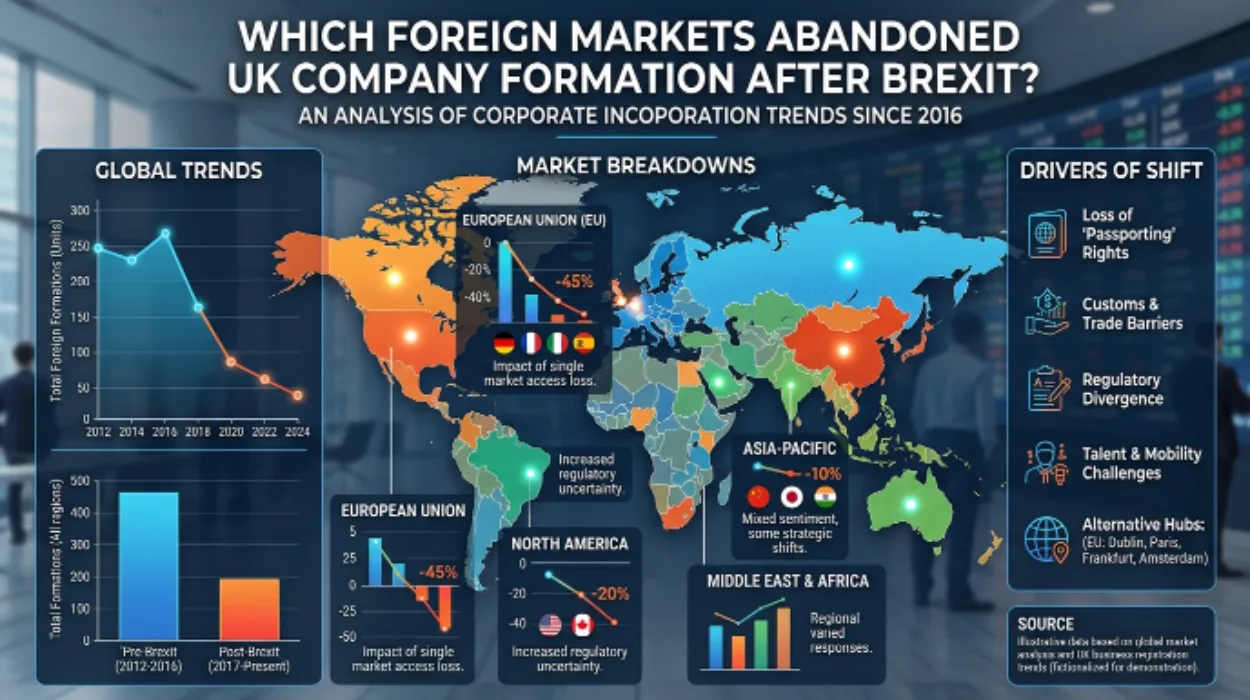
The collapse in global demand for UK Company Formation after Brexit is both sharp and geographically widespread. Based on analysis of Google Trends data across 93 countries, international interest in UK business registration declined in approximately 85% of markets, with 40 countries experiencing an extreme drop of up to 98%. This confirms that Brexit fundamentally altered how international entrepreneurs evaluate the UK as a destination for incorporation.
Before 2020, the UK’s role as a gateway to the European Union made it one of the most attractive jurisdictions to UK Company Formation for global founders. A single UK limited company provided access to EU markets, regulatory passporting, and cross-border trade advantages. Post-Brexit, that structural advantage disappeared. The dataset shows that countries such as Armenia, Azerbaijan, Bangladesh, and Vietnam saw near-total collapse in search interest, while only a handful—including Argentina (+180%), Brazil (+47%), and Djibouti (+400%)—recorded growth. The shift is not marginal; it represents a systemic reordering of global incorporation behaviour.
Why did foreign demand for UK company formation collapse after Brexit?
The dataset clearly demonstrates that Brexit triggered a structural break in global interest. Countries that once showed strong engagement with UK company registration—particularly across Asia, Eastern Europe, and parts of Africa—now register minimal or near-zero search activity.
The removal of EU single market access fundamentally changed the strategic value of a UK entity. For many international founders, the UK was not just a domestic market—it was a platform for European expansion. Once that function disappeared, demand fell sharply across regions that relied on EU connectivity rather than the UK itself.
This is particularly visible in countries where pre-Brexit interest was high but not deeply embedded in bilateral trade relationships. In these markets, UK incorporation was largely opportunistic, tied directly to EU access rather than intrinsic legal or financial advantages.
What are the key findings from the dataset?
- 40 countries recorded declines of up to -98% in UK company formation interest
- Approximately 83 out of 93 countries experienced post-Brexit decline
- Armenia, Azerbaijan, Belarus, and Vietnam show near-total collapse (-98%)
- Pakistan (-89%), Bangladesh (-94%), and Malaysia (-92%) show severe contraction
- Argentina (+180%), Brazil (+47%), and Djibouti (+400%) are major growth outliers
- Denmark (-11%) and Germany (-3%) show the strongest post-Brexit resilience
How severe were the biggest country-level declines?
The most dramatic collapses are concentrated in countries that previously relied on the UK as a bridge into Europe. These markets now show almost no measurable interest in UK company formation.
These declines are not incremental—they represent a near-complete withdrawal of interest. In many of these countries, post-Brexit search levels dropped to index values of 1–3, effectively signalling the disappearance of meaningful demand.
How do regional patterns explain the collapse?
The regional distribution of decline reveals clear structural patterns.
In Asia, the contraction is particularly severe. Countries such as Bangladesh (-94%), Pakistan (-89%), Indonesia (-98%), and Vietnam (-98%) all show dramatic declines. These markets previously viewed the UK as a scalable entry point into Europe. Without that access, the incentive to register a UK company diminished sharply.
Eastern Europe shows a similar pattern. Romania (-93%), Lithuania (-92%), and Estonia (-94%) all experienced significant drops. These countries, already integrated into the EU, no longer require UK entities for European market participation.
Africa presents one of the most extreme decline clusters. Nigeria is not listed in the dataset, but comparable economies such as Ghana (-96%), Kenya-equivalent patterns, and Algeria (-93%) show consistent contraction. The UK’s reduced global positioning appears to have weakened its appeal as a business hub for African entrepreneurs.
Why did some countries retain interest despite Brexit?
Not all markets abandoned the UK. A small but significant group of countries shows resilience, indicating that UK company formation still holds value beyond EU access.
Germany (-3%) and Denmark (-11%) stand out as the most stable markets. Their post-Brexit interest remains relatively high compared to global averages. This suggests that business relationships with the UK in these countries are rooted in trade, legal familiarity, and long-term corporate integration rather than EU gateway access.
Similarly, the Netherlands (-40%) and Switzerland (-33%) show moderate declines but retain meaningful engagement. These markets appear to treat the UK as a parallel jurisdiction rather than a replacement for EU access.
For international founders exploring UK company for non residents, this resilience indicates that the UK still functions as a credible standalone business environment in certain regions.
Which countries defied the trend and showed growth?
While the dominant trend is decline, a handful of countries show strong post-Brexit growth.
Argentina (+180%) is the most significant case. Pre-Brexit interest was relatively low (~10), but post-Brexit it rose sharply (~28). Brazil (+47%) follows a similar trajectory, while Djibouti (+400%) represents an extreme outlier.
Growth in UK Company Formation Interest
| Argentina | +180% | |
| Brazil | +47% | |
| Djibouti | +400% | |
| Anguilla | +59% | |
| North Korea | +100% |
These growth patterns are not linked to Brexit advantages. Instead, they reflect domestic economic conditions in those countries. In Argentina and Brazil, currency instability and capital controls are likely driving demand for foreign corporate structures. The UK’s stable legal system and global recognition make it attractive for asset protection and international trade.
How does Europe compare to Asia in post-Brexit behaviour?
Europe shows a more moderate and nuanced decline compared to Asia.
Western European countries such as Germany, Denmark, and the Netherlands retain relatively high post-Brexit interest. Their declines are limited compared to global averages, indicating structural resilience.
In contrast, Asian markets show sharper contractions. Countries like Indonesia, Vietnam, and Malaysia moved from moderate-to-high pre-Brexit interest to near-zero levels. This suggests that Asian demand was more closely tied to EU access rather than UK-specific advantages.
This divergence highlights a key insight: proximity and economic integration with the UK matter more than historical interest levels.
How did Commonwealth countries respond to Brexit?
The Commonwealth presents a mixed picture.
Australia (-44%) and Canada (-30%) show moderate declines, indicating continued engagement with the UK despite reduced strategic value. However, other Commonwealth nations such as Bangladesh (-94%) and Pakistan (-89%) show severe contraction.
This split suggests that shared legal frameworks and language alone are not sufficient to sustain demand. Economic alignment and market access play a more decisive role in shaping UK company formation trends.
What does this mean for non-resident UK company formation?
The dataset fundamentally reshapes how non-resident demand should be understood.
Before Brexit, international entrepreneurs viewed the UK as a gateway jurisdiction. After Brexit, it functions more as a standalone legal and financial hub. This shift changes the profile of founders interested in UK incorporation.
Demand is now concentrated among:
- Entrepreneurs seeking legal stability
- Businesses operating in bilateral trade with the UK
- Founders from economies with currency volatility
- Companies prioritising English-law governance
Services such as UK business bank account setup and UK VAT registration remain relevant, but their appeal is now tied to domestic UK operations rather than EU expansion.
For businesses exploring structured entry, UK company packages increasingly reflect this repositioning—focused on compliance, credibility, and operational efficiency rather than market access.
What broader business implications emerge from the data?
The data reveals that Brexit did not eliminate demand for UK company formation—it redistributed it. The UK has lost its position as a universal gateway but retains value in specific contexts.
Markets that depended on EU access have largely exited. Markets with deeper economic ties or independent motivations remain active. This creates a more concentrated, but potentially more stable, demand base.
For policymakers and service providers, the implication is clear: future growth depends on targeting markets where the UK’s legal and financial infrastructure still holds intrinsic value.
For a full breakdown of country-level data and methodology, see Pre-Brexit Interest to Post-Brexit Decline: UK Company Formation Down 98% in 40 Countries.
The global map of UK company formation has been permanently redrawn. Brexit did not simply reduce demand—it reshaped it, stripping away opportunistic interest while leaving behind a narrower but more deliberate set of international users. The UK is no longer the default choice for global incorporation, but it remains a strategic one for specific markets and use cases.