
File accounts for dormant companies with professional help to meet HMRC and Companies House rules and avoid fines; accountants prepare the dormant company accounts, submit to Companies House, and ensure HMRC records show zero liability.
What happens if I delay dormant company accounts?
Late filing triggers statutory penalties and increases compliance risk.
Companies House charges automatic penalties for late accounts: £150 after 1 day to £1,500 after 6 months for private companies. Directors face enforcement notices and potential disqualification records when filings remain outstanding.
Delay also complicates HMRC records. HMRC may open an enquiry, issue penalties, or demand tax returns even when turnover is zero. Professional filing reduces queries by ensuring accounts show the correct dormant status and by submitting confirmation statements if required.
How do professionals file accounts for dormant companies?
Accountants prepare abbreviated or micro-entity accounts, confirm dormancy, and submit filings electronically.
A professional confirms the company had no significant accounting transactions during the financial year. They choose the correct format: micro-entity accounts or dormant company accounts. They prepare balance sheets showing nil turnover, authorise director signatures, and submit the accounts to Companies House using secure filing channels.
Professionals also update HMRC records. They check the company’s corporation tax instance and, when appropriate, notify HMRC that the company is dormant to close or prevent tax enquiries. This reduces the chance of HMRC issuing unnecessary tax-facing correspondence.
Read our articles, How to Quickly Resolve Past Due Dormant Account Filings with Professional Help and Why Accurate Record Keeping is Crucial Even for Companies with Zero Turnover.
When is a company legally dormant?
A company is dormant when it has no accounting transactions except permitted ones.
Permitted transactions include fees for filing annual confirmation statements, payment for shares on formation, and penalties for late filing. Any trading activity, salary payments, rental income, or bank interest counts as an accounting transaction and removes dormant status. Professionals verify bank statements and ledger entries to confirm dormancy.
If a company receives any income, it must prepare full statutory accounts and may need to register for corporation tax. Filing the correct accounts type prevents incorrect HMRC assessments and Companies House non-compliance records.
What documents prove dormancy?
Balance sheet, director’s statement, and bank reconciliation showing zero trading prove dormancy.
The balance sheet must show no turnover and only permitted transactions recorded. A director’s statement declares the company’s dormant status for the accounting period. Bank reconciliations and ledger extracts demonstrate a lack of trading receipts or payments.
Accountants produce these documents in standard Companies House formats. They archive supporting evidence for audit trails and for potential HMRC reviews, typically retaining records for six years as required by UK law.
Can I file dormant accounts online?
Yes. Companies House accepts electronic submissions for dormant company accounts.
Professionals use authenticated filing services or the Companies House WebFiling system. Electronic submission reduces processing time and minimises transcription errors. Digital filing also provides immediate confirmation receipts and filing timestamps that help defend against disputes about late submissions.
If a company previously filed paper accounts, professionals can transition it to electronic filing and register the appropriate authentication codes on behalf of directors.
How much does professional filing cost?
Fees vary: typical UK accountant charges range from £60 to £300 for simple dormant accounts.
Costs depend on scope: single-year dormant accounts cost less than multi-year overdue filings. If an accountant must resolve prior non-compliance, prepare late explanations, and negotiate with Companies House or HMRC, fees rise. Professionals provide fixed-fee quotes for standard dormant filings and estimates for remediation work.
Compare prices by requesting itemised quotes that list account preparation, submission, and advisory time separately.
How do professionals handle late or overdue dormant filings?
They assess filings, prepare retrospective accounts, and submit late explanations to Companies House.
The process begins with a gap analysis: review bank statements, ledgers, and historic filings. The accountant prepares statutory accounts for missing years and completes any required confirmation statements. They include supporting directors’ statements explaining dormancy and, where necessary, request penalty remissions with factual evidence.
Professionals liaise with Companies House and HMRC to clarify status and provide documentary proof. This reduces enforcement escalation and can limit financial penalties.
What evidence do professionals use to request penalty remission?
They supply bank statements, management accounts, and proof of reliance on professional advice where relevant.
Companies House considers remediation when penalties result from a reasonable excuse. Documents include dated bank reconciliations showing nil trading, correspondence with advisors, and steps taken to correct filing. Accountants compile these into a clear submission that focuses on factual timelines and corrective action.
HMRC penalty reviews use similar evidence if tax returns were impacted. A professional structures these submissions to the specific statutory criteria.
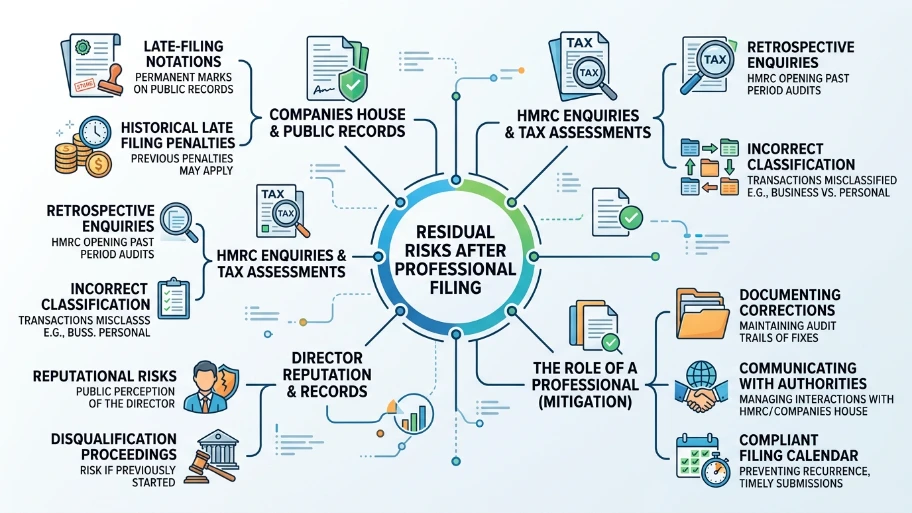
What risks remain after professional filing?
Residual risks include historical tax assessments, director record implications, and late filing penalties.
Even after professional corrections, Companies House may keep late-filing notations on public records. HMRC can open retrospective enquiries if transactions were incorrectly classified. Directors face reputational risks if disqualification proceedings have previously started.
A professional reduces these risks by documenting corrections, communicating with authorities, and maintaining a compliant filing calendar to prevent recurrence.
How does filing dormant accounts protect directors?
Timely and accurate filings maintain compliance records and reduce enforcement exposure.
Companies House and HMRC use filing history to evaluate director conduct. Clean, on-time accounts remove grounds for administrative penalties and support directors in future company matters, such as credit applications. Professionals prepare filings that conform to statutory formats and retain supporting records for six years.
Filing dormant accounts also helps during company sales or reinstatements, because potential buyers review historic compliance.
Explore our File Accounts for Dormant Companies guides,
Buy Our Dormant Filing Bundle to Successfully Manage All Your Annual Requirements
Sign Up Now for Expert Dormant Account Assistance and Professional Record Management
What practical steps should a business take now?
Engage a professional to review records, prepare dormant accounts, and submit filings promptly.
Start with these actions: gather bank statements for each missing year, collect board minutes on trading decisions, and confirm the company’s accounting reference date. Ask the accountant to prepare a remediation plan listing tasks, timelines, and fees.
Set automated reminders for annual filing dates and maintain an online copy of each submitted document. Filing dormant company accounts avoids automatic Companies House penalties and reduces HMRC enquiries. Professional filing provides accurate dormant accounts, timely electronic submissions, and documented evidence that defends against enforcement. From My Company delivers practical compliance: we prepare dormant company accounts, submit them to Companies House, and liaise with HMRC to confirm dormant status, reducing the risk of fines and enforcement.
Frequently Asked Questions
What happens if I don’t file accounts for my dormant company?
Failing to file accounts for a dormant company triggers automatic penalties from Companies House and may prompt HMRC enquiries. From My Company helps you file accounts for dormant companies on time to avoid fines and maintain compliance.
How do I know if my company is legally dormant?
A company is legally dormant when it has no significant accounting transactions beyond permitted items like filing fees. Professionals verify bank statements and ledgers before you file accounts for dormant companies to confirm the correct status.
Can I file dormant company accounts online myself?
Yes, Companies House accepts electronic submissions, but errors can cause delays or penalties. From My Company files accounts for dormant companies electronically using secure, authenticated channels to ensure accuracy and fast processing.
How much does it cost to file accounts for a dormant company?
Typical UK fees range from £60 to £300 for simple dormant filings, depending on complexity and whether prior years are overdue. From My Company provides fixed-fee quotes when you use our file accounts for dormant companies service.
What documents are needed to prove a company is dormant?
You need a balance sheet showing nil turnover, a director’s statement confirming dormancy, and bank reconciliations. From My Company prepares these documents and files accounts for dormant companies that meet Companies House and HMRC requirements.