
Accurate record keeping is crucial for dormant companies because it ensures legal compliance, prevents fines, preserves dormant status, and makes future filings and company changes straightforward. Accurate records limit enforcement action and support the timely submission of dormant company accounts and confirmation statements.
What is a dormant company, and why does record-keeping matter?
A dormant company has no significant accounting transactions during a financial year; accurate records confirm this status and satisfy Companies House and HMRC.
Dormant status depends on clean, verifiable accounts. Companies House and HMRC require documentation that shows no transactions occurred, except for permitted items such as filing fees and share allotments. Accurate ledgers, bank reconciliations showing no business transactions, and dated minutes of directors’ decisions provide evidence for dormancy.
Maintaining records prevents misclassification. If accounts or confirmation statements are missing, regulators may assume activity occurred and demand full accounts. That creates extra administrative work, penalties, and possible HMRC investigations. Clear records also speed up future reactivation, directorship changes, or company sales.
How does poor record-keeping lead to penalties and enforcement?
Late or missing accounts create automatic fines, and incomplete records increase the chance of HMRC compliance checks and Companies House investigations.
Companies House issues penalties for late filing that increase with the length of the delay. HMRC may open enquiries when tax returns and records do not reconcile. Failure to show dormant evidence can force the preparation of full statutory accounts and Corporation Tax returns. Penalties range from fixed fines to escalating weekly fees, and persistent non-compliance can lead to company strike-off procedures or director disqualification enquiries.
Precise examples: Companies House issues an initial penalty of £150 for private company accounts filed up to one month late; the fine rises in bands after that. These outcomes directly affect creditworthiness and the company’s legal standing.
What specific records should a dormant company keep?
Retain bank statements, board minutes, share transaction records, invoices (if any), and a basic cashbook that shows permitted transactions.
Bank statements demonstrate the absence of trading transactions. Board minutes document decisions that affect dormancy, such as appointing agents or maintaining premises. Share ledgers and allotment paperwork record ownership changes. A minimal cashbook logs permitted items like Companies House fees. Keep these records for at least six years, aligning with UK statutory retention rules for corporate documentation and tax records.
Store digital backups with clear filenames and dates. Use simple accounting software or secure spreadsheets that show transaction descriptions. Label entries as “permitted” or “none” to make audits straightforward.
How often should dormant company records be reviewed and reconciled?
Review records at least quarterly and reconcile bank statements annually before filing dormant accounts.
Quarterly checks reduce the risk that an unrecorded transaction breaks dormancy. Annual reconciliation confirms that bank balances and records match before preparing dormant company accounts and confirmation statements. Schedule a pre-filing review six weeks before Companies House deadlines to resolve discrepancies and gather supporting documents.
Assign a named person (director or outsourced agent) to sign off on reconciliations. This creates an audit trail and demonstrates governance if regulators query the dormancy status.
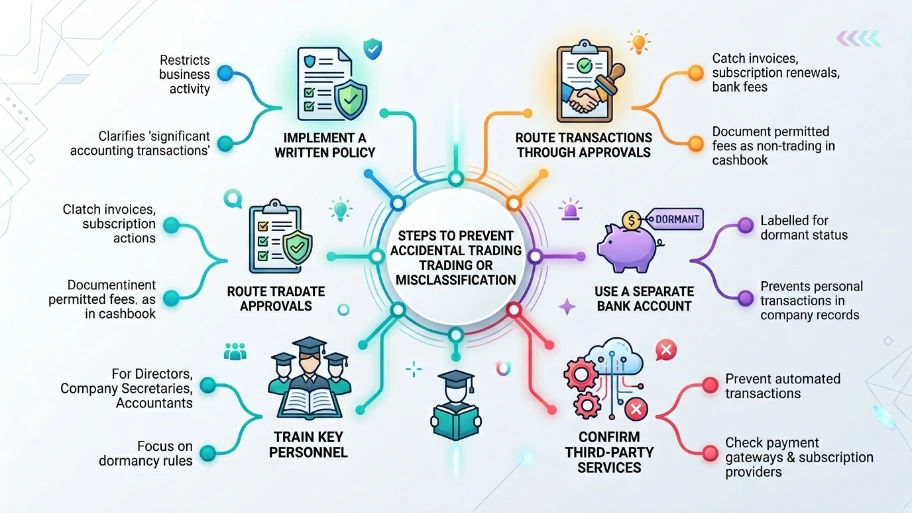
What steps prevent accidental trading or misclassification?
Implement a written policy that restricts business activity, route all potential transactions through an approvals process, and use a separate bank account labelled for dormant status.
A policy clarifies what counts as “significant accounting transactions.” Use approvals to catch invoices, subscription renewals, or bank fees that could be misposted. A dedicated account prevents personal transactions from appearing in company records. If a permitted fee or charge is expected, document it and mark it as non-trading in the cashbook.
Train anyone with access—directors, company secretaries, accountants on the dormancy rules. Regularly confirm that third-party services, such as payment gateways or subscription providers, are not creating automated transactions.
How do dormant accounts get filed correctly?
Prepare statutory dormant accounts that show nil trading, attach required statements, and file on time with Companies House and HMRC where applicable.
Dormant accounts for private companies usually include a balance sheet and notes stating the company was dormant for the financial year. Directors must sign the accounts. Companies House guidance lists permitted inclusions and the format required. If HMRC previously issued a notice to file a tax return, file a “return showing nil liability” or follow the agent pathway to inform HMRC of continued dormancy.
Outsourced agents can prepare and submit dormant accounts and confirmation statements. This reduces filing errors and ensures timely compliance.
Explore our File Accounts for Dormant Companies guides,
The Impact of Unfiled Dormant Accounts on Your Personal Director Credit Rating
How to Properly Close a Dormant Company if You No Longer Need
How can companies resolve past-due dormant filings quickly?
Engage a professional agent to assess historical records, reconstruct missing documentation, and submit overdue dormant accounts and confirmation statements to halt fines.
A professional starts by reconciling bank statements and cashbooks for the missing years. They prepare statutory dormant accounts and compute penalties due. The agent communicates with Companies House and HMRC to submit filings and, where appropriate, request penalty reductions or time-to-pay arrangements. This process reduces director workload and avoids escalation.
For an in-depth guide on resolving overdue dormant filings, see How to Quickly Resolve Past Due Dormant Account Filings with Professional Help. And Get Professional Help with Your Dormant Company Accounts and Avoid HMRC Fines. That article outlines timelines and document checklists for remediation.
When should a company seek professional help?
Seek professional help when records are incomplete, multiple filing years are overdue, or disputes with HMRC or Companies House exist.
Professionals validate director decisions, reconstruct cashbooks, and prepare formal accounts that satisfy regulatory tests for dormancy. They also provide representation during compliance checks. Using a regulated agent reduces the risk of persistent misfiling and increases the chance of penalty mitigation. From My Company provides support for dormant account reconstruction and filing. Using an experienced service cuts turnaround time and helps avoid further fines.
Accurate record keeping protects dormant companies from fines, investigations, and administrative burdens. A clear audit trail, quarterly reviews, and correct dormant accounts filings maintain legal status and simplify future corporate actions. Professional help accelerates the resolution of overdue filings and ensures ongoing compliance.
From My Company provides File Accounts for Dormant Companies to prepare and file statutory dormant accounts, restore compliance, and minimise enforcement risk. Use a trusted agent to document dormancy, file on time, and preserve your company’s standing.
Frequently Asked Questions
What does it mean to file accounts for dormant companies?
Filing accounts for dormant companies means submitting statutory dormant accounts to Companies House that show no significant trading transactions during the financial year. From My Company prepares and files these accounts to confirm dormancy and maintain compliance.
Who needs to file accounts for dormant companies in the UK?
Every UK limited company that is dormant must file dormant accounts with Companies House unless it is exempt (e.g., some charities). From My Company helps directors identify eligibility and file accounts for dormant companies on time.
How much does it cost to file accounts for dormant companies?
The cost includes any Companies House filing fee (often £0 for online dormant accounts) plus optional professional fees if you use an agent. From My Company offers transparent pricing for its file accounts for dormant companies service to avoid hidden charges.
What happens if I don’t file accounts for my dormant company?
Late or missing dormant accounts trigger automatic fines from Companies House and can lead to investigation, strike-off, or director liability. Using From My Company to file accounts for dormant companies ensures timely submission and prevents penalties.
Can I file dormant accounts myself or should I use a professional?
You can file dormant accounts yourself if you understand the required formats and permitted transactions, but many directors use a specialist to avoid errors. From My Company provides a file accounts for dormant companies service that validates records and submits compliant filings.