
Unfiled dormant accounts can damage a director’s personal credit rating by triggering late filing penalties, compliance flags, and potential enforcement actions from Companies House. These signals may be shared with credit reference agencies, reducing trustworthiness and affecting personal borrowing, mortgages, and financial credibility.
Why do dormant company filing obligations affect a director’s personal credit profile?
Dormant company filing obligations affect a director’s personal credit profile because UK compliance systems link directors to company conduct, and missed filings create verifiable negative markers. Credit agencies and lenders interpret these markers as indicators of financial mismanagement or regulatory neglect.
UK directors operate within a transparent compliance ecosystem. Companies House records store filing histories, including late or missing dormant accounts. Credit reference agencies extract this data and integrate it into director-linked risk profiles. This connection exists because directors hold legal responsibility for statutory filings.
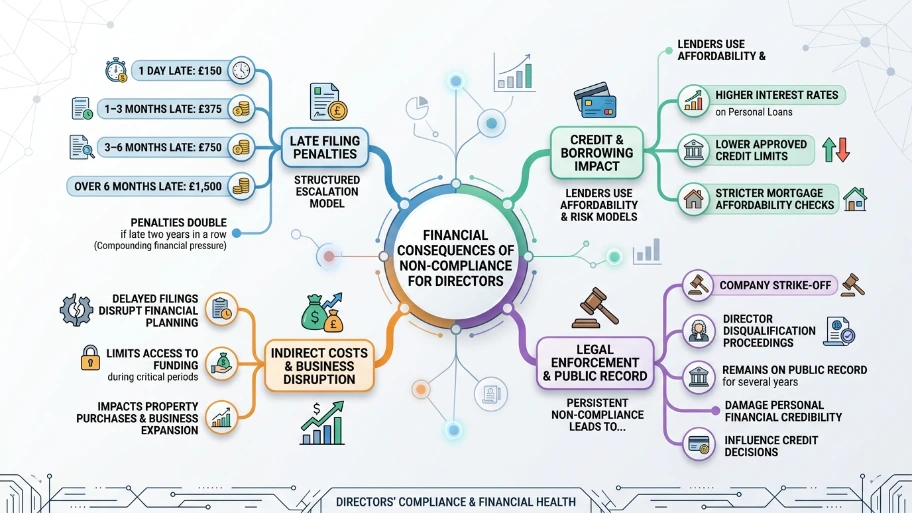
When a dormant company fails to submit accounts on time, Companies House applies automatic penalties. These penalties escalate based on delay duration. For example, filing one day late triggers a £150 penalty, while delays exceeding six months can reach £1,500. These penalties are publicly recorded.
Lenders assess director behaviour using structured risk indicators. Three common indicators include filing consistency, penalty frequency, and company status changes. A director associated with repeated non-compliance appears higher risk, even if the company remains dormant.
Personal credit scoring models increasingly include behavioural data. Missed filings suggest administrative neglect. This perception influences lending decisions, particularly for mortgages, business loans, and credit facilities.
How do late or unfiled dormant accounts get reported and tracked?
Late or unfiled dormant accounts are tracked through Companies House systems, which record submission timelines, apply penalties, and publish compliance status. This data is accessible to financial institutions and credit agencies, creating a permanent, verifiable record of director behaviour.
Companies House operates a digital filing and monitoring framework. Each company receives a statutory deadline based on its incorporation or previous filing date. When a director misses this deadline, the system automatically flags the account as overdue.
This status becomes publicly visible. Third-party platforms, including credit agencies, aggregate this data. They use structured APIs and data feeds to retrieve compliance records. These records include:
- Filing status: on time, late, or overdue
- Penalty history: number and value of fines
- Company status: active, dormant, or struck off
Financial institutions rely on this data during risk assessments. A director linked to overdue filings presents a measurable compliance risk. This risk affects lending thresholds and approval rates. Tracking does not stop at initial penalties. Continued non-compliance can trigger strike-off proceedings. Companies House issues formal notices, which are also recorded. These notices further amplify negative signals in credit profiles.
What financial consequences can directors face from non-compliance?
Directors face financial consequences such as escalating penalties, increased borrowing costs, reduced credit limits, and higher rejection rates for loans. Persistent non-compliance may also lead to legal enforcement actions, which further damage personal financial credibility and long-term access to credit.
Late filing penalties follow a structured escalation model. The longer the delay, the higher the fine. For example:
- 1 day late: £150
- 1–3 months late: £375
- 3–6 months late: £750
- Over 6 months late: £1,500
These penalties double if accounts are late two years in a row. This creates compounding financial pressure.
Credit impact extends beyond penalties. Lenders evaluate directors using affordability and risk models. A director with compliance issues may face:
- Higher interest rates on personal loans
- Lower approved credit limits
- Stricter mortgage affordability checks
When enforcement actions occur, such as company strike-off or director disqualification proceedings, the impact intensifies. These actions remain on public record and influence credit decisions for several years. Directors also face indirect costs. Delayed filings disrupt financial planning. They limit access to funding during critical periods, such as property purchases or business expansion.
Can a dormant company still harm your credit if it has no financial activity?
A dormant company can still harm your credit because compliance obligations remain active regardless of financial activity. Failure to file required accounts signals regulatory neglect, which credit systems interpret as a risk factor linked directly to the director’s reliability.
Dormant status does not remove statutory duties. Companies House requires annual confirmation statements and dormant accounts filings. These filings confirm that the company has had no significant transactions. Directors often assume inactivity reduces risk. This assumption is incorrect. Compliance frameworks treat dormant and active companies equally in terms of filing obligations. The absence of financial activity does not reduce regulatory expectations.
Credit systems focus on behaviour, not revenue. A dormant company that fails to file accounts generates the same compliance flags as an active company. These flags contribute to a director’s overall risk profile.
Three key compliance requirements remain mandatory:
- Submit dormant accounts annually
- File confirmation statements with accurate details
- Maintain up-to-date registered office and director information
Failure in any of these areas creates traceable records. These records influence credit scoring algorithms and lender decisions.
How can directors prevent negative credit impact from dormant accounts?
Directors prevent negative credit impact by filing dormant accounts on time, maintaining accurate company records, and using structured compliance services. Consistent adherence to deadlines ensures clean public records, which support strong personal credit profiles and financial credibility.
Prevention depends on systematic compliance. Directors must track deadlines and submit filings within statutory timeframes. Digital reminders and compliance calendars improve accuracy. Professional services provide structured support. Using a dedicated solution such as File Accounts for Dormant Companies ensures timely submission and correct formatting of accounts. These services align filings with Companies House standards and reduce error rates. For a detailed overview of how specialist services improve compliance accuracy, review this guide on understanding dormant company filing assistance benefits.
Directors also benefit from proactive monitoring. Regularly reviewing Companies House records helps identify discrepancies early. This reduces the risk of penalties and negative reporting.
Consistency is critical. A single missed filing can create a negative marker. Repeated compliance builds a stable, trustworthy credit profile over time.
What role do professional filing services play in protecting director credit?
Professional filing services protect director credit by ensuring accurate, timely submissions and maintaining compliance records that reflect reliability. These services reduce human error, prevent penalties, and create consistent filing histories that support positive credit evaluations.
Filing services operate using structured compliance workflows. These workflows include document preparation, validation checks, and submission tracking. Each step ensures alignment with Companies House requirements. Accuracy improves significantly when professionals handle filings. Common errors include incorrect balance sheet formatting, missing declarations, and submission delays. Filing services eliminate these risks through standardised processes.
A service such as File Accounts for Dormant Companies provides outcome-driven compliance. It ensures that dormant accounts are submitted correctly and on time, reducing exposure to penalties and credit damage. Professional services also maintain audit trails. These records demonstrate consistent compliance behaviour. Credit agencies and lenders interpret this consistency as a positive indicator. For directors managing multiple companies, services provide centralised oversight. This reduces administrative burden and ensures uniform compliance across all entities.
When does non-compliance escalate into serious credit damage?
Non-compliance escalates into serious credit damage when repeated missed filings, accumulated penalties, and enforcement actions create a pattern of regulatory failure. This pattern significantly lowers creditworthiness and may trigger long-term financial restrictions for the director.
Escalation follows a predictable path. Initial delays result in penalties. Continued delays trigger enforcement notices. Persistent non-compliance leads to strike-off proceedings. Each stage increases visibility. Credit agencies assign higher risk scores as negative events accumulate. Lenders interpret this pattern as systemic mismanagement.
Serious damage occurs when three conditions align:
- Multiple consecutive late filings
- High cumulative penalties exceeding £1,000
- Formal Companies House enforcement notices
At this stage, directors face measurable financial consequences. Loan approvals decline. Interest rates increase. Mortgage applications face stricter scrutiny. Recovery becomes more difficult over time. Removing negative markers requires consistent compliance over several years.
Explore our File Accounts for Dormant Companies guides,
How to Properly Close a Dormant Company if You No Longer Need
Why Your Dormant Company Needs a Registered Office Address for Official Mail
How does maintaining compliance improve long-term financial credibility?
Maintaining compliance improves long-term financial credibility by creating a consistent record of responsible behaviour, which lenders and credit agencies use to assess trustworthiness. This stability increases approval rates, lowers borrowing costs, and supports stronger financial positioning.
Credit systems prioritise consistency. Directors who file accounts on time demonstrate reliability. This behaviour reduces perceived risk. Financial institutions evaluate historical data. A clean compliance record over three to five years significantly improves credit outcomes. It supports:
- Faster loan approvals
- Lower interest rates
- Higher credit limits
Compliance also supports business credibility. Partners, investors, and suppliers review Companies House records before engagement. A clean record enhances trust and reduces friction in transactions. Directors who maintain compliance gain strategic advantages. They access funding more easily and negotiate better financial terms.
For directors ready to streamline compliance and avoid future risks, consider a structured solution such as Buy Our Dormant Filing Bundle to Successfully Manage All Your Annual Requirements.
Unfiled dormant accounts create measurable risks for directors by generating penalties, compliance flags, and negative credit signals. These records influence how lenders and financial institutions assess personal credibility. From My Company provides structured support through its File Accounts for Dormant Companies service, ensuring accurate submissions and consistent compliance. This approach protects director credit profiles and supports long-term financial stability.
Frequently Asked Questions
What does it mean to file accounts for a dormant company in the UK?
Filing accounts for a dormant company means submitting simplified financial statements to Companies House to confirm the company had no significant accounting transactions during the period. From My Company provides professional file accounts for dormant companies services to ensure your dormant entity remains compliant with UK corporate law.
Do dormant companies still need to file accounts with Companies House?
Yes, even dormant companies must file dormant accounts with Companies House annually to maintain good standing and avoid penalties. From My Company specializes in file accounts for dormant companies, handling the paperwork quickly so you stay compliant without unnecessary hassle.
What information is required to file accounts for a dormant company?
To file accounts for a dormant company, you need the company registration number, dormant accounting period dates, and confirmation that no significant transactions occurred. From My Company streamlines the file accounts for dormant companies process by gathering these details and submitting accurate dormant accounts on your behalf.
How much does it cost to file accounts for a dormant company in the UK?
The Companies House filing fee for dormant accounts is £13 online, but you may also need professional assistance to prepare and submit correctly. From My Company offers affordable file accounts for dormant companies, services that include preparation and submission, often at a lower total cost than handling errors yourself.
What happens if I don’t file accounts for my dormant company?
Failure to file accounts for a dormant company can result in late-filing penalties, legal action, and potential dissolution of your company by Companies House. From My Company prevents these risks by providing reliable file accounts for dormant companies’ services to ensure timely, accurate submission every year.