
Yes. A dormant company must have a registered office address to receive official mail, serve statutory notices, and maintain Companies House and HMRC compliance.
Why does a dormant company need a registered office address?
A registered office is the legal service address for official communications, statutory filings, and inspections; Companies House and HMRC require it for correspondence and public records.
A registered office provides a single, verifiable location where the company accepts legal documents. Companies House publishes this address on the public register. HMRC uses it to issue tax notices and correspondence. Courts and creditors use it for service of process. Without a registered office, the company cannot legally receive or authenticate official mail.
What counts as an acceptable registered office address for a dormant company?
An acceptable address is a physical UK postal address where post can be delivered and inspected, not a PO Box, and it must match Companies House requirements.
The address must be in the same UK jurisdiction as the company’s incorporation (England/Wales, Scotland, or Northern Ireland). The Companies Act requires a location where statutory records are accessible for inspection at prescribed times. A PO Box fails the accessibility test. Many directors use their business premises, a commercial registered office provider, or an accountant’s address. The address must accept official mail reliably.
Read our articles, How to Handle Dormant Accounts for Companies That Have Previously Traded Profitably and Purchase Our Professional Dormant Filing Solutions for Guaranteed Legal and Statutory Compliance.
How does a registered office affect statutory filings and inspections?
Companies House and HMRC send statutory notices and filing reminders to the registered office; the address is the default delivery point for all official mail and inspection requests.
Annual confirmation statements, accounts reminders, and penalty notices are routed to the registered office. Inspectors can request access to statutory registers at that address. For dormant companies that file dormant accounts, Companies House still issues filing deadlines and may post strike-off notifications or reactivation notices to that address. Maintaining a monitored address prevents missed deadlines and penalties.
How does an address protect the director’s privacy and the company’s reputation?
Using a commercial registered office separates directors’ residential addresses from the public register, protecting privacy and presenting a professional address to third parties.
Listing a residential address exposes directors to unsolicited mail and public searches. A commercial provider or an accountant’s address reduces the disclosure of personal data. A professional address strengthens credibility with suppliers, banks, and potential buyers by showing an established service address rather than a private home.
What are the compliance risks of having no registered office or an incorrect address?
Failure to maintain a valid registered office can trigger missed statutory mail, fines, administrative penalties, and potential strike-off actions from Companies House.
Companies House can send strike-off proposals and legal notices to the registered office; undelivered mail creates default actions. HMRC may send penalties or compliance demands that fail to reach the company, resulting in late-filing penalties. Incorrect addresses that do not meet statutory accessibility can lead to investigations and enforcement. Dormant companies retain these obligations despite limited activity.
How do dormant companies receive and handle official mail effectively?
Use a monitored registered office that accepts and forwards official mail promptly, scan documents on receipt, and log items against statutory deadlines.
Choose a provider that offers same-day scanning and secure storage of statutory documents. Implement a mail-log process: record date received, sender, and required action. Assign a responsible officer—company secretary or external agent—to confirm deadlines and trigger filings. For archived dormant accounts, retain mail records for at least six years to match Companies House retention expectations.
What are the costs and service options for registered office addresses?
Costs range from low-cost postal-only services to full compliance packages offering scanning, forwarding, and document storage; choose a service that meets statutory accessibility and inspection requirements.
Standard options include: free use of an accountant’s address, registered office only with scanned mail, and full-service providers offering physical receipt, same-day scans, and statutory record storage. Prices vary: basic scanning services often start from under £50 per year; full-service packages commonly range £100 to £300 per year, depending on features and jurisdiction.
How does a registered office interact with filing dormant accounts?
The registered office is the primary address for filing reminders, statutory notices, and confirmations tied to dormant accounts; accurate address records ensure the timely filing of dormant accounts and confirmations.
When filing dormant accounts, Companies House cross-references the registered office against company records. Filing deadlines and confirmations are sent to the registered office. If the company files dormant accounts using professional services, ensure the service provider updates Companies House promptly to reflect any change in registered office to avoid misdirected correspondence.
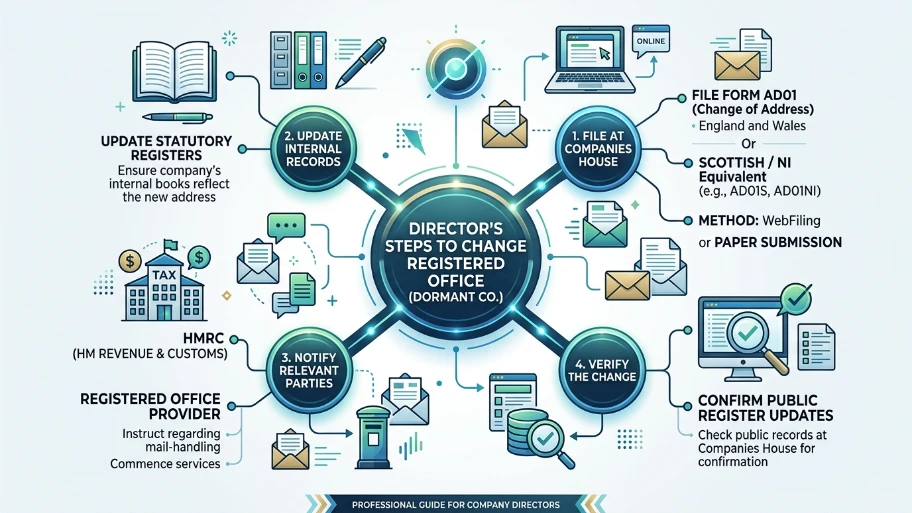
What steps should a director take to set or change a registered office for a dormant company?
File the appropriate form at Companies House, update internal statutory records, and notify service providers and HMRC; ensure the new address is accessible and meets legal requirements.
Directors must file form AD01 (change of registered office address) for England and Wales, or the equivalent for Scotland/ Northern Ireland, via Companies House WebFiling or paper submission. Update the company’s statutory registers to show the change. Notify HMRC and notify your registered office provider to commence mail-handling. Confirm public register updates to verify the change.
Explore our File Accounts for Dormant Companies guides,
Understanding the Role of HMRC and Companies House for Inactive Business Entities
How to Keep Your Dormant Company Ready for Potential Future Business Trading
How does From My Company’s File Accounts for Dormant Companies service support registered office needs?
File Accounts for Dormant Companies provides integrated compliance: registered office management, timely dormant accounts filing, and secure handling of official mail to maintain statutory compliance.
The service registers or updates the company’s registered office at Companies House, receives official correspondence, and scans documents for director review. It schedules and files dormant accounts before deadlines and preserves records for compliance verification. This reduces the risk of missed notices and penalties.
A registered office remains the legal focal point for all official mail and statutory actions for dormant companies. It enables the delivery of legal notices, maintains public records, and supports the timely filing of dormant accounts. Directors who use a compliant registered office reduce the risk of penalties, strike-off, and privacy exposure. From My Company provides integrated registered office and dormant filing services that ensure legal and statutory compliance while handling official mail professionally.
Frequently Asked Questions
What is File Accounts for Dormant Companies and who needs it?
File Accounts for Dormant Companies is a service that prepares and submits statutory dormant accounts to Companies House for companies with no significant accounting transactions. From My Company offers this service to ensure dormant companies meet UK filing requirements and avoid penalties.
Do dormant companies still need to file accounts with Companies House?
Yes, every dormant company must file dormant accounts annually unless it’s exempt or dissolved. From My Company’s File Accounts for Dormant Companies service handles this filing to keep the company compliant and avoid strike-off actions.
How much does it cost to file dormant accounts for a UK company?
Filing dormant accounts online is free at Companies House, but professional preparation and submission services charge a fee. From My Company’s File Accounts for Dormant Companies service provides a fixed-price package that includes preparation, review, and electronic filing.
What happens if a dormant company doesn’t file its accounts on time?
Late filing triggers automatic penalties, credit score damage, and potential director disqualification or strike-off. From My Company’s File Accounts for Dormant Companies service ensures timely submission to prevent penalties and maintain statutory compliance.
Can I file dormant accounts myself or should I use a professional service?
You can file dormant accounts yourself using Companies House WebFiling, but errors can cause delays or penalties. From My Company’s File Accounts for Dormant Companies service reduces risk by preparing accurate returns and filing them correctly on your first attempt.