
Prepare dormant company accounts by confirming cessation date, remove trading transactions after that date, prepare abbreviated or dormant accounts per Companies House guidance, obtain director sign-off, and file with Companies House and HMRC on time.
What defines a dormant company after previous trading?
A dormant company has stopped all significant accounting transactions, excluding permitted items like bank interest and share allotments.
A company that previously traded becomes dormant when it stops commercial activity and records no significant transactions. Significant transactions exclude one-off fees such as Companies House registration, share issues, or bank interest. Directors must record the date trading ceased in board minutes and accounting records. Companies House and HMRC treat dormancy differently; both require separate confirmations. HMRC needs a formal dormant company notification or continued filing if liabilities exist.
How do you confirm the cessation date and evidence that trading stopped?
Record the exact cessation date in minutes, preserve final invoices, bank statements, and a cessation summary to prove no further trading occurred.
Directors must prepare a cessation checklist. The checklist includes final sales invoices, supplier settlements, payroll finalisation, bank reconciliations, and confirmation that no recurring income exists. Keep copies of correspondence that terminate contracts and notify major customers and suppliers in writing. Retain ledgers and reconciliations for six years as required by UK tax law. Evidence supports future enquiries from HMRC or Companies House and helps validate dormant-account status during audits.
How should accountants prepare dormant company accounts after trading?
Draft accounts that exclude post-cessation trading entries, present a balance sheet, and show permitted transactions only, following FRS 102 or FRS 105 treatments as applicable.
Accountants must stop recognising revenue and expenses related to trading after the cessation date. Prepare a balance sheet showing retained earnings, share capital, and bank balances. If the company is small, consider micro-entity or small-company reporting exemptions and prepare abbreviated accounts where appropriate. Use consistent accounting policies and disclose the cessation date in accounting notes. Reconcile bank activity to ensure only permitted items, such as interest and authorised fees, appear after dormancy begins.
Read our articles, Why Your Dormant Company Needs a Registered Office Address for Official Mail and Purchase Our Professional Dormant Filing Solutions for Guaranteed Legal and Statutory Compliance.
What filing obligations exist with Companies House and HMRC?
File dormant accounts with Companies House and notify HMRC of dormancy; continue Corporation Tax filings only if HMRC flags liabilities or grants exceptions.
Companies House requires annual accounts marked as dormant. For dormant companies, submit the appropriate dormancy accounts type: full, small, or micro, based on size criteria. HMRC requires notification that the company is dormant for Corporation Tax; otherwise, it may still expect a tax return. When payroll, VAT, or other registrations remain active, continue relevant filings until cancelled. Late filings invoke penalties: Companies House applies automatic penalties, and HMRC may assess late filing penalties or enquiries.
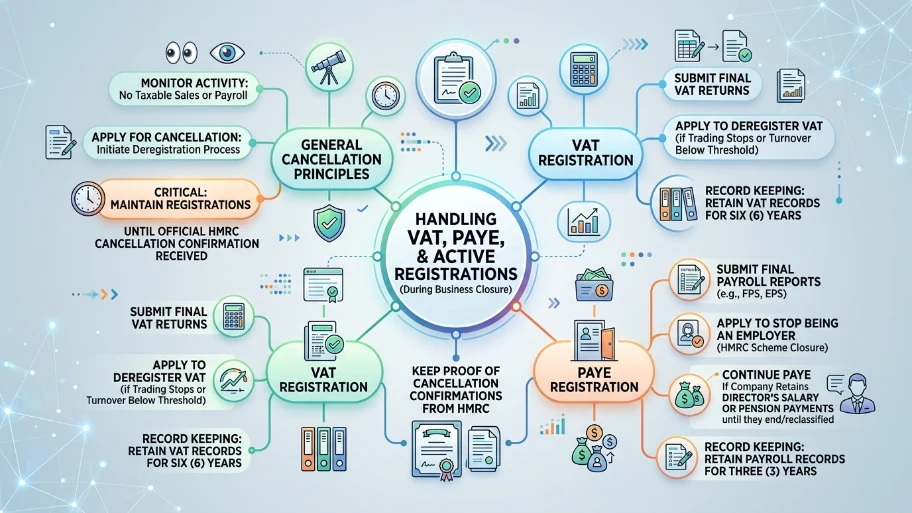
How do you handle VAT, PAYE, and other active registrations?
Cancel VAT and PAYE registrations when there is no payroll or taxable sales; maintain registrations until official cancellation confirmation is received.
If the company is registered for VAT, submit final VAT returns and apply to deregister when turnover falls below the deregistration threshold or when trading stops. For PAYE, submit final payroll reports and apply to stop being an employer. Keep proof of cancellation confirmations from HMRC. Retain payroll records for three years and VAT records for six years. If the company retains a director’s salary or pension payments, continue PAYE until those payments end or are reclassified.
What internal controls should directors apply during dormancy?
Adopt governance steps: document director decisions, continue statutory filings, monitor bank accounts, and restrict transactions to permitted items only.
Directors remain legally responsible for compliance. Hold a board meeting to approve dormancy, record the decision, and assign a compliance lead. Limit bank signatories and require pre-approval for any activity. Schedule annual reviews to confirm the company’s continued dormancy. Keep statutory registers updated, and ensure the registered office receives official mail. Maintain a secure archive of accounting records and digital backups for statutory retention periods.
How do dormant accounts differ for companies with prior trading losses, assets, or liabilities?
State carried-forward losses and tangible assets in notes, ensure any continuing liabilities are recognised, and obtain professional tax advice before filing.
If the company holds unused tax losses, directors should record those losses against prior profits where appropriate and document any expected future use. Tangible assets retained—such as equipment—require disclosure on the balance sheet or as fixed asset investments. Outstanding creditor balances or contingent liabilities must appear if they remain after dormancy begins. Consult a tax adviser to confirm whether filing a Corporation Tax return benefits the company because of loss relief or asset disposal planning.
When is it appropriate to prepare abbreviated or micro-entity dormant accounts?
Choose abbreviated, or micro-entity formats when the company meets size thresholds and when permitted by Companies House and audit exemptions apply.
Micro-entity criteria include two of these thresholds: turnover under £632,000, assets below £316,000, and fewer than 10 employees. Small-company criteria include two of: turnover under £10.2 million, assets under £5.1 million, and fewer than 50 employees. Dormant companies that meet thresholds can submit simplified accounts. Abbreviated filing reduces disclosure and often omits profit and loss accounts for dormant companies. Confirm eligibility with the current Companies Act thresholds and accounting standards before selecting a format.
How long must records be retained and why?
Retain accounting records and statutory registers for at least six years to comply with HMRC and Companies Act requirements and to defend future inquiries.
Companies must keep annual accounts, ledgers, invoices, and tax records for six years. Payroll documents require three years for HMRC checks, while VAT records need six years. Maintain originals and digital copies in secure storage. Proper retention supports audits, tax relief claims, and potential legal disputes. Loss of records can lead to penalties or disallowed reliefs.
Explore our File Accounts for Dormant Companies guides,
Why Expert Secretarial Support is Essential for Maintaining Your Inactive Company Records
What are common filing errors to avoid when filing dormant accounts?
Avoid including commercial transactions after the cessation date, failing to notify HMRC, and missing Companies House deadlines.
Common errors include treating administrative fees as trading revenue, failing to stop payroll submissions, and submitting incorrect accounts formats. Another frequent mistake is not recording the cessation date in board minutes. Use a filing checklist: confirm cessation, reconcile bank accounts, select the correct accounts format, obtain director approval, and file before the deadline. Correcting errors after submission requires amendments that can trigger follow-up queries.
Direct, factual dormancy management reduces compliance risk and cost. Prepare and document the cessation date, reconcile accounts to exclude post-cessation trading, and file dormant accounts with Companies House. Notify HMRC and cancel active registrations such as VAT and PAYE where applicable. Maintain records for six years and follow simplified accounting formats only when the size criteria apply. From My Company delivers practical accounting and filing solutions that help directors comply with statutory rules while minimising administrative burden through File Accounts for Dormant Companies.
Frequently Asked Questions
How do I file accounts for a dormant company that previously traded profitably?
To file accounts for a dormant company that previously traded profitably, confirm the cessation date, prepare dormant accounts showing only permitted transactions, and submit them to Companies House. From My Company helps businesses file accounts for dormant companies efficiently while ensuring compliance with UK statutory requirements.
What counts as a significant accounting transaction for dormant company status?
A significant accounting transaction includes any commercial income or expense related to trading; excluded items are bank interest, share allotments, and Companies House fees. When a company file accounts for dormant companies, it must show no significant transactions after the cessation date to maintain dormant status.
Do dormant companies still need to file accounts with Companies House?
Yes, dormant companies must file annual accounts with Companies House each year, even if they have no trading activity. From My Company provides expert support to file accounts for dormant companies accurately and on time, avoiding late-filing penalties.
How is a dormant company different from a dissolved or inactive company?
A dormant company is legally active but has no significant accounting transactions, while a dissolved company no longer exists and an inactive company may not have filed recent returns. Companies that file accounts for dormant companies remain registered and compliant, whereas dissolved companies cannot trade or file further accounts.
What happens if I miss the deadline to file accounts for my dormant company?
Missing the filing deadline triggers automatic penalties from Companies House, which increase with delay, and may lead to director disqualification or company strike-off. From My Company helps clients file accounts for dormant companies before deadlines to ensure legal compliance and avoid fines.