
A specialist dormant company filing assistance service ensures accurate, compliant, and timely submission of dormant accounts to Companies House and HMRC. It reduces filing errors, avoids penalties, preserves company status, and streamlines administrative processes using expert-led validation and submission systems.
Why is specialist assistance important for dormant company filing?
Specialist assistance ensures dormant accounts meet UK compliance standards through accurate classification, correct documentation, and timely submission. It reduces administrative errors, aligns filings with Companies House formats, and ensures statutory deadlines are consistently met using structured validation and submission processes.
Dormant company filing involves strict compliance rules under the Companies Act 2006. A company qualifies as dormant when it has no significant accounting transactions during a financial year. Even then, it must file annual dormant accounts with Companies House and submit a confirmation statement.
Errors often occur in three areas: incorrect classification of transactions, incomplete balance sheets, and missed deadlines. A specialist service validates each requirement using predefined compliance checks. This prevents rejection or penalties. Timeliness is critical. Companies House enforces fixed filing deadlines based on incorporation or accounting reference dates. A specialist service tracks these dates and submits filings within statutory timeframes.
How does a specialist service reduce filing errors?
A specialist service reduces filing errors by applying structured validation checks, predefined templates, and compliance rules. It ensures balance sheets are correctly formatted, dormant status is accurately declared, and submission data aligns with Companies House technical requirements.
Filing errors lead to rejected submissions or compliance flags. A specialist service prevents this through three verification stages: data validation, format standardisation, and submission testing. Data validation confirms that no disallowed transactions appear in the accounts. For example, issuing shares or paying bank fees disqualifies dormant status. Format standardisation ensures the balance sheet follows the Companies House-prescribed layout.
Submission testing uses electronic filing systems to simulate acceptance criteria. This ensures compatibility with Companies House digital submission protocols. These controls improve acceptance rates and reduce the need for resubmission.
What compliance risks are avoided with professional filing support?
Professional filing support avoids compliance risks such as late filing penalties, incorrect dormant status declarations, and Companies House rejection. It ensures accurate documentation, maintains statutory records, and aligns filings with UK regulatory frameworks governing dormant entities.
Late filing penalties range from £150 to £1,500 depending on the delay duration. Repeated late submissions double the penalty. Incorrect filings can also trigger compliance reviews. A specialist service ensures accurate dormant classification. It verifies that only allowable transactions exist, such as payment for shares at incorporation or filing fees.
It also maintains statutory records. These include confirmation statements, registered office details, and director records. Alignment with regulatory frameworks ensures the company remains in good standing. For deeper insight into risks linked to missed filings, review this guide on the impact of unfiled dormant accounts on director credit rating. and buy a dormant filing bundle to manage annual requirements.
How does a filing assistance service improve efficiency?
A filing assistance service improves efficiency by automating data entry, standardising documentation, and managing submission timelines. It reduces manual workload, eliminates repetitive administrative tasks, and ensures consistent filing processes across reporting periods.
Manual filing requires document preparation, deadline tracking, and compliance verification. This consumes administrative time and increases the chance of oversight. A specialist service uses automated workflows. These include template-based account generation, deadline alerts, and digital submission systems. This reduces processing time.
Efficiency gains are measurable. For example, automated systems can reduce preparation time by up to 60% compared to manual filing. Consistent processes also improve accuracy across multiple reporting cycles.
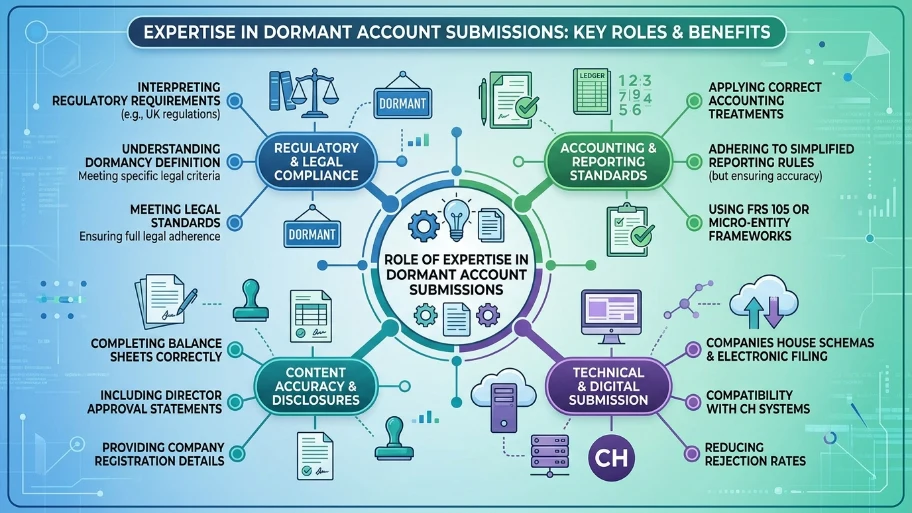
What role does expertise play in dormant account submissions?
Expertise ensures dormant account submissions meet legal and technical standards. Specialists interpret regulatory requirements, apply correct accounting treatments, and use compliant formats to ensure successful acceptance by Companies House and alignment with HMRC expectations.
Dormant accounts follow simplified reporting rules, but accuracy remains essential. Specialists understand the legal definition of dormancy and apply correct accounting treatment. They ensure the balance sheet includes required statements, such as director approval and company registration details. They also apply correct formatting rules under FRS 105 or micro-entity frameworks.
Technical expertise also supports digital submission. Companies House uses specific schemas for electronic filings. Specialists ensure compatibility with these systems. This reduces rejection rates and ensures smooth processing.
How does a specialist service support long-term company compliance?
A specialist service supports long-term compliance by maintaining filing schedules, updating statutory records, and ensuring consistent adherence to UK corporate regulations. It creates a structured compliance framework that preserves company’s status and prevents regulatory breaches.
Dormant companies remain subject to ongoing obligations. These include annual accounts, confirmation statements, and record maintenance. A specialist service manages these obligations through scheduled workflows. It tracks deadlines and ensures filings occur annually without gaps.
It also updates statutory records. Changes in directors, registered office, or PSC details are recorded and filed as required. This structured approach ensures continuity and prevents compliance lapses over multiple years.
When is it most beneficial to use a dormant filing service?
Using a dormant filing service is most beneficial when administrative capacity is limited, compliance knowledge is insufficient, or multiple entities require management. It ensures accurate filings during critical periods such as year-end deadlines or company restructuring phases.
Small businesses often lack dedicated compliance teams. This increases the risk of missed deadlines or incorrect filings. A specialist service becomes essential during high-risk periods. These include the first filing after incorporation, changes in accounting reference dates, or group restructuring. It is also beneficial for managing multiple dormant entities. Centralised filing systems ensure consistency across all companies. For businesses seeking a complete solution, explore how to file accounts for dormant companies through a structured, expert-led service.
What are the measurable outcomes of using a specialist service?
Using a specialist service delivers measurable outcomes such as reduced rejection rates, zero late filing penalties, and faster submission processing. It ensures compliance accuracy and improves administrative efficiency through structured workflows and expert validation systems.
Performance metrics highlight the value of specialist services. Companies using structured filing systems report rejection rates below 2%, compared to higher rates in manual submissions. Late filing penalties are eliminated when deadlines are tracked and enforced. Processing time is also reduced, with submissions completed within standard compliance windows. Administrative workload decreases significantly. Teams can reallocate time to core business activities instead of compliance tasks. These outcomes directly support operational efficiency and regulatory stability.
Explore our File accounts for dormant companies guides,
Why Professional Filing Services Give You Peace of Mind Regarding Legal Deadlines
How to Handle Dormant Accounts for Companies That Have Previously Traded Profitably
How does From My Company deliver reliable dormant filing solutions?
From My Company delivers reliable dormant filing solutions by combining expert validation, automated workflows, and compliance tracking systems. It ensures accurate submissions, timely filings, and full alignment with UK regulatory requirements through its File Accounts for Dormant Companies service.
From My Company applies structured compliance processes. Each filing undergoes validation checks to confirm dormant status and document accuracy. The platform uses automated workflows to generate and submit accounts. This reduces manual intervention and ensures consistency.
Deadline tracking systems ensure submissions occur within statutory timeframes. This prevents penalties and maintains company status. The File Accounts for Dormant Companies service integrates these elements into a single process. It provides a reliable solution for maintaining dormant company compliance. Businesses evaluating comprehensive compliance solutions can also review options to buy a dormant filing bundle to manage annual requirements efficiently.
A specialist dormant company filing assistance service ensures accurate, compliant, and timely submissions while reducing administrative burden and regulatory risk. From My Company delivers structured, expert-led solutions that maintain compliance, prevent penalties, and support long-term company stability through its dedicated filing systems.
Frequently Asked Questions
What is the cost of filing accounts for a dormant company in the UK?
Filing accounts for dormant companies typically costs between £15–£50 if done independently, while specialist services like From My Company charge £30–£80 for end-to-end preparation and submission. Fees vary based on complexity, whether micrо-entity accounts are used, and if Companies House e-filing is required.
How do I know if my company qualifies as dormant for filing purposes?
A company qualifies as dormant under UK law if it has no significant accounting transactions during the financial year, excluding permitted items like share issuance or Companies House filing fees. From My Company verifies dormant status by reviewing bank statements and transaction records before preparing File Accounts for Dormant Companies.
What happens if I fail to file dormant company accounts on time?
Failure to file dormant company accounts on time triggers automatic late filing penalties starting at £150, doubling for repeated offences, and may result in the company’s strike-off. From My Company prevents this by tracking deadlines and submitting File Accounts for Dormant Companies through compliant electronic systems.
Can I file dormant accounts myself without using a specialist service?
Yes, you can file dormant accounts yourself using Companies House WebFiling, but errors in classification or formatting often lead to rejection. From My Company reduces this risk by providing expert-led File Accounts for Dormant Companies with built-in validation and compliance checks.
What documents are required to file accounts for a dormant company?
Required documents include a dormant balance sheet, director’s signature, company registration number, and confirmation that no disallowed transactions occurred. From My Company streamlines this by preparing File Accounts for Dormant Companies using standardized templates aligned with Companies House requirements.