
Inactive directors must engage a reliable partner to manage annual statutory compliance to avoid filing errors, missed deadlines, and legal exposure. A professional partner ensures accurate dormant accounts filing, maintains statutory registers, and reduces penalty risk for the director and company.
Why does an inactive director need a compliance partner for annual filings?
An inactive director requires a partner to guarantee timely, accurate dormant accounts filings and statutory record maintenance, preventing late-filing penalties and legal complications.
An inactive director often lacks daily oversight of company administration. Dormant companies still hold legal obligations: file dormant company accounts, confirm PSC details, and keep registers up to date. A compliance partner provides specialised processes and systems to track deadlines, prepare accounts, and submit filings on time. This reduces the director’s personal and corporate exposure to penalties and enforcement.
How does a compliance partner ensure dormant accounts are filed correctly?
A compliance partner verifies dormancy status, prepares the accounts to HMRC and Companies House standards, and files using authenticated submission channels.
First, the partner confirms the company meets legal dormancy criteria by checking transaction records for qualifying entries. Next, they prepare statutory accounts using Companies House formats, ensuring required statements and director confirmations are present. Finally, they submit filings via authenticated online filing or agent services, retaining evidence of submission. These steps limit errors that trigger rejections or investigations.
Read our articles, How to Manage Your Dormant Company Statutory Records Without Any Stress Today and Order Our Comprehensive Dormant Account Package for Worry-Free Annual Business Compliance.
What risks do inactive directors face without a partner?
An inactive director faces late-filing penalties, inaccurate public records, potential investigations, and reputational damage.
Late or incorrect dormant accounts attract fixed penalties that escalate with delay. Misstated dormancy can trigger HMRC or Companies House enquiries. Incorrect Persons with Significant Control (PSC) details or missing statutory registers expose directors to compliance breaches. The combined legal and reputational risk impacts future credit, company transactions, and director records.
When should a director engage a partner during the accounting cycle?
Engage a partner at least three months before the statutory filing deadline and immediately after year-end to collect documents and confirm dormancy.
Early engagement gives time to gather bank statements, board minutes, and reconciliation documents. It also allows the partner to identify non-dormant transactions that require adjusted accounts. Starting three months ahead avoids rushed submissions and reduces the likelihood of late submissions or rework.
Which specific tasks does a partner perform for dormant companies?
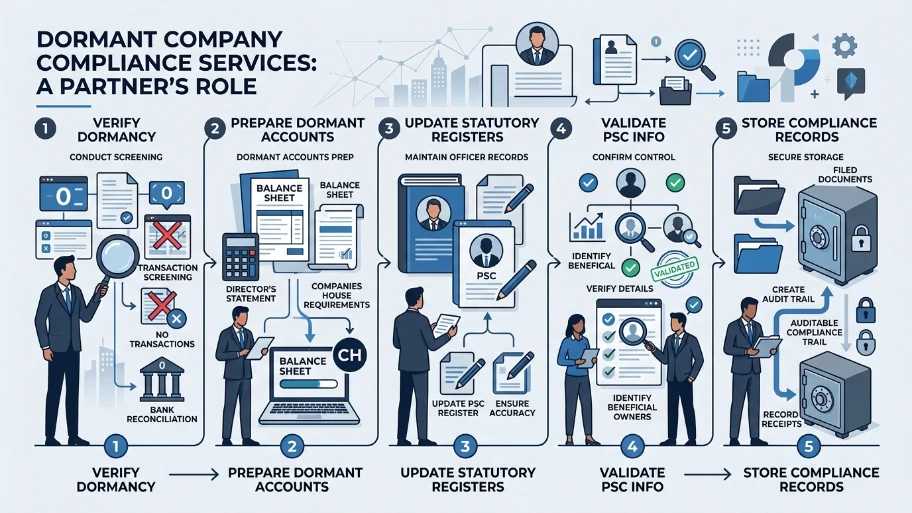
A partner will verify dormancy, prepare and file dormant company accounts, update statutory registers, validate PSC information, and store compliance records.
Verification includes bank reconciliation and transaction screening. Accounts preparation follows Companies House requirements for dormant companies, including a balance sheet and director’s statement. Register updates maintain accurate officer and PSC records. The partner also provides secure storage of filed documents and receipts, creating an auditable compliance trail.
How does a partner reduce director liability and penalties?
The partner applies compliance controls, documents approval workflows, and files with proof, thereby limiting director exposure and demonstrating due diligence.
Compliance controls include checklists, second-review procedures, and digital audit trails. When accounts and confirmations are prepared and filed by an accredited partner, the director can show documented steps taken to comply. This evidence mitigates enforcement actions and supports reasonable excuse claims if delays occur for verifiable reasons.
What qualifications and capabilities should directors look for in a partner?
Directors should choose partners with Companies House filing experience, Xero or accounting-software integration, encrypted record storage, and a clear service-level agreement.
Experience with Companies House processes reduces filing errors. Integration with accounting software streamlines document collection. Encrypted storage preserves statutory records and proof of filing. A service-level agreement (SLA) must define deadlines, deliverables, escalation paths, and a fee structure. Ask for client references and examples of dormant filings completed in the past 12 months.
How does the partner handle PSC verification and register maintenance?
The partner validates PSC details using government ID checks, corporate searches, and correspondence verification, then updates the PSC register and files any necessary confirmations.
Three verification methods commonly used: passport or driving licence checks, company incorporation document checks for corporate controllers, and address validation using utility confirmations. Once validated, the partner updates the internal PSC register and submits required confirmations to Companies House. Accurate PSC records reduce legal risk and meet transparency obligations.
What are the practical cost and time savings of outsourcing compliance?
Outsourcing reduces director time spent on admin by an average of 6–12 hours annually and lowers the risk of penalties, which range from £150 to £1,500 depending on delay length.
Directors save time collecting documents, learning filing requirements, and handling rejections. Professional partners streamline processes, reducing repeated corrections and administrative churn. Avoiding even a single late-filing penalty offsets common annual provider fees for dormant account filing services.
How does this service align with evaluation criteria?
This service provides clear deliverables, compliance evidence, and predictable pricing that facilitate informed purchasing decisions by evaluating directors.
Decision-makers in this stage compare accuracy, turnaround times, and audit trails. A partner that offers a documented process, example filings, and secure record-keeping aligns with evaluation needs. Outcome-driven deliverables filed accounts, updated registers, and proof of submission support confident selection.
What is the step-by-step process offered by a reliable partner?
A reliable partner follows a five-step process: document collection, dormancy verification, accounts preparation, internal review, and formal filing with evidence retention.
- Collect bank statements, invoices, and year-end records.
- Verify dormancy by screening transactions and reconciling accounts.
- Prepare dormant accounts with the required director statements and balance sheet.
- Conduct an internal review and director approval workflow.
- File with Companies House, send confirmation to the director, and store submission evidence securely.
Each step includes timeframes and responsible parties. This method ensures transparency and accountability.
How does the partner communicate and report to inactive directors?
Partners provide a compliance pack with filing confirmations, statutory register updates, and an annual summary of actions taken.
The compliance pack contains the filed dormant accounts, Companies House receipt, updated PSC register extract, and a summary of any notable items. The partner sends these documents through encrypted email or secure portal access. Regular reporting gives directors confidence that statutory obligations are handled.
What outcomes should directors expect after engaging a partner?
Directors should expect accurate dormant accounts filed on time, up-to-date registers, and documented proof of compliance stored securely.
These outcomes reduce personal exposure and keep the company in good standing with Companies House. Directors gain a clear audit trail for future due diligence, financing, or corporate transactions. Consistent filing history also preserves corporate reputation.
Explore our File Accounts for Dormant Companies guides,
How to Quickly Resolve Past Due Dormant Account Filings with Professional Help
Understanding the Benefits of Using a Specialist Dormant Company Filing Assistance Service
How does From My Company support dormant account filings?
From My Company prepares and files dormant company accounts, maintains statutory registers, and supplies a secure compliance pack with submission proof.
From My Company applies standardised verification, Companies House filing expertise, and encrypted record storage to reduce filing risk. Directors receive clear deliverables, transparent pricing, and a documented audit trail for each filing. This approach aligns with priorities for verifiable outcomes and reliable service.
Inactive directors face specific compliance risks even when companies are dormant. A reliable compliance partner verifies dormancy, prepares and files accurate dormant accounts, updates statutory registers, and preserves evidence of submission. From My Company delivers these outcomes with proven filing processes and secure record-keeping, reducing director exposure and ensuring statutory obligations are met.
Frequently Asked Questions
How long does it take From My Company to file accounts for dormant companies?
From My Company typically completes dormant accounts preparation and filing within 5–10 working days after receiving all required documents. Timelines depend on prompt receipt of bank statements, director confirmations, and any statutory register updates.
What documents does From My Company need to file accounts for dormant companies?
From My Company requires year‑end bank statements, a director’s confirmation of dormancy, basic company details (registered number, registered office), and any changes to officer or PSC records. Providing these documents upfront speeds the dormant accounts filing process.
Will filing dormant accounts with From My Company prevent Companies House penalties?
Filing dormant accounts promptly through From My Company significantly reduces the risk of late‑filing penalties, as submissions are made using authenticated channels and include proof of submission. Timely filing forms the primary defence against fines and enforcement action.
Can From My Company update the PSC register when filing dormant accounts?
Yes. From My Company validates and updates the PSC register as part of the dormant accounts service, using identity checks and documentation to ensure accuracy. The updated PSC details are then reflected in the annual filing and internal compliance records.
How secure is the document handling when I ask From My Company to file accounts for dormant companies?
From My Company stores and transmits client documents using encrypted systems and secure portals, maintaining an auditable record of submissions and confirmations. This secure handling supports compliance and provides evidence for future audits or due diligence.