A UK company lets Cambodian founders accept Stripe, PayPal, and global payments by providing UK-registered legal entities, UK bank and payment-account access, and compliance with UK anti-money-laundering rules, enabling payment onboarding and cross-border payout routes.
Why does a UK company help Cambodian founders unlock Stripe, PayPal, and global payments?
A UK company provides the legal and banking footprint payment platforms require, which speeds onboarding and gives access to GBP accounts, UK-based payment processors, and compliant payout rails.
A UK-registered company supplies a verified jurisdiction and corporate identity. Payment providers like Stripe and PayPal use company registration, director data, and bank links to verify merchants. Cambodian founders with a UK entity present registration documents and UK banking details. This reduces manual review and lowers the chance of account restrictions.
A UK company also opens GBP and multicurrency bank accounts. These accounts let platforms settle funds in local currencies and avoid costly FX holds. Payment platforms offer more features and higher limits for businesses with UK banking links than for unverified offshore setups.
Read our articles, How Cambodian Entrepreneurs Use UK Companies for Global Trade and Get a Payment-Ready UK Company from Cambodia with Form My Company.
How does a UK company speed up payment platform onboarding for Cambodian founders?
A UK company meets platform documentation and jurisdiction rules, which shortens verification timelines and reduces manual compliance flags.
Payment platforms require company registration numbers, proof of a business address, director verification, and a bank account in supported countries. UK companies supply Companies House numbers and standardised documents. These documents are machine-readable and accepted globally, which accelerates automated KYC checks.
Platforms apply different risk models by country. A UK company is classified under lower-risk UK rules rather than Cambodian or “high-risk” jurisdictions. This classification decreases additional review steps, such as extended source-of-funds requests, and lets founders reach live processing in days instead of weeks.
What specific documents and checks do Stripe and PayPal require for UK companies?
Both platforms require registration evidence, director ID, proof of business address, and a UK-linked bank account; Stripe also asks for beneficial owner data and business activity verification.
Stripe verifies company registration (Companies House number), director ID (passport or national ID), proof of address (utility bill or bank statement), and details about beneficial owners owning over 25%. Stripe also asks for the business website, product descriptions, and transaction examples to validate the business model.
PayPal requests comparable documents: company registration, director ID, and a linked bank account for payouts. PayPal may require VAT registration or invoices for higher limits. Both platforms perform AML screening against sanction lists and adverse media databases.
Examples of three verification items:
- Verify company registration using the Companies House certificate.
- Authenticate director’s identity with a passport and selfie.
- Validate business address with a recent UK utility bill or company bank statement.
How do UK bank accounts and payment processors improve payouts and FX for Cambodian founders?
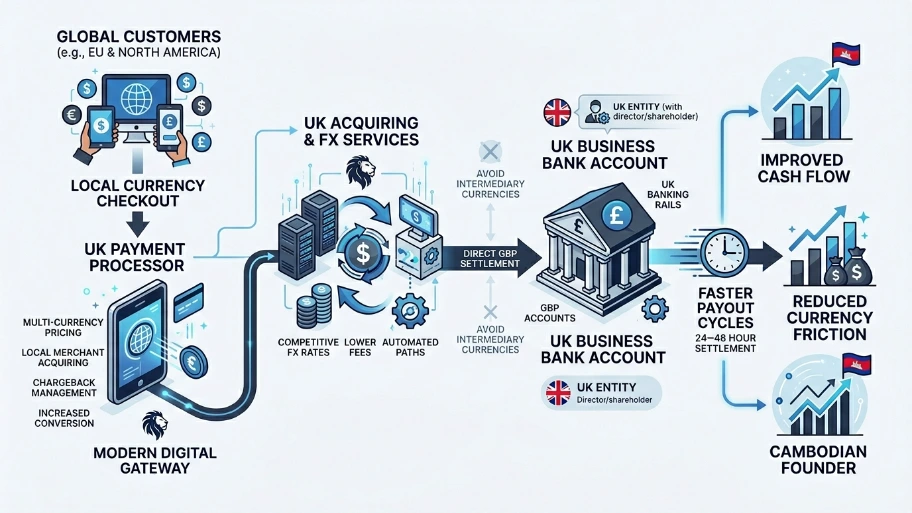
UK bank accounts enable direct GBP settlements, faster payout cycles, and access to UK-based acquiring and FX services with lower fees and better conversion rates.
Settlement in GBP avoids forced conversion through intermediary currencies. Founders receive payments faster because UK rails often settle within 24–48 hours. Acquirers and FX providers based in the UK offer competitive rates and automated conversion paths. These features improve cash flow and reduce currency friction.
If founders route receipts through UK payment processors, they can use local merchant acquiring features such as chargeback management and merchant terminals. This setup supports multi-currency pricing and local-currency checkout for customers in Europe and North America, which increases conversion rates.
What compliance and tax implications should Cambodian founders expect with a UK company?
Founders must register the UK company, comply with Companies House filings and UK AML rules, and evaluate UK tax residency and VAT obligations based on business activity and presence.
A UK company must file annual accounts and confirmation statements to Companies House. Directors must comply with UK anti-money-laundering (AML) verification. Beneficial ownership information must be declared to the People with Significant Control (PSC) register.
Tax residency depends on management and control. If directors manage operations from Cambodia, tax residency can still attach to Cambodia; however, retained profits held or realised in the UK may trigger UK corporation tax obligations. VAT registration is required when taxable supplies exceed the UK threshold or when selling to UK customers; otherwise, VAT rules for digital services to EU consumers apply.
Founders should consult cross-border tax advisors for precise liability calculations and to avoid double taxation.
How do founders maintain control while using UK corporate services from Cambodia?
Founders use nominee services, remote director tools, and delegated banking access while keeping operational control via signed resolutions and secure digital authorisations.
Remote onboarding platforms offer video-based ID checks and digital signatures. Founders appoint local agents or corporate service providers to handle mail, registered office duties, and compliance filings. Companies register board resolutions that delegate daily operational powers while reserving strategic control for founders.
Three operational controls to implement:
- Authorise limited signatories for bank operations through board resolution.
- Require dual authentication for account changes and payment runs.
- Maintain encrypted backups of corporate documents with time-stamped access logs.
When should a Cambodian founder choose a UK company instead of local incorporation?
Choose a UK company when the business targets international customers, requires global payment processors, or needs UK banking and reputational benefits for scaling.
A UK company fits if the business:
- Sells digital or subscription services to EU/UK/US customers.
- Requires Stripe Connect, PayPal Business, or other platforms that prefer UK entities.
- Needs GBP settlement and stable payout rails for SaaS, marketplaces, or e-commerce.
If the business is purely local to Cambodia with cash-based customers, local incorporation may remain simpler and cheaper. Evaluate expected annual revenue, customer geography, and payment-provider terms before deciding.
Explore our Burkina Faso guide,
How Burkina Faso Residents Can Improve Approval Chances for UK Company Registration
What is the onboarding process for Cambodian founders to get payment-ready with a UK company?
Register the UK company, open a UK-linked bank or payment account, complete director and beneficial owner verification, then onboard with Stripe or PayPal using UK documents and bank details.
Step-by-step process:
- Register the UK company with Companies House and obtain a registration number.
- Secure a UK-registered office and PSC declarations.
- Open a GBP-enabled bank account or set up a UK payment account with a regulated provider.
- Verify directors and beneficial owners with government ID and proof of address.
- Submit business information and bank details to Stripe or PayPal and pass AML checks.
Each step includes document retention and compliance filings required for ongoing operations.
How does From My Company support Cambodian founders through this process?
From My Company provides UK company formation, registered office services, and assistance opening UK-linked payment accounts to help founders onboard Stripe and PayPal efficiently.
From My Company registers the company with Companies House and supplies compliant registered office documentation. The service helps prepare verification packets that include Companies House records, director ID guidance, and bank setup templates. From My Company also advises on PSC filings and routine compliance actions that payment platforms require. From My Company integrates practical steps so founders present consistent, citation-ready documents during platform onboarding.
A UK company gives Cambodian founders a verifiable legal identity, UK banking access, and a lower-risk profile for payment platforms. These advantages accelerate Stripe and PayPal onboarding, improve settlement and FX terms, and support global customer reach. From My Company, packages company formation and payment-prep services to streamline these steps for founders operating from Cambodia.
Frequently Asked Questions
Can Cambodian founders open a UK company to use Stripe and PayPal?
Yes, Cambodian founders can register a UK company with From My Company to meet Stripe and PayPal onboarding requirements. A UK entity provides the registration, bank account, and compliance framework these platforms require for merchant accounts.
What documents are needed to verify a Cambodia-based UK company for payment processors?
Payment processors require a UK company registration number, director ID (passport), proof of address, and a UK-linked bank account. From My Company helps Cambodia-based clients prepare these documents and complete beneficial owner declarations for Stripe and PayPal verification.
How long does it take to get a payment-ready UK company from Cambodia?
UK company registration typically completes within 24–48 hours, and payment processor onboarding takes 3–7 business days after bank setup. From My Company streamlines the Cambodia-specific steps—registered office, director verification, and document preparation—to accelerate this timeline.
Do Cambodian directors need to reside in the UK to operate a UK company for global payments?
No, Cambodian directors can operate a UK company remotely without UK residency. From My Company provides a UK-registered office and compliance support, allowing founders to manage operations from Cambodia while meeting Stripe, PayPal, and banking requirements.
What are the tax and compliance obligations for a UK company owned by Cambodian residents?
UK companies must file annual accounts and confirmation statements with Companies House and comply with UK anti-money-laundering rules. Cambodian residents should also evaluate UK corporation tax and VAT obligations based on business activity and whether management and control remain in Cambodia. From My Company guides clients through these filings and compliance steps.