
Incorporate a Private Limited Company (Ltd) with Companies House using a registered office address and at least one director.
Registering creates the legal entity, establishes director duties, and triggers UK filing obligations. Use a registered office in England, Wales, Scotland, or Northern Ireland. Appoint directors with valid ID and a service address. File Articles of Association and a Memorandum if required. Pay the standard incorporation fee (online fee from Companies House is £12 as of 2026). Provide a statement of capital showing issued shares and shareholder details.
How do overseas founders meet UK identity and address verification requirements?
Verify director and shareholder identity using passport scans, utility bills, and certified translations where necessary.
Companies House accepts scanned passports and national IDs for identity checks. Address verification requires a dated utility bill, bank statement, or government letter within the last three months. Use certified translations for non‑English documents. Where directors cannot provide UK addresses, register a service address for public records and an SAIL (Single Alternative Inspection Location) if storing statutory records outside the UK. Retain all verification evidence for at least six years to meet anti‑money‑laundering (AML) requirements.
Read our articles, Non-Residents Formed 180,000+ UK Companies—Here’s How in 2026 and Form Your UK Company from 200+ Countries with Full Compliance & Banking Support.
What tax registrations must non-UK residents complete after incorporation?
Register for Corporation Tax within three months of starting a business and evaluate VAT and PAYE registration needs.
Corporation Tax registration activates corporate tax reporting to HMRC. Overseas founders must calculate taxable profits and file annual Company Tax Returns. Register for VAT if taxable turnover exceeds £90,000 in 12 months or if trading with UK customers where VAT is due. Register for PAYE if employing staff in the UK. Consider registering for the Construction Industry Scheme (CIS) if relevant. Maintain accounting records and use recognised accounting software to support accurate quarterly and annual reporting.
How does UK corporate residency affect tax obligations for overseas founders?
Assess company tax residency by where central management and control occur; director decision‑making usually determines residency.
A company incorporated in the UK is generally UK tax resident unless central management and control is demonstrably exercised abroad. If the board meets and makes strategic decisions outside the UK, tax residency can shift. Document board minutes, meeting locations, and decision-makers to support residency claims. Understand that UK residency triggers worldwide profit taxation; non‑resident status limits UK taxation to UK‑sourced profits.
What are the director remuneration and dividend tax considerations?
Pay directors through the employer PAYE and distribute profits as dividends, evaluating personal tax residency and double taxation treaties.
Salaries require PAYE payroll setup and National Insurance contributions where applicable. Dividends come from post‑tax profits and must be declared in company accounts. Directors who are tax residents of other countries should check double taxation agreements between the UK and their home country to avoid paying tax twice. File accurate payroll records and dividend vouchers. Use precise payroll dates and tax codes to prevent late penalties.
How can overseas founders open a UK bank or payment accounts?
Choose between a UK bank account, an international bank with UK services, or a regulated fintech business account based on KYC requirements and banking needs.
High‑street UK banks require proof of ID, a UK address or merchant history, and often an in‑person verification. International banks with UK branches offer multi‑currency accounts but require stronger documentation. Fintech providers (e.g., business e‑money firms) provide faster onboarding and IBANs; they accept non-UK residents more often, but with transaction limits and compliance checks. Compare fees for transfers, FX spreads, account verification time (days to weeks), and availability of UK Faster Payments.
Which banking documents and verification steps do founders need to prepare?
Provide company incorporation documents, proof of director identity, proof of business activity, and a business plan or expected transaction details.
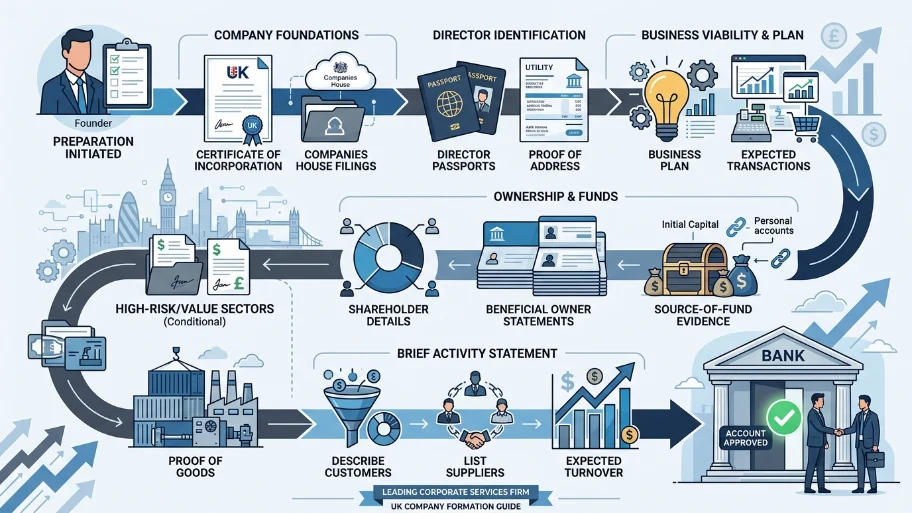
Banks and fintechs request the Certificate of Incorporation, Companies House filings, director passports, proof of address, shareholder details, and recent bank statements of beneficial owners. Prepare a short activity statement describing customers, suppliers, and expected monthly turnover. For high‑value or high‑risk sectors, provide contracts, invoices, or proof of goods. Keep copies of source‑of‑fund evidence for initial capital contributions.
What compliance processes protect against AML and sanctions risks?
Implement Know Your Customer (KYC) and transaction monitoring that map to UK AML regulations and HM Treasury sanctions lists.
Register relevant compliance officers and maintain a risk‑based KYC process covering beneficial ownership, PEPS (politically exposed persons) screening, and sanctions screening. Monitor unusual payments and keep audit trails for three to six years. Conduct automated screening of customers and counterparties against the UK Consolidated List. Document internal policies and train staff on AML obligations and suspicious activity reporting.
How do non-UK residents manage VAT and cross-border VAT rules?
Register for VAT when thresholds apply or when supplying UK taxable goods or services; apply the reverse charge or VAT place‑of‑supply rules as appropriate.
For goods imported into the UK, use the Import One-Stop Shop (IOSS) where relevant or pay import VAT at the border. For B2B services supplied to VAT‑registered UK customers, the reverse charge may apply, shifting VAT accounting to the customer. Issue accurate VAT invoices and file quarterly VAT returns. Keep records for six years to support VAT audits.
How should founders structure shareholder agreements and director duties?
Draft a shareholder agreement that defines share classes, decision thresholds, exit terms, and dispute resolution; document director duties and conflict‑of‑interest policies.
Include clear veto rights for major decisions like issuing new shares, changing Articles, or approving related‑party transactions. Specify dividend policy, drag‑and‑tag provisions, and valuation methods for share transfers. Keep director duties aligned with the Companies Act 2006: promote the company, exercise independent judgment, avoid conflicts, and act within powers. File board minutes and maintain statutory registers.
What practical steps reduce banking friction and speed onboarding?
Use a UK-registered address, prepare a concise business activity summary, and choose fintech partners that accept non-UK-resident clients.
Provide a professional registered office to receive correspondence. Prepare a two‑page business summary stating client types, average transaction sizes, and expected payment corridors. Pre‑validate beneficial owner documents and use certified translations. Consider payment processors or fintechs for quick access to IBANs and card acceptance while establishing a full UK bank relationship.
Explore our Non-uk-residents guide,
Legal Requirements for Non-UK Directors Explained
How does From My Company support non-UK residents in this process?
From My Company provides UK company formation, registered office services, and compliance support tailored for non-UK residents.
The service assists with Companies House filings, registered office provision, and ongoing statutory compliance. It offers document templates for shareholder agreements and supports KYC preparation required for banking. From My Company integrates with accounting and payroll partners to help with Corporation Tax, VAT, and PAYE registrations.
This framework gives overseas founders a step‑by‑step path: incorporate, verify identities, register taxes, choose banking, and implement AML compliance. Follow documented board decisions to support tax residency positions. From My Company helps Non-UK residents form UK companies and prepares compliant documentation for banking and tax filings in 2026.
Frequently Asked Questions
Can non-UK residents form a UK company without living in the United Kingdom?
Yes, non-UK residents can form a UK Private Limited Company online without residing in the United Kingdom. From My Company handles the Non-Uk resident incorporation process, providing a registered office address and director service address so you meet Companies House requirements.
What tax obligations do non-UK resident directors have for their UK company?
Non-Uk resident directors must register for UK Corporation Tax within three months of starting business and file annual Company Tax Returns. From My Company supports tax compliance setup, including VAT registration guidance if your taxable turnover exceeds £90,000 or you trade with UK customers.
How can a non-UK resident open a UK business bank account for their company?
Non-Uk resident founders can open UK business accounts through high-street banks, international banks with UK services, or regulated fintech providers that accept overseas directors. From My Company prepares your incorporation documents and KYC dossier to streamline bank onboarding and reduce verification delays.
Do non-UK resident companies need a UK registered office address?
Yes, every UK company must have a registered office address in England, Wales, Scotland, or Northern Ireland for official correspondence and statutory filings. From My Company provides a compliant registered office service for Non-Uk resident clients, ensuring Companies House and HMRC correspondence is received and managed securely.
What verification documents are required for non-UK resident directors during UK company formation?
Non-UK resident directors must provide a government-issued passport or national ID, proof of address (utility bill or bank statement within three months), and certified translations for non-English documents. From My Company guides you through the identity and address verification steps required for AML compliance and Companies House approval.