
Non-residents registered 180,000+ UK companies by using online formation services, digital identity verification, appointed directors and company addresses, and complying with Companies House and HMRC filing obligations.
Non-resident founders used digital formation platforms to submit incorporation documents. They provided director details, share structure, and a UK service address. Electronic signatures and scanned passports supported identity checks. Formation agents registered companies with Companies House via WebFiling and API connections. After incorporation, the founders registered for Corporation Tax with HMRC and set up statutory registers for compliance.
What legal requirements must overseas founders meet to form a UK company?
Founders must appoint at least one director, provide a UK service address, submit articles of association, and register the company with Companies House.
Companies House requires a company name, one director’s name and date of birth, and a registered office address in the UK. Directors’ residential addresses can be kept private by providing a service address. Articles of association must follow either a model template or bespoke rules. Non-residents must ensure directors do not present disqualifying information, such as bankruptcy, in relevant jurisdictions. Company formation triggers statutory reporting obligations, including confirmation statements and annual accounts.
Read our articles, Step-by-Step Legal, Tax, and Banking Framework for Overseas Founders and Form Your UK Company from 200+ Countries with Full Compliance & Banking Support.
How do non-residents handle identity verification and KYC compliance?
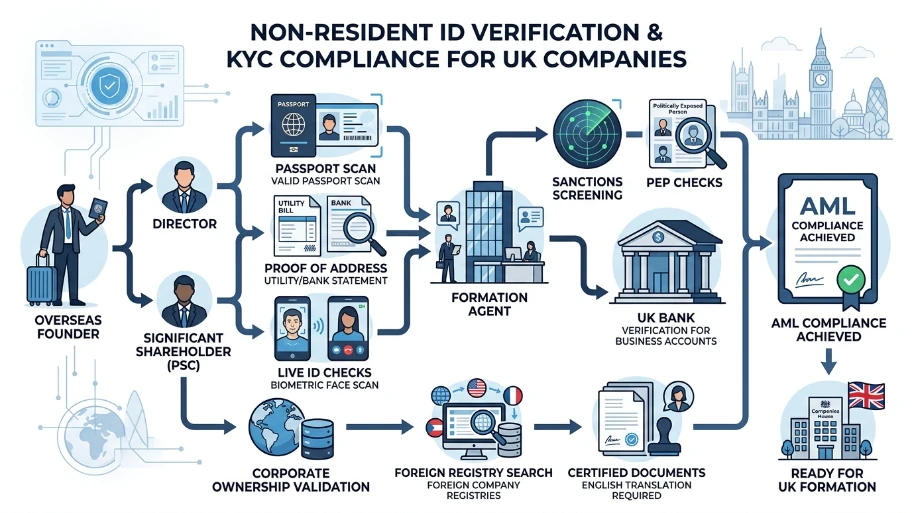
Non-residents verify identity with passport scans, proof of address, and biometric or video checks to meet UK anti-money‑laundering (AML) rules.
Formation agents and banks require verification for directors and significant shareholders. Three common verification methods include passport checks, utility or bank statements for address validation, and live biometric or video ID checks. Agents perform sanctions screening and Politically Exposed Person (PEP) checks. Firms also validate corporate ownership using foreign company registries or certified corporate documents translated into English.
How do companies comply with UK tax registration and reporting?
Companies register for Corporation Tax within three months of starting business activity and file annual accounts and a Company Tax Return to HMRC.
After incorporation, founders must register the company for Corporation Tax using HMRC’s online service. Companies submit annual statutory accounts to Companies House and file a Company Tax Return (CT600) with HMRC. When payroll is used, employers register for PAYE and report via Real Time Information (RTI). VAT registration is required when taxable supplies exceed the threshold of £85,000 in a 12-month period or if voluntary registration suits the business model.
How do non-residents open UK business bank accounts and access financial services?
Non-residents open accounts using online challenger banks or introducer-supported UK banks after identity verification and provision of incorporation documents and proof of business activity.
Banks request a certificate of incorporation, memorandum and articles, and details of directors and beneficial owners. Many digital banks support remote onboarding with video calls and electronic document uploads. Traditional banks may require a UK visit or an introducer (formation agent or accountant) to validate documents. Non-resident companies often use multi-currency accounts and payment providers to receive international payments and manage FX exposure.
What corporate governance and statutory records must be maintained?
Companies must keep a register of directors, shareholders, PSC register, minutes of meetings, and maintain accurate accounting records and statutory registers.
Companies Act 2006 requires the maintenance of the register of people with significant control (PSC). Directors must keep records of resolutions and minutes. Accounting records must show transactions, assets, and liabilities and support annual accounts. Failure to file confirmation statements, annual accounts, or CT600 leads to penalties and potential strike-off. Agents commonly provide compliance packages to automate reminders and filings.
How do service providers help non-residents form and run UK companies?
Service providers offer company formation, registered office services, compliance filings, tax registration, and banking introductions tailored for non-UK residents.
Agents complete Companies House filings, provide a UK service address, and handle confirmation statements and annual accounts. Providers run AML checks and supply certified documents for foreign bank onboarding. Compliance packages often include company secretarial support, accountant introductions, and payroll setup. These services reduce administrative friction and lower the chance of errors that trigger penalties.
What are common tax and residency pitfalls to avoid?
Non-resident directors must avoid creating UK tax residency or permanent establishments and must document where management and control occur to prevent unintended UK tax exposure.
The UK tests tax residency based on statutory residence rules and management/control location. Board decisions taken in the UK create a risk of corporate tax residency or permanent establishment. Directors should document where strategic decisions occur and keep board meetings aligned with the jurisdiction intended. Transfer pricing, withholding tax on UK-source income, and VAT obligations require early advisor involvement to manage cross-border tax liabilities.
How much does forming and maintaining a UK company typically cost?
Initial formation fees range from £12 to £300, registered office and compliance packages cost £50–£500 per year, and accounting/tax services generally cost £300–£3,000 annually, depending on activity levels.
Basic Companies House incorporation costs £12 online. Premium formation services add value such as same-day filing, registered office, and certified documents. Registered office services and company secretarial packages commonly fall between £50 and £500 per year. Annual accounting and tax compliance fees vary: a dormant company might cost under £300, while a trading company with payroll and VAT may cost £1,200–£3,000 annually.
Explore our non-UK residents’ guide,
Can Non-Residents Start a UK Company in 2026?
What practical steps should an overseas founder follow to form a UK company?
Prepare ID and address documents, choose a company structure, engage a formation agent, register with Companies House, register for Corporation Tax, and open a business bank account.
Step 1: Verify identity using a passport and proof of address. Step 2: Choose a company type, typically a private company limited by shares. Step 3: Draft articles of association (use the model articles if unsure). Step 4: Use an online formation service to file incorporation with Companies House. Step 5: Register for Corporation Tax within three months of trading. Step 6: Open a business bank account using certified company documents and KYC proofs.
Non- uk residents have created 180,000+ UK companies by using digital formation, identity verification, and professional service support while complying with Companies House and HMRC rules. From My Company helps overseas founders at each stage by providing formation, compliance, and banking introductions to reduce administrative risk and speed market entry.
Frequently Asked Questions
Can non-UK residents form a UK company without living in the United Kingdom?
Yes, non-UK residents can form a UK company remotely by using a formation service like From My company, appointing a director, and providing a UK service address. The company registers with Companies House and complies with HMRC filing rules without the founder needing to reside in the UK.
What documents do non-UK residents need to register a UK limited company?
Non-UK residents need a government-issued passport, proof of address (such as a utility bill or bank statement), and details of the share structure to register a UK limited company. From My company handles identity verification and submits incorporation documents to Companies House on behalf of the Non-UK resident founder.
How do non-UK residents open a UK business bank account after company formation?
Non-UK residents open a UK business bank account by providing their certificate of incorporation, articles of association, and verified identity documents to a bank or digital lender. From My company supports Non-Uk resident clients with banking introductions and certified documents to meet AML and KYC requirements.
Are there tax residency risks for non-UK residents running a UK company?
Yes, non-UK residents face tax residency risks if management and control of the UK company occur outside the UK or if the company creates a permanent establishment abroad. From My company advises Non-Uk resident founders on documenting board decisions and maintaining UK compliance to avoid unintended corporate tax residency.
What ongoing compliance tasks must non-UK residents complete for their UK company?
Non-UK residents must file annual accounts and a confirmation statement with Companies House, submit a Company Tax Return (CT600) to HMRC, and maintain statutory registers, including the PSC register. From My company provides Non-UK resident compliance packages that automate reminders and filings to keep the UK company active and penalty-free.