

Non-UK residents can establish and own a UK limited company without relocating to the country. However, understanding how to register a non-UK company for Corporation Tax requires distinguishing between a UK-incorporated company owned by overseas founders and an overseas-incorporated company that becomes liable to UK Corporation Tax.
A UK company is generally subject to UK Corporation Tax on its taxable profits, regardless of whether its shareholders or directors live abroad. An overseas-incorporated company has different registration requirements, depending on its UK residence status and activities. This guide explains the company formation process, HMRC registration requirements, tax responsibilities and practical considerations for international entrepreneurs.
Can Non-Residents Start a UK Company?
Non-UK residents can complete much of the UK company incorporation process remotely without travelling to the UK. The process involves choosing a company structure, providing the required director and shareholder details, preparing the incorporation documents and submitting the application to Companies House. Read our guide to registering a company in the UK for a broader explanation of the incorporation process and the documents required.
UK company law does not generally impose a UK residency requirement on company directors or shareholders. However, every UK company must maintain an appropriate registered office address in its relevant UK jurisdiction and comply with Companies House identity verification and filing requirements.
Foreign entrepreneurs can establish a company remotely, but incorporation does not automatically provide immigration permission, guarantee a UK business bank account or remove tax obligations in their country of residence.
The main requirements include:
- Choosing an appropriate company structure and name.
- Appointing at least one eligible individual director.
- Identifying shareholders and people with significant control.
- Providing an appropriate UK registered office address.
- Completing applicable Companies House identity verification.
- Submitting the incorporation application with accurate company information.
For overseas founders, understanding these requirements before applying helps avoid registration errors and unnecessary delays.
Corporation Tax Registration for Non-UK-Owned Companies
A UK company owned by non-UK residents generally has UK Corporation Tax responsibilities because the company is incorporated in the UK. The residence of its shareholders does not automatically change the company’s tax obligations.
It is important to distinguish between two situations:
UK-incorporated company with overseas owners: A company incorporated in the UK is generally treated as UK tax-resident and must deal with Corporation Tax on its taxable profits, subject to applicable tax rules and reliefs.
Non-UK-incorporated overseas company: A company incorporated outside the UK may need to register for Corporation Tax if it becomes liable under UK tax rules. Relevant circumstances include having a dependent agent permanent establishment in the UK or meeting other specific UK tax liability conditions.
When Must a UK Company Register for Corporation Tax?
When a company is incorporated through the standard Companies House online service, it will usually be set up for Corporation Tax at the same time, unless it is dormant.
If the company is incorporated through a route that does not automatically complete its tax registration, its directors must ensure that HMRC is notified when the company becomes active and liable to Corporation Tax.
A company generally needs to tell HMRC within three months of starting business activity if it has not already been registered for Corporation Tax.
Business activity can include providing services, selling products, advertising, renting property or carrying out other commercial operations. The precise position depends on the company’s circumstances.
How Does an Overseas Company Register for UK Corporation Tax?
An overseas-incorporated company that becomes liable to UK Corporation Tax must follow the relevant HMRC registration process.
The information HMRC may require includes:
- The company’s registered name.
- Country of incorporation.
- Overseas company registration number.
- Registered office address.
- Date of incorporation.
- Date the company became liable to UK Corporation Tax.
- Details of its UK business activities.
- Contact information for the person responsible for the registration.
The correct registration route depends on why the overseas company has become liable. For example, HMRC has specific procedures for companies trading through a dependent agent permanent establishment in the UK.
Companies should review the official HMRC guidance or seek professional tax advice where their residence or permanent establishment position is unclear.
UK Company Formation Requirements for Overseas Directors
Non-UK residents can serve as directors of UK companies, provided they meet the relevant eligibility requirements. They must be individuals aged 16 or over and must not be disqualified from acting as company directors.
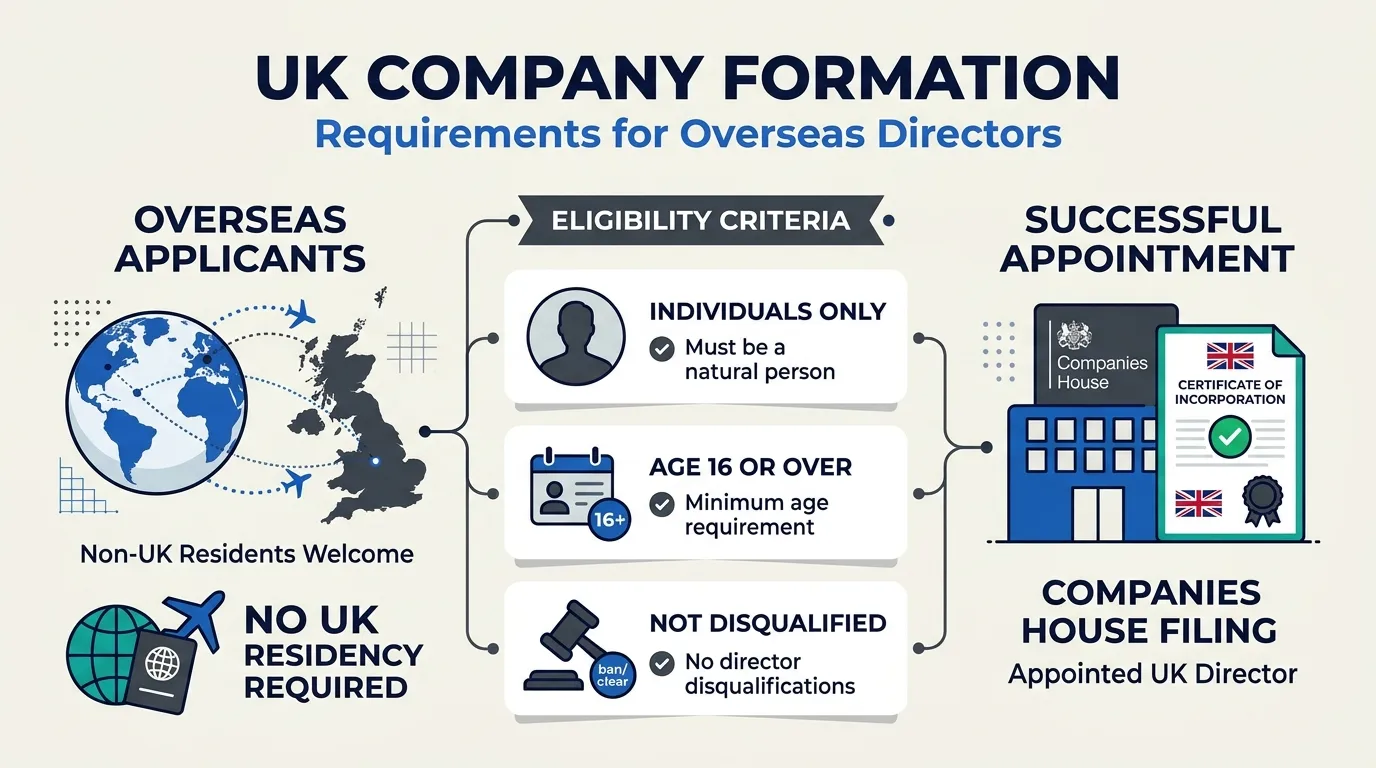
There is no general requirement for an overseas director to relocate to the UK. However, directors must provide the necessary information and complete applicable Companies House identity verification.
Identity Verification for Foreign Directors
Companies House identity verification requirements apply to directors and people with significant control under the relevant implementation arrangements.
Overseas directors should check the accepted verification methods and documents before starting the incorporation process. A passport or other accepted identity document may be required, depending on the verification route.
A director who completes identity verification receives a personal code that must be used in the relevant Companies House process.
Verification requirements should not be confused with general banking checks. A bank or financial service provider may request additional documents to establish identity, residential address, source of funds and business activity.
Registered Office Address Requirements
Every UK company must maintain an appropriate registered office address in its chosen UK jurisdiction.
This address is used for official company correspondence and must meet Companies House requirements. It must be capable of receiving documents and ensuring that they come to the attention of someone acting on behalf of the company.
Overseas founders who do not have UK premises can consider a professional registered office service. The service must meet the relevant requirements, and the company remains responsible for ensuring that official correspondence is handled correctly.
A registered office address is different from a director’s residential address or service address. These details have separate purposes and should not be treated as interchangeable.
How Can Overseas Founders Complete Remote UK Company Registration?
Overseas entrepreneurs can complete eligible UK company formation applications remotely through Companies House or an authorised formation provider.
The process involves preparing the company details, verifying the relevant individuals, submitting the incorporation application and arranging the necessary post-registration administration.
Step 1: Choose the Company Structure
A private company limited by shares is a common option for overseas entrepreneurs establishing a commercial business.
It provides a formal ownership structure through shares and separates the company’s legal identity from its shareholders. The appropriate structure depends on the business objectives, ownership arrangements and intended activities.
Step 2: Select and Check the Company Name
Choose a suitable company name that complies with Companies House naming requirements. Check its availability and consider relevant trademark restrictions before submitting the application.
Step 3: Appoint Directors and Identify Shareholders
Provide accurate information about the directors, shareholders and people with significant control.
A single individual can generally act as both the sole director and sole shareholder of a private limited company, provided the relevant requirements are met.
Step 4: Arrange a Registered Office Address
Provide an appropriate address in the relevant UK jurisdiction. Overseas founders can use a compliant professional registered office service where they do not have suitable UK premises.
Step 5: Complete Identity Verification
Ensure the relevant directors and people with significant control complete the applicable identity verification requirements.
Prepare the necessary personal information and follow the current Companies House verification process.
Step 6: Submit the Incorporation Application
Submit the company information to Companies House through the relevant online service or formation provider.
The application includes the proposed company name, registered office, director details, share information and other required particulars.
Step 7: Receive the Certificate of Incorporation
After approval, Companies House issues a Certificate of Incorporation containing the company registration number and incorporation date.
Keep the incorporation documents securely, as they may be needed for banking, tax registration and other business arrangements.
Step 8: Organise Tax and Business Administration
After incorporation, assess the company’s Corporation Tax registration, accounting arrangements, banking requirements and other compliance obligations.
If the company is dormant, trading or undertaking activities outside the UK, its tax position should be reviewed accordingly.
What Tax Obligations Should Non-Resident Company Owners Understand?
Owning a UK company from abroad does not remove its responsibility to comply with relevant UK tax requirements. The company’s activities, taxable profits, management arrangements and residence status all influence its obligations.
Corporation Tax
UK companies generally need to account for Corporation Tax on their taxable profits. The applicable rate depends on the level of profits and relevant tax rules.
Directors should maintain accurate financial records and ensure that the company meets its registration, return and payment responsibilities.
VAT Registration
VAT registration depends on taxable turnover and the applicable registration rules. The standard UK VAT registration threshold is currently £90,000, although different rules can apply to overseas businesses and particular trading arrangements.
A company should assess its VAT position rather than assume that overseas ownership removes the requirement to register.
PAYE and Employment Responsibilities
If the company employs staff or pays directors in circumstances requiring payroll registration, it may need to register for PAYE and operate the appropriate payroll procedures.
Employment arrangements, payroll obligations and National Insurance responsibilities should be reviewed before payments begin.
Tax Residence and International Tax Considerations
Overseas owners should also consider the tax rules in their country of residence.
Some countries tax residents on worldwide income, while others apply different rules to foreign company ownership, dividends and management activities. Double taxation agreements may also affect the final tax position.
Where company management and control takes place across multiple jurisdictions, professional tax advice can help identify potential residence and permanent establishment issues.
How Much Does It Cost to Register a UK Company from Abroad?
The total cost of establishing a UK company depends on the official Companies House filing fee and any additional services selected by the founder.
The current standard digital incorporation fee is £100. Same-day incorporation through the eligible software service costs £156, while paper incorporation costs £124.
Overseas founders may also budget for additional services, including:
- Registered office address provision.
- Director service address services.
- Identity verification assistance, where charged by a provider.
- Company formation support.
- Accounting and bookkeeping.
- Tax registration and professional advice.
- Banking assistance and other administrative services.
The actual cost depends on the provider and package inclusions. Review the service terms, renewal charges and additional fees before making a purchase.
For a detailed comparison of formation expenses, read our guide on how much it costs to register a company in the UK.
Choosing a UK Company Formation Package as a Non-Resident
Overseas founders often need more than basic incorporation assistance. A suitable formation service should address the requirements associated with international ownership, registered office arrangements, director verification and company administration.
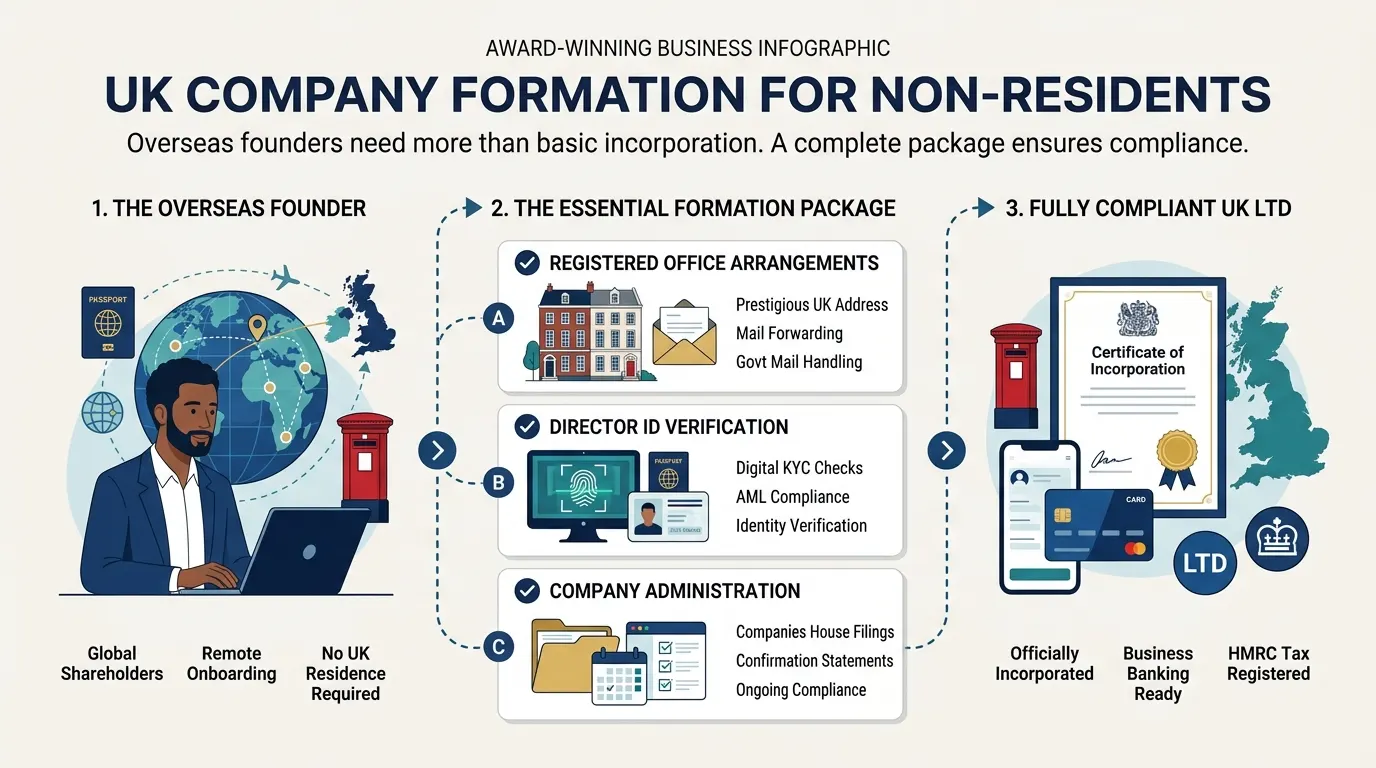
When comparing providers, consider the following:
- Whether the service supports non-UK resident founders.
- Whether the registered office address is included.
- Whether director identity verification assistance is available.
- Whether incorporation documents are provided.
- Whether support is available after registration.
- Whether additional charges or annual renewals apply.
You can compare the available UK company formation packages to understand the different services and support options.
Founders from different countries should also consider their individual documentation and business circumstances. For example, entrepreneurs exploring an international setup can review the Estonia company formation option for non-UK residents and compare it with establishing a UK company.
Why Choose Form My Company for Non-Resident Company Formation?
Form My Company supports overseas entrepreneurs who want to establish a UK business without managing every formation requirement independently.
The service can help founders prepare their company information, arrange incorporation and access relevant company address and administrative services.
Before choosing a package, consider the support required for your particular circumstances. Overseas owners should pay particular attention to registered office arrangements, identity verification, banking eligibility and the company’s ongoing tax obligations.
Form My Company offers a non-UK residents company formation package designed for entrepreneurs establishing a UK company from abroad. Review the package details to understand its current features, eligibility and pricing.
Frequently Asked Questions
Can non-UK residents register a company in the UK?
Yes. Non-UK residents can generally establish and own a UK limited company without living in the UK. They must meet the applicable company registration, registered office and identity verification requirements.
Do overseas company owners have to register for Corporation Tax?
A UK-incorporated company is generally subject to UK Corporation Tax on its taxable profits, even if its shareholders live overseas. A non-UK-incorporated company has different registration requirements depending on its UK tax residence and activities.
How do I register a non-UK company for Corporation Tax?
The registration process depends on why the overseas-incorporated company is liable to UK Corporation Tax. HMRC provides specific registration procedures for different circumstances, including dependent agent permanent establishments. Companies should identify the correct route before applying.
Does a UK company need a UK-resident director?
No general UK residency requirement applies to directors of UK private limited companies. An overseas individual can serve as a director if they meet the applicable eligibility and verification requirements.
Can I register a UK company without visiting the country?
Yes. Eligible founders can complete company formation remotely through the Companies House online service or a formation provider. They must still meet the applicable identity verification and registration requirements.
Does a non-resident company need a UK registered office?
A UK-incorporated company must maintain an appropriate registered office address in its relevant UK jurisdiction. Overseas founders can use a compliant professional address service if they do not have suitable UK premises.
When should a UK company register for Corporation Tax?
A UK company is usually set up for Corporation Tax during online incorporation unless it is dormant. Where registration has not been completed automatically, the company must notify HMRC when required, generally within three months of starting business activity.
What is the difference between a UK company and an overseas company?
A UK company is incorporated under UK company law and registered with Companies House. An overseas company is incorporated in another country. An overseas company may still have UK Corporation Tax obligations if its activities or tax residence create a UK tax liability.
How much does it cost to incorporate a UK company in 2026?
The standard digital Companies House incorporation fee is £100. Additional formation services, registered office arrangements, verification support and professional assistance can increase the total cost.
Start Your UK Company Formation with Form My Company
Establishing a UK company from overseas is possible without relocating, but successful formation requires careful attention to company registration, identity verification, tax responsibilities and ongoing compliance.
Form My Company helps international entrepreneurs explore suitable company formation services and the additional support needed to establish their UK business.
If you are ready to proceed, explore our Private Limited Ltd Company Formation Package to review the available services and take the next step towards registering your UK company.