
A PSC Register at Companies House records information about the people and, where applicable, legal entities that have significant control over a UK company. It helps identify who owns or controls a business through shareholdings, voting rights, director appointment rights or other forms of significant influence. Companies must identify their registrable controllers, confirm the required information and submit the appropriate details to Companies House within the applicable statutory deadlines.
Understanding the PSC Register helps directors, shareholders and company administrators maintain accurate ownership records, meet reporting obligations and reduce the risk of incorrect filings. This guide explains what a PSC Register is, what information it contains, where to find it and how to keep PSC information up to date.
What Is a PSC Register?
A PSC Register is the record of people with significant control over a company. PSC stands for Person with Significant Control. The regime supports transparency by making relevant ownership and control information available through Companies House.
A person may qualify as a PSC if they meet one or more of the following conditions:
- They hold more than 25% of the company’s shares.
- They hold more than 25% of the company’s voting rights.
- They have the right to appoint or remove a majority of the company’s directors.
- They exercise, or have the right to exercise, significant influence or control over the company.
- They exercise significant influence or control over certain trusts or firms that meet the relevant statutory conditions.
The assessment must consider the company’s actual ownership and control arrangements. A shareholder agreement, indirect holding, trust arrangement or voting agreement can affect whether someone qualifies as a PSC.
For corporate ownership structures, the applicable rules determine whether a relevant legal entity must be recorded and what information needs to be reported. Companies should not assume that the person named as a shareholder is always the only person who needs to be considered.
PSC Register Companies House: What Must Companies Know?
The PSC Register Companies House system provides a public record of registrable ownership and control information. Companies must take reasonable steps to identify their PSCs, obtain and confirm the necessary details, and report the information required by law.
Companies House publishes the relevant information so that users can understand who controls a company. Banks, suppliers, investors and other parties may review these records as part of their business checks.
The company remains responsible for identifying its PSCs correctly and submitting accurate information. Where ownership is indirect or control arrangements are complicated, the company may need to examine corporate records, shareholder agreements and other documents before deciding who qualifies.
Companies should also distinguish between the PSC information submitted to Companies House and the separate identity verification requirements that apply to individuals in relevant roles. Identity verification is a distinct compliance obligation and does not replace the need to identify and report PSC information correctly.
For the official requirements, consult the GOV.UK guidance on people with significant control.
What Information Must a PSC Register Contain?
The information required depends on whether the registrable PSC is an individual or a relevant legal entity. Companies must collect the appropriate details and follow the applicable Companies House reporting requirements.
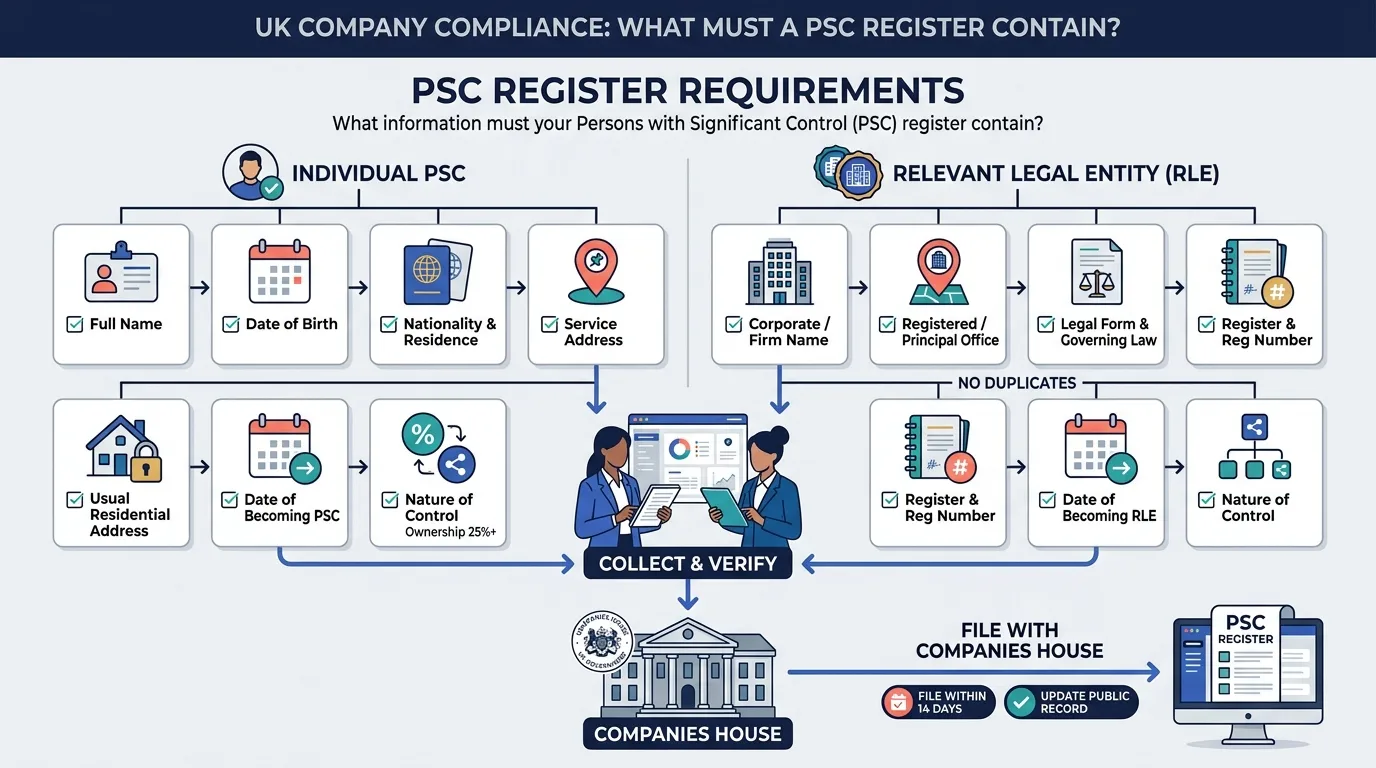
Information about an individual PSC
Relevant information generally includes:
- Full legal name.
- Date of birth.
- Nationality.
- Country, state or part of the UK where the individual usually lives.
- Service address.
- Usual residential address, where required.
- Date the individual became a PSC.
- The statutory condition or conditions through which the individual exercises control.
- The applicable shareholding and voting-right categories, where relevant.
A PSC’s residential address is treated differently from their service address. Residential address information is not generally displayed on the public register, subject to the applicable rules and exceptions.
The information shown publicly may also differ from the information a company collects or holds for compliance purposes. Companies should therefore distinguish between the information they need to obtain, the information they must report and the information that becomes publicly available.
Information about a relevant legal entity
Where a legal entity qualifies for registration under the applicable PSC rules, the information required may include its name, registered or principal office, legal form, governing law, registration details and the relevant nature of control.
The treatment of corporate controllers depends on the statutory conditions and the entity’s position within the ownership structure. A company should not automatically record every corporate shareholder as a registrable relevant legal entity without checking the applicable requirements.
PSC Register Format: How Should the Information Be Organised?
The PSC register format should make the company’s ownership and control position clear, accurate and easy to review. There is no single generic template that can safely cover every ownership structure, so the information must reflect the relevant statutory requirements and Companies House reporting process.
A practical internal checklist can help company officers prepare the correct details before submitting information.
| Information to check | Why it matters |
|---|---|
| PSC name or relevant entity details | Identifies the registrable controller |
| Date the person became a PSC | Establishes when the control relationship began |
| Nature of control | Explains why the person or entity qualifies |
| Shareholding and voting rights | Records the relevant control thresholds |
| Address and personal details | Supports accurate identification and reporting |
| Changes to ownership or control | Helps identify when an update is required |
| Supporting company records | Provides evidence for the company’s assessment |
Use this checklist as a preparation aid rather than a substitute for the statutory requirements. The required information and treatment of entries depend on the facts of the company.
Companies should also understand the current legal position. Following changes introduced under the Economic Crime and Corporate Transparency Act 2023, the reporting arrangements have changed, including the move away from maintaining certain separate local statutory registers. Companies should follow current Companies House requirements rather than relying on an old PSC register template or historic filing procedure.
Which Companies Need to Identify and Report PSCs?
The PSC regime applies to UK companies within its scope, including most private limited companies. Other types of organisations, including certain partnerships, have their own relevant requirements and guidance.
A company should not assume that it is exempt simply because it is dormant, has only one shareholder or does not currently trade. Its legal structure and circumstances determine the requirements that apply.
A company with a straightforward ownership structure may be able to identify its PSCs by reviewing its register of members, shareholdings and voting rights. More complex businesses may need to consider indirect ownership, parent companies, trusts, agreements and rights to appoint directors.
Where no registrable PSC can immediately be identified, the company must follow the relevant investigation and reporting requirements. The PSC record must not simply be left blank without addressing the company’s position through the appropriate statement or notice.
Where Can You Find the Companies House PSC Register?
PSC information can be searched through the public Companies House register. Users can search for a company by name or company number and review the information available on its public profile.
The public record can help users check:
- The PSCs reported for a company.
- The nature of their control.
- Relevant dates and reported changes.
- Whether the company’s publicly available information appears consistent with other available records.
A Companies House search is a useful starting point, but it does not replace appropriate due diligence. Public information may not explain every underlying ownership arrangement, and a company’s circumstances may change before all relevant updates appear on the public record.
Directors and company administrators should review the company’s own ownership documents and confirm that the information being reported is accurate. Investors and business partners should consider whether additional evidence or professional advice is needed before relying on a particular ownership position.
How Do Companies Maintain and Update PSC Information?
Maintaining PSC information involves monitoring changes in ownership and control, confirming relevant details and reporting changes through the appropriate Companies House process.
Step 1: Review ownership and control
Examine the company’s shareholdings, voting rights, articles of association and relevant agreements. Consider whether any individual or relevant legal entity meets one or more PSC conditions, including through indirect ownership or other control arrangements.
Step 2: Confirm the required details
Obtain and confirm the information required for each registrable PSC. Check names, dates, addresses and the nature of control carefully. If the information is incomplete or unclear, take reasonable steps to establish the correct position before making a submission.
Step 3: Record changes accurately
Changes may arise from share transfers, new share issues, altered voting arrangements, changes in director appointment rights or a change in the person exercising significant influence or control. Keep appropriate supporting company records and establish when the change occurred and when it was confirmed.
Step 4: Report information within the applicable deadline
Companies generally need to provide confirmed PSC information and report changes to Companies House within the applicable 14-day statutory period. The precise requirement depends on the type of information and the circumstances, so check the current guidance for the relevant event.
Do not assume that every PSC update follows a blanket two-stage process of 14 days for an internal register followed by another 14 days for Companies House. The current reporting rules and deadlines must be applied to the particular change.
Step 5: Review the public record
After submitting information, check the company’s Companies House record to confirm that the relevant details have been recorded correctly. Retain appropriate evidence of the submission and resolve discrepancies promptly.
PSC Register Guidance: Identity Verification and Company Records
PSC reporting and identity verification are related but separate responsibilities. Companies must identify their registrable controllers and report the required information, while individuals who fall within the relevant identity verification rules must complete the applicable verification process and provide their personal code as required.
Companies should not assume that collecting a passport, proof of address or other identification document automatically satisfies every Companies House obligation. The accepted verification route and documents depend on the process being used and the current official requirements.
For a practical explanation, read our guide to PSC identity verification in the UK. For a step-by-step walkthrough of the verification process, see how to complete PSC identity verification.
Companies should handle personal information securely and only collect, retain and share it as appropriate for their legal and administrative responsibilities. Access to sensitive documents should be restricted, and records should be managed in line with applicable data protection requirements.
What Happens if PSC Information Is Incorrect or Late?
Failure to comply with PSC requirements can have serious consequences. Depending on the circumstances, inaccurate information, failure to provide required details or failure to respond to statutory notices may constitute an offence and may result in financial penalties or other legal consequences.
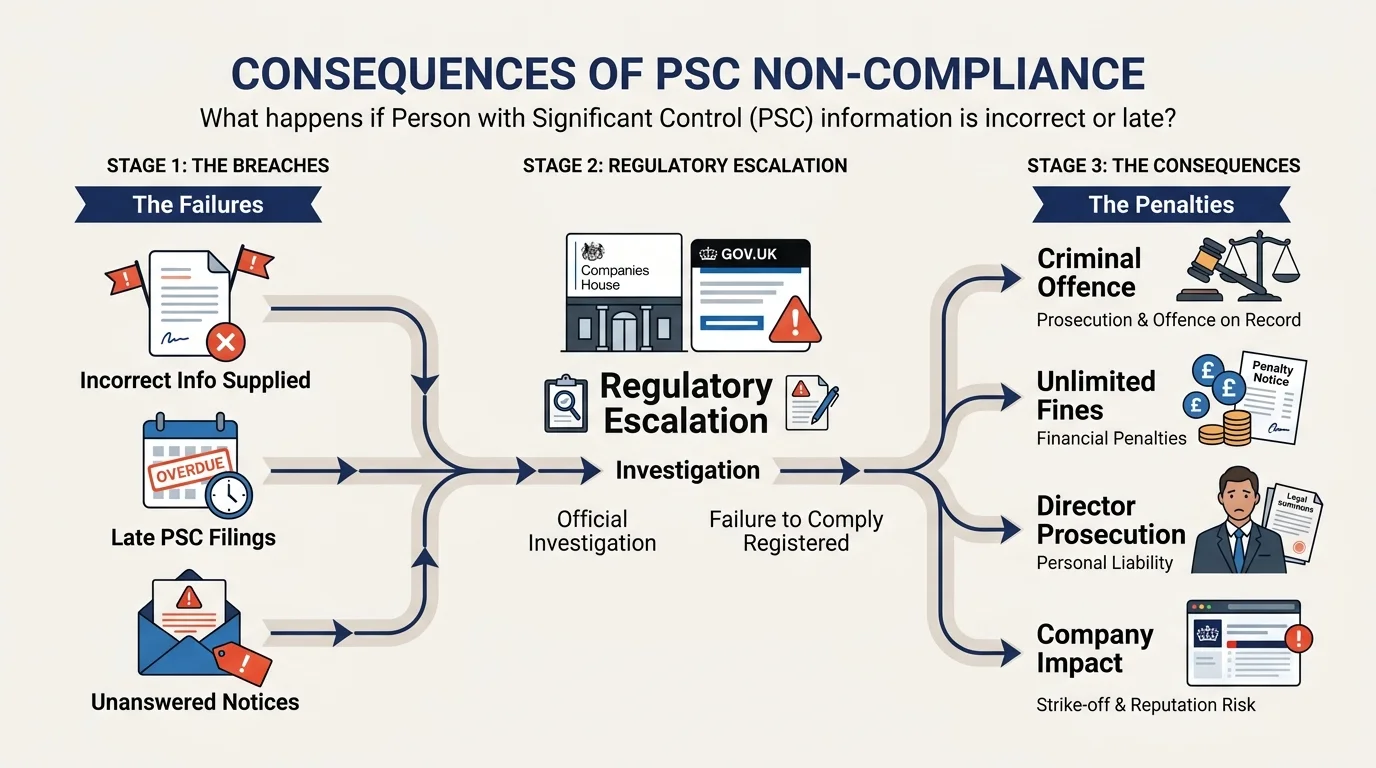
Inaccurate public records can also create practical difficulties. Banks, investors, suppliers and other parties may rely on Companies House information when carrying out checks, so inconsistencies can lead to further enquiries or delays.
To reduce these risks, companies should:
- Review ownership and voting arrangements regularly.
- Confirm PSC details before submitting them.
- Monitor changes that may affect control.
- Check the applicable deadline for each reportable event.
- Keep relevant supporting documents securely.
- Review submitted information on the public register.
- Obtain professional advice when the ownership structure is unclear.
The consequences of non-compliance depend on the specific legal duty and facts. Companies should consult current statutory guidance rather than relying on general penalty figures or outdated filing instructions.
When Should a Company Use Professional PSC Register Support?
Professional support can be useful where a company has layered ownership, overseas corporate shareholders, trusts, nominee arrangements, disputed shareholdings or several changes to control occurring at the same time.
A company secretarial professional can help review the ownership structure, identify the relevant reporting requirements, prepare accurate PSC information and manage the appropriate administrative steps. This is particularly useful where the company is unsure whether a person or entity meets the statutory conditions.
Form My Company provides a dedicated PSC Register service for businesses that need help managing their PSC information. Before choosing a service, review the scope of support offered and establish whether it covers your specific reporting and record-keeping needs.
Professional assistance does not remove the company’s responsibility to provide accurate information, but it can help make the process more organised and reduce avoidable administrative errors.
The PSC Register Companies House system helps make the ownership and control of UK companies more transparent. Companies must identify the people and relevant legal entities that meet the statutory conditions, confirm the required details and report information within the applicable deadlines.
Accurate PSC reporting depends on more than recording shareholdings. Directors and company administrators must also consider voting rights, director appointment rights, indirect control and other relevant arrangements. Regular reviews, careful record management and compliance with current Companies House guidance help maintain reliable company information.
If your business needs support with PSC records, review the Form My Company PSC Register service to explore the available assistance.
Frequently Asked Questions
What is a PSC Register and why is it required?
A PSC Register records people and, where applicable, relevant legal entities with significant control over a company. It supports transparency by requiring companies to identify registrable controllers and report the required information to Companies House.
What is the PSC Register format?
The PSC register format depends on the company’s circumstances and the type of registrable controller. Information may include identity and address details, the date control began and the statutory conditions through which control is exercised. Companies should follow current Companies House guidance rather than rely on an outdated template.
How do I find a PSC Register on Companies House?
Search for the company by name or company number on the Companies House website. Open its public profile and review the available persons with significant control information and relevant filing history.
How often must PSC information be updated?
Companies must report relevant confirmed information and changes within the applicable statutory deadlines. Many PSC reporting requirements use a 14-day period, but the exact deadline depends on the event and current rules. Check official guidance before submitting a change.
Does a dormant company need to consider PSC requirements?
Dormant status does not automatically remove a company’s PSC obligations. The company should assess its ownership and control position and follow the applicable requirements for identifying and reporting PSC information.
Is PSC identity verification the same as registering a PSC?
No. Identifying and reporting a PSC is separate from identity verification. Individuals subject to the verification requirements must complete the applicable process and provide their personal code as required. Companies should check current Companies House guidance for both obligations.
Where can I get help with PSC Register compliance?
Form My Company offers a dedicated PSC Register service for businesses that need assistance with PSC records. Companies with complicated ownership or control arrangements should ensure that the support they choose matches their specific circumstances and reporting needs.