
To complete PSC identity verification, individuals must submit government-issued photo identification and proof of address through the official Companies House online service or an authorized corporate service provider to authenticate their identity under the Economic Crime and Corporate Transparency Act 2023 compliance guidelines.
What Is PSC Identity Verification and Why Is It Required?
PSC identity verification is a mandatory legal process requiring Persons with Significant Control to authenticate their identity with Companies House to prevent corporate fraud, increase transparency, and comply with the UK Economic Crime and Corporate Transparency Act 2023 regulations.
The Economic Crime and Corporate Transparency Act 2023 introduces mandatory identity checks for all individuals registered as Persons with Significant Control (PSCs) in UK companies. This legislative framework aims to deter financial crime, eliminate opaque corporate ownership structures, and ensure that individuals listed on the public register are accurately identified.
Failing to complete identity verification within the prescribed legal timeframes results in severe penalties, including corporate fines, disqualification of directors, and restrictions on company actions. Companies House enforces these measures to build a more transparent UK business ecosystem, making compliance an urgent operational priority for all registered entities.
What Documents Do You Need to Complete PSC Identity Verification?
Completing PSC identity verification requires one valid government-issued photo identification document—such as a passport or photocard driving licence—and a supporting proof of address document issued within the last three months, including utility bills or official bank statements.
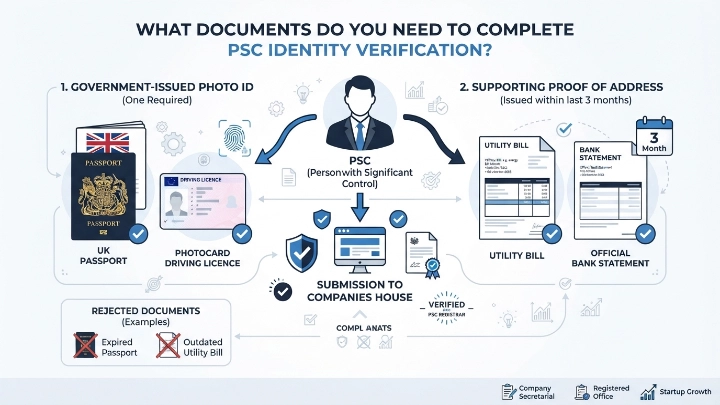
Preparing the correct documentation accelerates the verification workflow and minimizes registration rejections. Companies House accepts specific high-integrity documents that confirm both the individual’s full legal name and their primary residential address.
Specific identity documents required for primary validation:
Submit a valid international passport containing machine-readable zone data.
Provide a photo driving licence issued by the UK, EU, or an approved international jurisdiction.
Supply a national identity card featuring an embedded biometric chip.
Supporting proof of address documents accepted for secondary validation:
Present a utility bill dated within three months for electricity, gas, or water services.
Upload a bank or building society statement showing official residential address details.
Include a current council tax bill issued by a UK local authority.
How Do You Complete PSC Identity Verification Step by Step?
Completing PSC identity verification involves accessing the Companies House digital service or an authorized provider, submitting primary photo identification, completing facial recognition biometric checks, verifying residential address details, and receiving an official identity verification code for registry confirmation.
The verification process follows a standardized procedure designed to maintain high security while providing a seamless user experience. Following this sequence prevents administrative delays and ensures full compliance with UK corporate law.
Step 1: Prepare Verification Documents and Access the Portal
The verification workflow begins by gathering primary photo identification and supporting proof of address. Users must ensure that digital copies or original physical documents are clear, undamaged, and unexpired. Accessing the official digital portal requires establishing a secure login using verified email credentials.
Step 2: Upload Government-Issued Identification
Once inside the digital portal, users upload high-resolution images of their official identification documents. The system validates the document using optical character recognition and checks security features such as holographic elements, machine-readable zones, and watermarks to confirm authenticity.
Step 3: Complete Biometric Liveness and Facial Matching
The digital system requires users to complete a real-time biometric scan using a smartphone or web camera. This process compares live video capture with the photo on the submitted identification document. The technology confirms that the person completing the application is the true owner of the identity document.
Step 4: Verify Residential Address Information
Users input their current residential address and upload secondary documentation to confirm their physical location. The details on the address proof must match the corporate filings exactly. Any discrepancy between personal records and registry submissions requires immediate reconciliation before final submission.
Step 5: Receive and Submit Your Unique Identity Code
After successful automated verification, Companies House generates a unique personal identity code. The PSC or their corporate representative must input this code into the company’s registry filings. This step permanently links the verified individual to the official PSC register.
Who Is Affected by the PSC Identity Verification Requirements?
PSC identity verification affects all individual Persons with Significant Control, company directors, relevant legal entities, and general partners of limited partnerships operating within the United Kingdom corporate registry system under current legislative frameworks.
The statutory requirements extend beyond individual PSCs to encompass all key corporate officers across various business structures. Understanding who must complete verification ensures that every relevant entity in a business hierarchy remains fully compliant.
Entities subject to statutory identity verification obligations:
Verify individual PSCs holding more than 25% of company shares or voting rights.
Authenticate company directors, including shadow directors and corporate directors.
Validate legal representatives of Relevant Legal Entities (RLEs) holding controlling interests.
Register general partners in limited partnerships operating under UK law.
When Must You Complete PSC Identity Verification?
Existing PSCs must complete identity verification during a transition period specified by Companies House, while new PSCs and directors must complete verification before or alongside their initial appointment filings to maintain statutory compliance.
Timing requirements depend directly on the corporate status of the individual. Newly incorporated entities must ensure that all initial PSCs complete verification prior to company formation, preventing delays in corporate setup.
For existing entities, Companies House establishes strict transitional windows linked to the annual confirmation statement filing date. Failing to submit verified codes alongside the confirmation statement results in non-compliance notices and potential registry sanctions.
What Are the Penalties for Non-Compliance with PSC Verification?
Failing to complete PSC identity verification results in criminal offences, severe civil fines up to £10,000, potential director disqualification for up to 15 years, and restrictions on company registry filings.
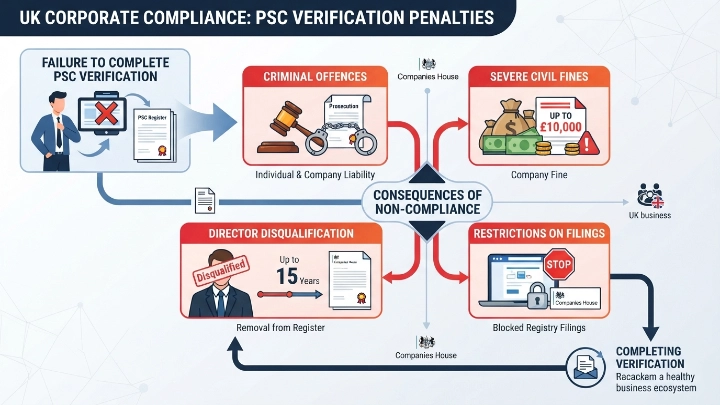
Companies House enforces strict regulatory measures against companies and individual officers who ignore verification mandates. Criminal liability attaches to both the non-compliant individual and the corporate entity itself.
Impenetrable sanctions ensure high compliance rates across all UK business sectors:
Impose daily default fines on non-compliant individuals and corporate officers.
Reject corporate registry filings, preventing structural changes or ownership transfers.
Initiate formal disqualification proceedings against directors failing compliance duties.
Strike non-compliant corporate entities off the official register after extended default periods.
How Can Form My Company Assist with PSC Verification and Compliance?
Form My Company assists businesses by managing end-to-end PSC identity verification, updating statutory records, maintaining statutory registers, and submitting accurate compliance data directly to Companies House.
Navigating regulatory updates demands administrative time and precise legal understanding. Corporate service providers streamline compliance management by auditing ownership structures, identifying PSC filing gaps, and managing verification procedures efficiently.
Businesses can streamline their statutory maintenance by utilizing a dedicated PSC Register service to ensure complete regulatory alignment. Maintaining proper records prevents compliance failures and protects corporate standing.
To understand the legal foundation behind these requirements, review our detailed guide on What Is PSC Identity Verification Under the ECCTA 2023? which covers legal definitions and obligations. For immediate hands-on administrative assistance, choose to Complete PSC Identity Verification With Form My Company to secure full corporate compliance today.
Using professional verification services eliminates administrative friction and guarantees that every filing complies with the Economic Crime and Corporate Transparency Act 2023 standards.
Explore our PSC Register guide,
Director ID vs. PSC Identity Checks: Requirements Compared
Confirmation Statement vs. Annual Accounts: The Difference Explained
Frequently Asked Questions
What is a PSC Register and why must UK companies maintain one?
A Persons with Significant Control (PSC) Register is an official statutory record that identifies individuals or legal entities holding significant influence or ownership in a UK company, typically exceeding 25% of shares or voting rights. Under the Economic Crime and Corporate Transparency Act, maintaining an updated PSC Register is a mandatory legal requirement to prevent corporate opacity and financial crime. Form My Company assists businesses in maintaining an accurate PSC Register to ensure continuous compliance with Companies House regulations.
How do I update my company’s PSC Register with Companies House?
Updating a PSC Register requires submitting specific notice forms, such as the PSC01 or PSC02, to Companies House within 14 days of any change in ownership or control details. Companies must verify the personal information of new or existing directors and significant shareholders before submitting formal filings. Form My Company manages the entire PSC Register filing process to guarantee accurate, timely, and compliant registry submissions.
What are the legal penalties for failing to maintain an accurate PSC Register?
Failing to keep an up-to-date PSC Register constitutes a criminal offence under UK corporate law, exposing both the company and its officers to severe financial penalties. Non-compliant businesses face civil fines up to £10,000, potential director disqualifications, and restrictions on corporate filings. Utilizing the dedicated PSC Register management service from Form My Company protects business owners from regulatory sanctions and administrative enforcement actions.
Who counts as a Person with Significant Control (PSC) in a company?
A Person with Significant Control is an individual or relevant legal entity that holds more than 25% of company shares, controls over 25% of voting rights, or possesses the right to appoint or remove a majority of the board of directors. Individuals who exercise significant influence or control over a company’s operations without holding equity also meet the legal criteria. Form My Company conducts thorough corporate ownership audits to precisely identify and classify every PSC for official registration.
Can a limited company have a legal entity listed on its PSC Register?
Yes, a corporate body can be listed on a PSC Register if it qualifies as a Relevant Legal Entity (RLE). To meet RLE standards, the entity must hold a controlling interest in the subsidiary, maintain its own official PSC records, and be subject to its own statutory reporting obligations in the UK. Form My Company evaluates complex corporate group structures to ensure legal entities are correctly documented on the company PSC Register.