
Director ID is a unique 15-digit identifier assigned to individual corporate directors to prevent identity fraud, whereas PSC identity checks verify the identities of persons with significant control through official documentation to confirm corporate ownership transparency under UK law.
Why Are Director ID and PSC Identity Checks Required for UK Companies?
UK law mandates Director ID and PSC identity checks to increase corporate transparency, reduce financial crime, and prevent fraudulent appointments on the Companies House register.
The Economic Crime and Corporate Transparency Act introduced these mandatory verification processes to secure corporate records. Fraudulent director appointments previously created significant legal liabilities for unsuspecting individuals and businesses. Verifying identities before official registration ensures that corporate structures contain accurate, authentic personal information.
Company directors must obtain a unique identification number before taking office. This number follows the individual throughout their professional career, regardless of how many companies they manage. The process links verified personal credentials to public filings, preventing rogue actors from creating fictitious directorships.
Persons with significant control (PSCs) exert substantial influence over company decisions, holding over 25% of shares or voting rights. Verifying PSC credentials ensures that ultimate beneficial ownership remains clear to regulators, law enforcement, and commercial partners. Unverified individuals cannot maintain register entries without triggering statutory penalties.
Businesses must comply with these regulatory measures to maintain corporate standing. Non-compliance results in civil penalties, potential director disqualification, and rejection of official corporate filings. Implementing structured identity verification workflows protects corporate entities from regulatory sanctions.
How Do Director ID Requirements Compare to PSC Identity Checks?
Director ID focuses on individual management verification through a permanent unique identifier, while PSC identity checks validate beneficial ownership and corporate control across company ownership structures.
| Feature / Requirement | Director ID Verification | PSC Identity Verification |
| Primary Target | Individual appointed directors | Individuals controlling over 25% shares/votes |
| Identifier Granted | Permanent 15-digit Director ID | Verified PSC compliance status |
| Responsible Body | Insolvency Service / Registrar | Companies House / Authorised Corporate Service Provider |
| Primary Objective | Prevent director fraud and false appointments | Map accurate ultimate beneficial ownership |
Individual directors apply directly to the government system to obtain their unique identification number. The application requires personal address history, national insurance numbers, and primary identity documents. Once issued, the director uses this single ID for all existing and future directorships.
PSC verification requires validation of the individuals controlling the legal entity. Companies must verify PSC identity using passport checks, biometric scans, and address validation. The process confirms that individuals holding voting rights match public disclosures filed at Companies House.
Directors face individual personal liability for failing to secure their identification numbers before appointment. PSC compliance failure impacts both the individual controller and the company itself. Companies House enforces restrictions on corporate actions if PSC disclosures remain unverified.
Both verification processes share primary identity validation standards but serve distinct corporate governance roles. Director ID tracks management accountability across multiple legal entities over time. PSC checks expose shadow ownership and prevent illicit financial flows through complex corporate holdings.
What Documents Are Needed to Complete PSC Identity Checks?
PSC identity checks require government-issued photo identification, proof of residential address, and official biometric verification data to confirm individual identities.
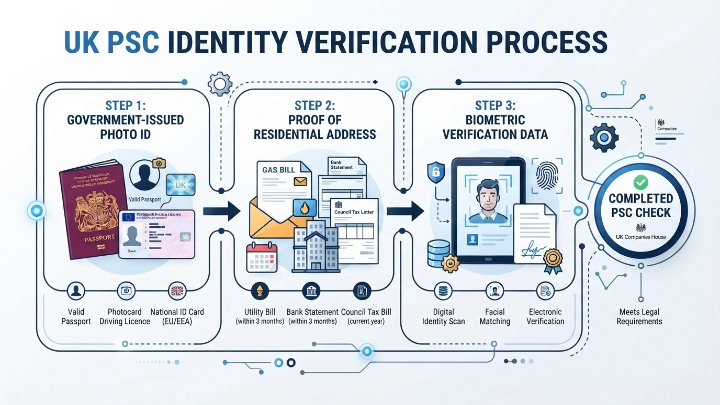
Individuals must supply primary photo identification issued by an official government authority. Valid documents include valid passports, photocard driving licences, and national identity cards. The issuing authority must confirm validity through active database cross-references.
Proof of address documents must confirm residential details within specified time limits. Acceptable documents include bank statements, utility bills, and government tax correspondence issued within three months. Documents must display the individual’s full legal name matching the official register.
Digital biometric verification captures facial scanning data matched against primary photo documents. Automated verification platforms confirm document authenticity features, including holographic marks, electronic chips, and optical security features. Biometric cross-referencing prevents identity theft using stolen physical credentials.
Corporate service providers process these documentation requirements using secure compliance portals. Submitting clear, high-resolution scans accelerates verification timelines and avoids administrative rejections. Failure to provide complete documentation delays statutory corporate filings.
What Are the Key Compliance Deadlines for Identity Verification?
New directors and PSCs must complete identity verification prior to appointment, while existing role holders face strict statutory transition deadlines set by Companies House.
Newly appointed directors must complete identity verification before filing official appointment notices. Companies House rejects incorporation filings and director appointment forms submitted without valid verification data. Pre-appointment verification ensures immediate public register accuracy.
Existing company directors receive a defined transition window to secure their verification credentials. Directors must complete the process alongside their annual confirmation statement filings following statutory implementation. Missing this statutory window invalidates directorship status and triggers enforcement actions.
Newly identified PSCs must complete verification within 14 days of achieving significant control status. The company must record verified details in its internal register within 14 days following confirmation. Timely reporting maintains alignment between internal registers and public records.
Failing to meet statutory deadlines constitutes a criminal offence for both individuals and corporate officers. Companies House issues administrative fines and can institute court proceedings against non-compliant entities. Directors face operational disruption when unverified status blocks standard corporate filings.
How Do Identity Verification Rules Impact Business Operations?
Identity verification requirements delay corporate filings, alter onboarding workflows, and necessitate formal compliance structures for all UK registered entities.
Incorporation procedures now require upfront identity validation for all founding officers and shareholders. Founders must complete digital verification before submitting incorporation paperwork to Companies House. Immediate preparation prevents administrative holds on new business formations.
Corporate banking partners demand full compliance documentation before opening commercial accounts. Banks require verified Director IDs and PSC records to satisfy anti-money-laundering regulations. Clear verification records expedite merchant account approvals and credit evaluations.
Third-party transactions, including commercial leases and equity investments, require verified officer records. Investors inspect public register credentials during due diligence processes to confirm legal standing. Unverified records introduce risk flags that stall corporate finance deals.
Businesses often require professional physical administrative space to handle corporate correspondence, formal verifications, and board meetings. Accessing professional conference room options for corporate meetings provides the physical infrastructure required for formal governance reviews and officer onboarding. Maintaining organized compliance facilities supports operational continuity during statutory audits.
What Are the Penalties for Failing Identity Verification Checks?
Failing to complete identity verification results in financial penalties, restriction of corporate activities, civil liability, and potential disqualification as a company director.
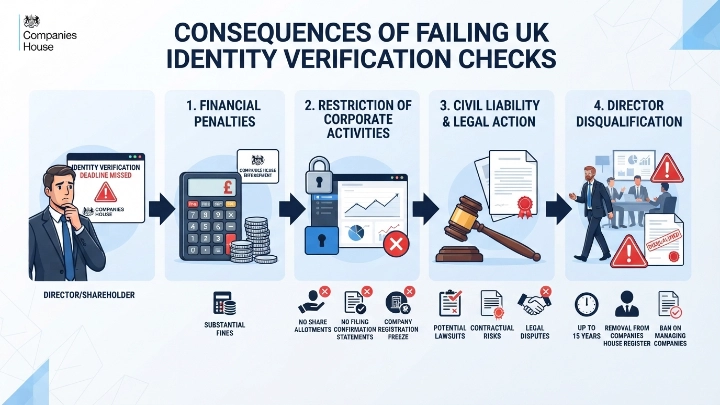
Companies House applies direct financial penalties to non-compliant officers and corporate entities. Daily default fines accumulate for every day an unverified director or PSC remains on the register. Unpaid administrative penalties escalate to formal debt recovery actions.
Unverified directors lose legal authority to execute official company filings and statutory documents. Companies House rejects confirmation statements, annual accounts, and structural changes submitted by unverified officers. Rejections leave the corporate entity in default of statutory reporting duties.
Repeated non-compliance triggers formal disqualification proceedings under the Company Directors Disqualification Act. Courts issue disqualification orders ranging from 2 to 15 years for severe governance failures. Disqualified individuals cannot manage, form, or market UK corporate entities.
Criminal liability applies when individuals deliberately provide false or misleading identity information. Law enforcement authorities investigate deliberate identity misrepresentation as financial fraud. Criminal convictions result in severe personal fines and potential imprisonment.
How Can Businesses Manage Corporate Compliance Efficiently?
Businesses streamline corporate compliance by implementing automated verification platforms, maintaining organized internal registers, and utilizing specialized corporate service providers.
Automated digital compliance portals allow officers to submit credentials securely from remote locations. Digital onboarding software validates government documents within minutes using real-time security database checks. Rapid processing reduces onboarding delays for incoming management personnel.
Centralized compliance tracking ensures that filing deadlines remain visible to governance teams. Internal systems track confirmation statement due dates, officer appointment timelines, and verification status changes. Automated alerts prevent accidental deadline breaches and missed filings.
Outsourcing compliance management to specialists reduces administrative burdens on internal management teams. Specialized providers manage identity validation workflows, Companies House filings, and corporate record updates. Expert guidance minimizes filing rejections and regulatory exposure.
Reviewing comprehensive guidance on why proof of identity matters for UK PSCs helps company management establish compliant internal governance protocols. Understanding underlying statutory mechanisms prepares officers for evolving reporting standards. Proactive governance planning prevents emergency compliance interventions.
Selecting experienced corporate formation partners ensures seamless alignment with statutory regulations. Businesses can secure identity verification services with Form My Company to manage director and PSC credentials effectively. Professional compliance support protects corporate standing across all operational stages.
Summary of UK Officer Identity Rules
UK corporate governance relies on strict identity verification to eliminate fraudulent registrations and secure public records. Director ID provides individual accountability across multiple directorships, while PSC verification validates real beneficial ownership. Meeting these distinct legal mandates requires systematic record-keeping, verified documentation, and strict adherence to statutory deadlines. Form My Company assists businesses in navigating these regulatory requirements to maintain compliance with Companies House standards.
Explore our Conference Room guides,
Confirmation Statement vs. Annual Accounts: The Difference Explained
Trading vs. Dormant Accounts: Which One Does Your Business Need?
Frequently Asked Questions
What facilities are included when booking a conference room with Form My Company?
Booking a conference room with Form My Company provides access to fully equipped meeting spaces featuring high-speed internet, audiovisual presentation technology, and professional seating arrangements. Additional amenities typically include digital displays for presentations, climate control, and on-site support to ensure seamless business meetings and client presentations.
How do I book a meeting or conference room through Form My Company?
You can reserve a professional meeting space by visiting the Form My Company conference room service page and selecting your preferred date, time, and location layout. The online booking system allows businesses to customize room configurations and select technical equipment packages tailored to specific corporate events or team sessions.
Can I hire a Form My Company conference room for an hour or full day?
Yes, Form My Company offers flexible meeting room rental plans, including hourly bookings, half-day sessions, and full-day access. This flexible scheduling allows businesses, freelancers, and corporate teams to pay only for the time they need while maintaining access to premium executive facilities.
Are Form My Company conference rooms suitable for hybrid or video meetings?
Form My Company conference rooms feature high-definition video conferencing hardware, surround audio equipment, and secure high-speed Wi-Fi optimized for hybrid meetings. These rooms allow remote and in-person attendees to connect reliably across major video platforms like Zoom, Microsoft Teams, and Google Meet.
Where are Form My Company conference rooms located, and how many guests can they accommodate?
Form My Company offers professional conference rooms in prime commercial locations designed to host small team huddles, board meetings, or larger corporate workshops. Room capacities range from intimate 4-to-6 person meeting spaces up to executive boardrooms holding 15 or more attendees depending on layout requirements.