
UK small businesses need expert PAYE registration assistance to ensure full compliance with HM Revenue and Customs (HMRC), eliminate costly filing errors, avoid automatic late-registration penalties, and set up a streamlined payroll framework before their very first employee payment date.
What Is PAYE Registration for UK Employers?
PAYE registration is the mandatory official process of enrolling a UK business with HMRC as an employer, allowing the business to deduct Income Tax and National Insurance contributions directly from employee wages at the source.
Every employer in the United Kingdom must register for Pay As You Earn (PAYE) when hiring staff. This obligation triggers as soon as an employee earns £123 or more per week, receives company benefits, or holds another job.
Registration generates two crucial identifiers from HMRC: an Employer PAYE Reference Number and an Accounts Office Reference. These identification details enable small businesses to submit Real Time Information (RTI) reports directly to tax authorities during every payroll cycle.
Failing to register before the first payday leads to immediate compliance breaches. HMRC mandates that businesses register at least four weeks before paying staff to ensure the activation of payroll credentials on time.
Why Is Expert Assistance Critical for Small Business PAYE Setup?
Expert assistance ensures accurate payload submissions, prevents processing delays with HMRC, handles complex director pay structures, and frees small business owners from navigating complex regulatory tax portals independently.
Setting up employer accounts involves navigating intricate administrative steps on government portals. Small business owners frequently encounter delays due to incorrect director details, mismatched business addresses, or incorrect operational start dates.
Professional service providers handle identity validation, submit corporate details precisely, and sequence the registration process correctly. Errors on initial filings require direct intervention from HMRC support, which often takes weeks to resolve.
Expert assistance guarantees proper alignment with UK employment tax laws from day one. Specialist advisors verify entity classification, structure director salary thresholds accurately, and ensure your enterprise remains compliant as staff levels expand.
How Does PAYE Registration Differ From Ongoing Payroll Management?
PAYE registration establishes your legal tax account with HMRC, whereas ongoing payroll management involves calculating recurring deductions, generating payslips, and submitting monthly Real Time Information reports.
Registering for PAYE is a foundational setup task. It creates your official tax entity within HMRC databases and grants access to submit payroll data.
In contrast, routine payroll management requires running monthly or weekly calculations. Employers calculate Income Tax, Employee National Insurance, Employer National Insurance, and statutory payments like sick pay or parental leave.
Understanding this distinction helps business leaders structure their operational workflows effectively. Evaluating internal administrative capacity allows firms to decide between managing routine filing internally or outsourcing long-term operations. To choose the right operational path for your business, evaluate PAYE Registration vs. Payroll Management: Choosing Your Workflow.
When Must a UK Business Register for PAYE?
A UK business must register for PAYE before the first actual payday occurs, but no earlier than two months before the company starts paying wages to employees or directors.
Timing determines statutory compliance for new UK employers. Registering too late causes processing backlogs, preventing the business from issuing compliant payslips on time.
HMRC processing times typically range from 5 to 15 working days. Applying four weeks prior to the target payment date provides a comfortable buffer for receiving your physical activation code by post.
When businesses pay staff without an active PAYE scheme, emergency tax codes apply automatically. This causes incorrect tax deductions from staff salaries, requiring manual adjustments and extra administrative work later.
What Specific Documents Are Required for Business PAYE Registration?
PAYE registration requires five core verification items: Companies House registration numbers, official director identity details, business contact information, active UK bank account details, and expected payroll start dates.
Gathering precise corporate documentation prevents application rejections during HMRC processing. The tax authority verifies corporate details directly against Companies House registries.
The exact required documentation includes:
Provide Companies House registration numbers and official corporate name details
Submit full names, National Insurance numbers, and residential addresses for all active directors
Supply the physical operating address and official business contact details
Input valid UK business bank account details for direct payment processing
State the exact date of the first planned payday and total expected employee count
Providing accurate figures ensures HMRC sets up correct filing schedules from the start. Mismatched director information triggers manual security reviews that stall account activation.
What Common Pitfalls Occur During Self-Registration?
Self-registration pitfalls include selecting incorrect business start dates, misclassifying director payments, missing HMRC posting deadlines for activation codes, and failing to register for online employer services.
Unassisted applicants often confuse company incorporation dates with actual payroll start dates. Entering an incorrect start date causes HMRC to issue penalties for missing RTI reports before the business even hires staff.
Another frequent failure involves director remuneration setup. Small business owners acting as sole directors often forget that paying themselves above National Insurance thresholds requires an active PAYE scheme.
Navigating physical mail delays poses additional risks. HMRC posts activation codes to registered corporate offices. If business owners miss activation deadlines, the temporary access credentials expire, forcing them to restart the entire registration process.
How Does Professional Setup Ensure Ongoing Statutory Compliance?
Professional setup guarantees that your initial tax parameters match statutory UK standards, automating reporting readiness and aligning your business with workplace pension auto-enrolment rules.
Correct scheme setup extends beyond tax collection. Every UK employer must comply with Workplace Pension duties under The Pensions Regulator guidelines upon registering as an employer.
Professional advisors structure your account to integrate pension obligations smoothly. They ensure employer schemes log auto-enrolment postponement dates accurately and track employee age and earnings triggers correctly.
Establishing accurate reporting frameworks avoids financial penalties under HMRC’s penalty model. Late Real Time Information (RTI) submissions trigger automatic monthly fines ranging from £100 to £400 depending on total headcount.
What Steps Are Involved in the PAYE Registration Process?
The registration process involves five sequential steps: gathering entity documentation, verifying director identities, submitting HMRC electronic applications, receiving official tax references, and activating online employer services.
Completing these operational phases systematically guarantees account approval without administrative rejections.
Gather corporate formation documents and director identity credentials
Validate corporate tax records against official Companies House registrations
Submit official online application forms through HMRC gateway portals
Receive Employer PAYE Reference and Accounts Office Reference numbers
Activate online government gateway employer accounts using physical verification codes
Following this precise sequence ensures your payroll software connects directly to tax servers before your initial payment date.
How Does Form My Company Assist Small Businesses With PAYE Setup?
Form My Company delivers full-service PAYE registration support, handling document collection, HMRC filing submissions, portal activations, and regulatory checks to ensure your business remains compliant from day one.
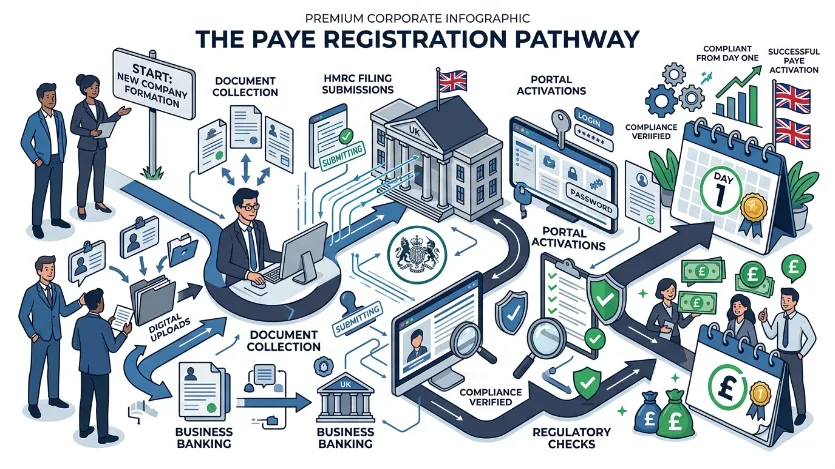
Small business leaders face tight schedules while launching operations. Form My Company streamlines administrative setup tasks by acting directly on behalf of your corporate entity during employer enrollment.
Our specialists review all director documentation to eliminate errors before submitting data to HMRC. This attention to detail eliminates application rejections and speeds up reference number generation.
Beyond basic tax registrations, Form My Company helps businesses establish complete corporate foundations. Whether establishing physical presence or setting up administrative spaces, access executive meeting facilities via our Conference Room services to support your ongoing corporate operations.
By placing your account setup with Form My Company, you protect your business against costly compliance oversights. To understand your complete legal duties as a new employer, read our comprehensive overview on PAYE Registration: Understanding Your Employer Obligations in the UK.
How Do Employers Access and Manage Their PAYE Account?
Employers access their PAYE account through the online HMRC Government Gateway service using their unique user ID, password, and two-factor authentication credentials.
Once HMRC approves your application, they issue two critical identifiers: a 3-digit tax office code with your employer reference, and a 13-character Accounts Office Reference number.
These references link your third-party payroll software directly to HMRC servers. Every time you run payroll, your software uses these credentials to submit Full Payment Submissions (FPS) and Employer Payment Summaries (EPS).
Maintaining secure access to this portal is vital. The online account displays your current balance, tracks incoming tax payments, alerts you to coding notices, and stores official correspondence from tax inspectors.
What Are the Financial Penalties for Non-Compliance?
Non-compliance penalties include fixed monthly late-filing fines starting at £100, interest charges on unpaid statutory taxes, and cumulative penalties for late payments exceeding 30 days.
HMRC automatically tracks filing deadlines through digital reporting systems. Missing an RTI submission deadline triggers an automatic financial penalty based on business size.
Small businesses with 1 to 9 employees face automated fines of £100 per late period
Enterprises with 10 to 49 staff members face £200 fines per late month
Mid-sized firms employing 50 to 250 staff incur £300 monthly late fees
Businesses with over 250 employees receive maximum fines of £400 per month
In addition to late-filing fees, HMRC charges daily interest on overdue tax and National Insurance payments. Serious or repeated non-compliance leads to formal tax audits and severe operational sanctions.
How to Get Started With Professional PAYE Registration?
To get started, compile your business details, select an expert registration provider, submit your corporate information, and let specialists manage your HMRC filings.
Delegating registration tasks to experienced specialists ensures complete legal accuracy. It removes administrative stress, allowing you to focus on core operations and business expansion.
Form My Company coordinates directly with government bodies to secure your employer credentials quickly. Our dedicated team ensures your business meets every compliance benchmark without hassle.
Contact Form My Company today to secure expert registration support. Establishing compliant payroll operations protects your brand reputation and guarantees seamless payroll execution from your very first payday.
Explore our Conference Room guide,
File Your Director Resignation Fast with Form My Company
Save Costs with Form My Company’s Director Appointment Bundle
Frequently Asked Questions
What are the benefits of booking a conference room for a small business meeting?
Booking a conference room provides UK small businesses with a professional, fully equipped environment featuring high-speed internet, audiovisual technology, and administrative support without long-term overhead costs. Using dedicated meeting spaces through Form My Company allows growing enterprises to host client presentations, director assemblies, and team workshops in an authoritative corporate setting.
How do I choose the right conference room layout for a business presentation?
Selecting the ideal conference room layout depends on your event format, total attendee count, and required level of audience interaction. Room arrangements such as boardroom style suit executive discussions, whereas classroom or theater layouts work best for training sessions and corporate workshops. Form My Company offers flexible room configurations to support diverse business meeting requirements.
What amenities are typically included with professional meeting room rentals?
Professional meeting room rentals typically include high-speed Wi-Fi, digital displays or projectors, video conferencing facilities, and whiteboards for collaborative brainstorming. Services provided via Conference Room ensure enterprises access modern communication technology, comfortable seating setups, and optional catering support to deliver seamless corporate events.
Can small businesses rent conference rooms on an hourly or daily basis?
Yes, UK small businesses can hire professional conference rooms on flexible hourly, half-day, or full-day schedules to match their specific event timelines and budget constraints. This pay-as-you-use model managed by Form My Company eliminates fixed lease expenses while giving virtual offices and remote teams access to premier meeting spaces whenever required.
How does hosting meetings in a formal venue impact client perception?
Hosting clients in a dedicated, professionally managed venue establishes credibility, projects brand stability, and demonstrates commitment to corporate standards. Utilizing premium conference space services through Form My Company enhances your business reputation during critical negotiations, investor pitches, and formal board meetings.