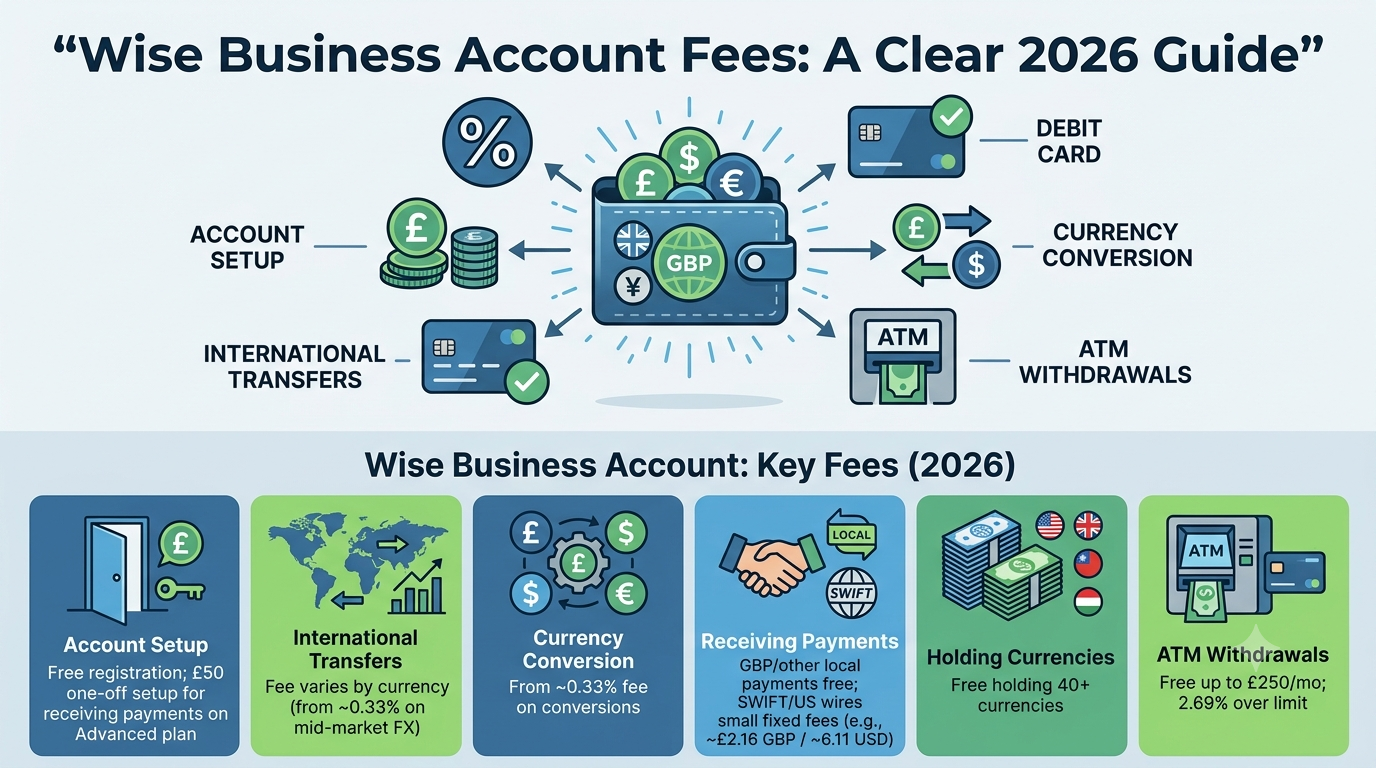
Wise Business Account Fees
The Wise Business account is popular with UK founders, contractors, and non-resident owners because of its multi-currency features and its “no monthly fee” pricing. But “free” and “no monthly fee” don’t tell the whole story, and it’s worth understanding exactly where the costs sit before you sign up. At Form My Company, we help founders form their UK companies and introduce them to banking partners suited to their needs, including Wise. In this guide we explain how Wise Business account fees work in 2026, in plain English.
Because Wise’s pricing changed on 26 November 2025 and rates continue to evolve, this guide focuses on the current fee structure, and we recommend checking Wise’s official pricing page directly for the very latest numbers before applying.
How Wise Business Pricing Works
Wise Business uses a pay-as-you-go pricing model, meaning there’s no monthly subscription. Instead, you pay for specific things like the account setup, transfers, and currency conversion when you use them. This can be efficient for businesses that don’t want a fixed monthly fee, but it does mean the “free” headline needs some context, especially since the UK pricing structure changed in late 2025.
The Two Wise Business Plans in the UK
UK users now choose between two plan types, and the difference is significant. Wise’s UK Business pricing structure changed with effect from 26 November 2025. Receiving money, direct debits, and getting paid features are not available with the Essential Plan, which you can open for free. A one-time setup fee of £50 unlocks the Advanced plan features, including account details to receive payments in 22+ currencies or 8+ currencies for non-SWIFT payments.
In practice, this means most businesses need the Advanced plan. If you need to receive payment from clients, which most businesses do, the Advanced plan is not optional. The cost framing that helps is £50 once, then only the FX fee on months you convert. The Essential plan is genuinely useful if you only want to send money and hold balances, but the moment you need to invoice clients or receive incoming payments, you’re on the Advanced plan.
The Main Fees Explained
Beyond the plan choice, there are a handful of fee types that make up your total cost:
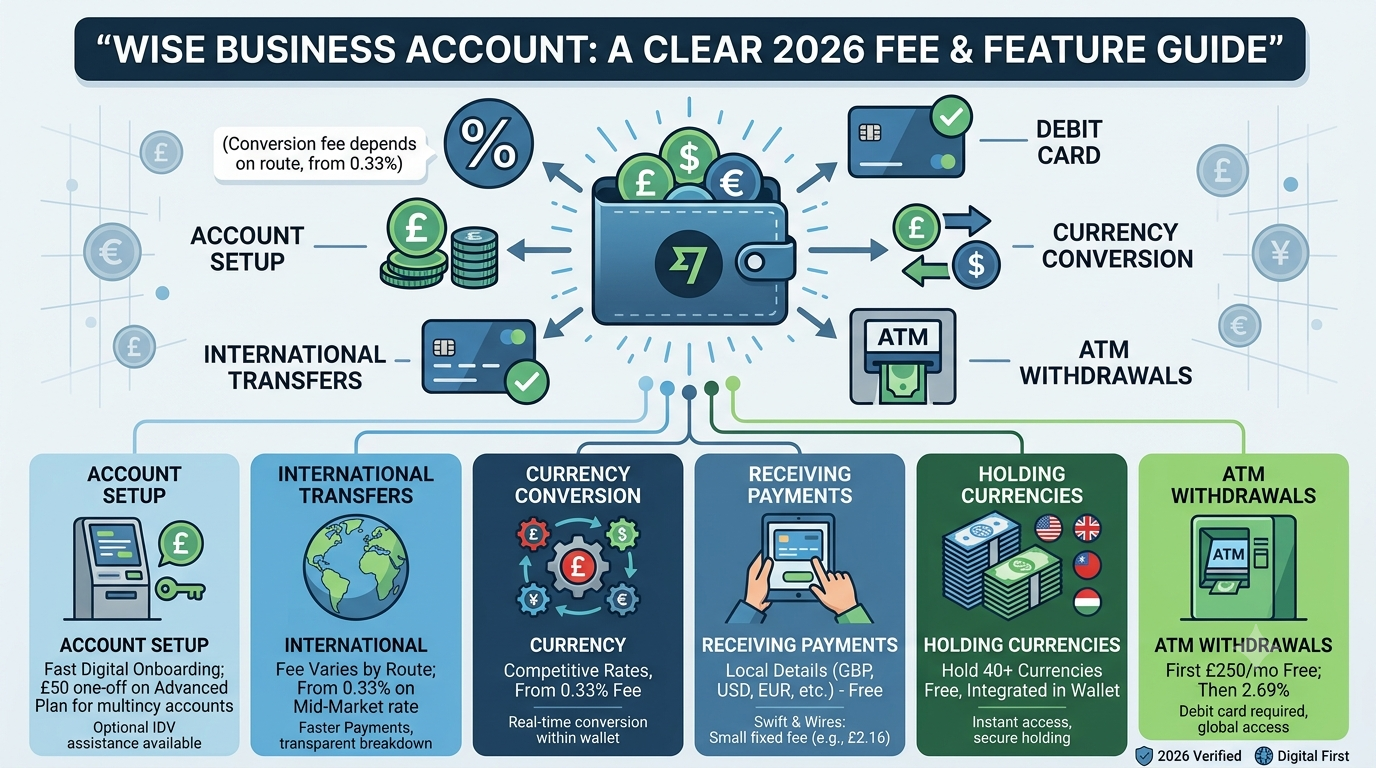
- One-time setup fee. £50 to unlock the Advanced plan. This is charged once, not monthly.
- Currency conversion (FX) fees. When you convert between currencies, Wise uses the mid-market exchange rate and adds a small percentage fee. FX conversions cost the mid-market rate plus a declared fee from 0.33%, varying by currency pair, with GBP to EUR confirmed at 0.37% in April 2026.
- Sending money internationally. Fees vary by destination country, currency, and how you fund the transfer. Wise shows the fee and exchange rate upfront before you confirm.
- Domestic GBP transfers. On the Advanced plan, you get free domestic GBP transfers.
- Receiving incoming payments. Available on the Advanced plan. Some inbound SWIFT payments carry a fee, so it’s worth understanding these if you receive large international wire transfers regularly.
- Debit card. A one-off issue fee applies to the Wise Business debit card, where available in your region.
- No monthly subscription. There’s no ongoing monthly account fee on either plan.
Fees for Non-Resident UK Company Owners
If you’re a non-resident forming a UK limited company, the Wise fee picture is the same as for UK-based businesses. The £50 one-off Advanced fee, mid-market FX conversions, and pay-as-you-go transfer pricing all apply in the same way, which is one reason Wise is a popular banking option for overseas owners of UK companies. It’s a predictable, transparent cost model regardless of where you’re based.
The Important Point About Wise and FSCS
Fees aren’t the only financial consideration, and there’s one distinction worth understanding before you decide where to keep your company’s money. Wise is a financial technology company authorised by the FCA under the Electronic Money Regulations, not a fully licensed UK bank. Customer funds are safeguarded rather than covered by FSCS deposit protection. It’s not the same as putting money in a high street bank with FSCS cover, so factor this in when deciding how much of your working capital to hold with Wise versus a traditional bank.
When Wise Business Is Genuinely Good Value
For the right business, Wise’s fees can be very competitive. Wise tends to be strong value if you regularly send or receive international payments, hold or convert money in multiple currencies, want transparent, upfront fees rather than a monthly subscription, or run a lean operation where the £50 one-off cost is quickly outweighed by savings on foreign exchange.
It’s less compelling if your business is UK-only in GBP with no international element, since there’s no FX advantage to unlock and other UK-focused accounts may suit better. Some businesses use Wise Business alongside a traditional UK account, keeping each for what it does best.
Comparing Wise’s Fees Fairly
The most honest way to compare Wise with other providers is to look at your own likely usage: your expected transfer volumes, currency pairs, and whether you’ll receive international payments. A quick model works well, adding the one-off £50, estimating monthly FX conversion fees based on your currency mix, and comparing that with the monthly fees, FX markups, and transaction charges of alternatives like Revolut Business, Tide, or a high street bank. Wise’s transparency, showing fees and rates before you commit, makes this straightforward to do.
How Form My Company Helps
We form your UK limited company and introduce you to banking partners suited to your setup, including Wise for founders whose needs match its multi-currency, international-payment strengths. Combined with fast, correct company formation, a compliant UK registered office address, and identity verification support, we help you get from incorporation to trading smoothly. Final account approval always rests with the provider, but our introductions and support make the path far easier.
Set Up Your Company and Banking Today
Understanding Wise Business account fees helps you decide whether it’s the right fit for your business, and the current UK structure of a free Essential plan and £50 Advanced plan is straightforward once you know what you actually get on each. With Form My Company, getting your UK company formed and finding suitable banking is quick and fully supported. Get started today, and always check Wise’s current pricing page before applying for the very latest fee details.
Frequently Asked Questions
Does Wise Business charge a monthly fee?
No. There’s no monthly subscription on either plan. Instead, Wise uses a pay-as-you-go model, so you pay for setup, transfers, and currency conversion as you use them.
What is the £50 Wise Business fee?
It’s a one-off setup fee that unlocks the Advanced plan, which includes receiving payments, direct debits, invoice tools, and local account details in multiple currencies. Most businesses need this plan.
What can I do on the free Essential plan?
The Essential plan is free to open and lets you send money and hold currency balances. However, since November 2025 it no longer includes receiving payments or direct debits, so many businesses upgrade to Advanced.
How much does Wise charge for currency conversion?
Wise uses the mid-market exchange rate and adds a small percentage fee that varies by currency pair, starting from around 0.33%. For example, GBP to EUR was around 0.37% in April 2026.
Are domestic GBP transfers free?
On the Advanced plan, domestic GBP transfers are free. This makes Wise practical for UK-based payments as well as international ones once you’ve unlocked Advanced.
Do non-residents pay different Wise Business fees?
No. The fee structure is the same for non-resident owners of UK companies as for UK-based businesses, which is one reason Wise is popular with overseas founders wanting predictable, transparent banking costs.
Is Wise Business protected by FSCS?
No. Wise is an FCA-authorised electronic money institution, not a bank, so customer funds are safeguarded rather than covered by FSCS deposit protection. This is worth factoring in when deciding how much to hold there.