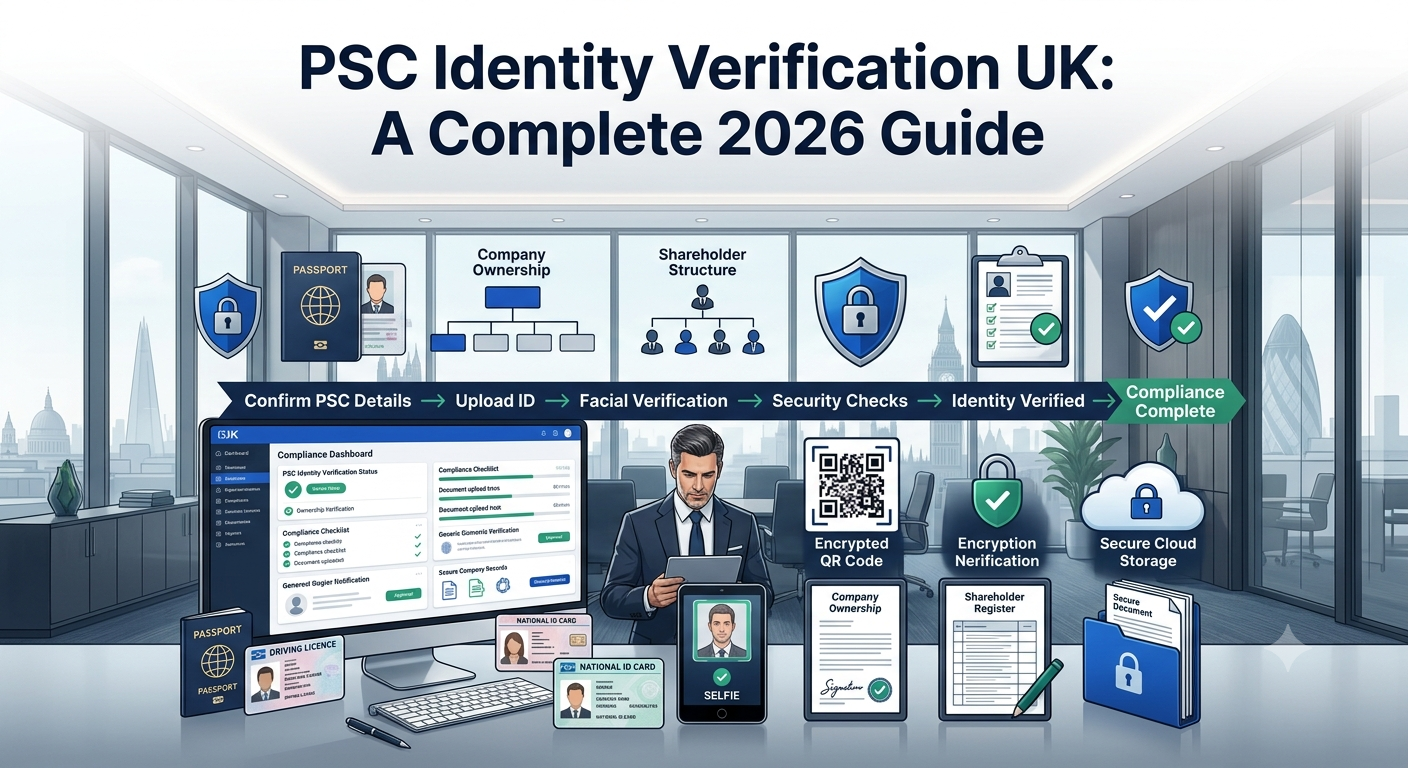
PSC Identity Verification
If you’re a Person with Significant Control (PSC) of a UK company, identity verification isn’t optional. Under the Economic Crime and Corporate Transparency Act (ECCTA), every PSC must verify their identity with Companies House, and the deadlines are already in force. This applies whether you’re also a director of the company or not, whether you’re UK-based or overseas, and whether the company is trading or dormant. At Form My Company, we’re an Authorised Corporate Service Provider (ACSP), and we help PSCs meet the verification requirement remotely, wherever they’re based. This guide explains everything a PSC needs to know about identity verification in the UK.
What Is a PSC?
Before we get into verification, it helps to be clear about what makes someone a PSC. Under UK company law, a Person with Significant Control is someone who owns or controls a company in one of these ways:
- Direct ownership. Holds more than 25% of the company’s shares.
- Direct voting control. Holds more than 25% of the voting rights.
- Right to appoint or remove directors. Has the right to appoint or remove a majority of the board.
- Significant influence or control. Otherwise exercises significant influence or control over the company (or over a trust or firm that has significant control).
For most small UK companies, PSCs are individuals: sole founders, co-founders with meaningful ownership stakes, or family members with significant holdings. For more complex structures, PSCs can also include corporate entities.
Every UK company has to identify and record its PSCs on the Companies House register. This is a legal requirement, and PSCs appear publicly alongside directors on the company’s Companies House profile.
What Is PSC Identity Verification?
PSC identity verification is a legal requirement introduced under the ECCTA that every PSC of a UK company must verify their identity with Companies House. The verification confirms that the person named as PSC is a real, identifiable individual, and the goal is to make ownership of UK companies genuinely transparent.
Once verified, a PSC receives a unique personal code confirming their status. This code stays with them across all their UK roles, present and future, so future company involvements don’t usually require re-verification.
Voluntary verification began on 8 April 2025. Verification became mandatory for all UK company directors and PSCs at Companies House from 18 November 2025.
Why PSC Verification Matters
PSC identity verification is at the heart of the ECCTA reforms because it’s the mechanism that makes beneficial ownership genuinely reliable. Before verification:
- PSC entries could be inaccurate or fictitious. Companies could list names that couldn’t be verified.
- Hidden ownership was easier. Nominee shareholder arrangements sometimes obscured who really owned companies.
- Fraud was easier to commit. Shell companies with fake PSCs were used for various schemes.
- With mandatory verification:
- Names on the PSC register are real people. Companies House can confirm the identity behind each entry.
- Beneficial ownership becomes transparent. Banks, investors, and the public can trust the register.
- Nominee shareholder arrangements lose their privacy appeal. The beneficial owner still has to verify and be publicly declared.
- Enforcement becomes possible. Companies House can pursue false or missing PSC filings.
Deadlines for PSC Verification
The deadlines for PSC verification depend on when you became a PSC and whether you’re also a director of the same company. This is where PSC verification differs importantly from director verification.
- New PSCs from 18 November 2025. Anyone newly meeting the PSC threshold from this date must complete verification before their PSC status is filed with Companies House.
- Existing PSCs who are also directors of the same company. Typically verified aligned with the next confirmation statement filing during the transition period.
- Existing PSCs who are not directors of the same company. This is the important one that many owners miss. These PSCs must verify by the 14th of the month of their birth month. For example, if you were born in March, your deadline is 14 March 2026. If you were born in July, your deadline is 14 July 2026.
- PSCs with multiple company roles. If you’re a PSC of more than one entity, your verification deadline is the earliest applicable one across all your roles.
- New appointments. If you take on a new PSC role or directorship after 18 November 2025, that appointment can trigger an earlier deadline aligned with the new role’s deadlines rather than your birth month.
The birth-month deadline for existing PSCs who aren’t directors is the deadline that catches out many people, particularly those who set up UK companies years ago and haven’t been closely involved in day-to-day compliance.
Who Needs to Verify
The core group is anyone recorded as a PSC on a UK company’s Companies House register. This includes:
- Founding shareholders with 25%+ ownership. The most common PSC category for small companies.
- Family members with significant holdings. For example, in a family business where shares are split.
- Investors with 25%+ stakes. Where investment gives them significant control.
- Beneficial owners behind nominee arrangements. Even if shares are formally held by a nominee shareholder, if you meet the PSC criteria as beneficial owner, you must be declared and verified.
- Trust settlors, trustees, or beneficiaries who exercise control. Depending on the specific trust arrangement.
- Corporate parents that meet PSC criteria. For subsidiaries.
- PSCs of dormant companies. Dormant doesn’t exempt PSC verification.
- PSCs of LLPs. LLP members with significant control are also covered under separate but analogous rules.
If you’re not sure whether you’re a PSC, check your company’s Companies House record and confirm with the company itself. Companies are required to identify and record their PSCs, and you should already be listed if you meet the criteria.
The Two Verification Routes
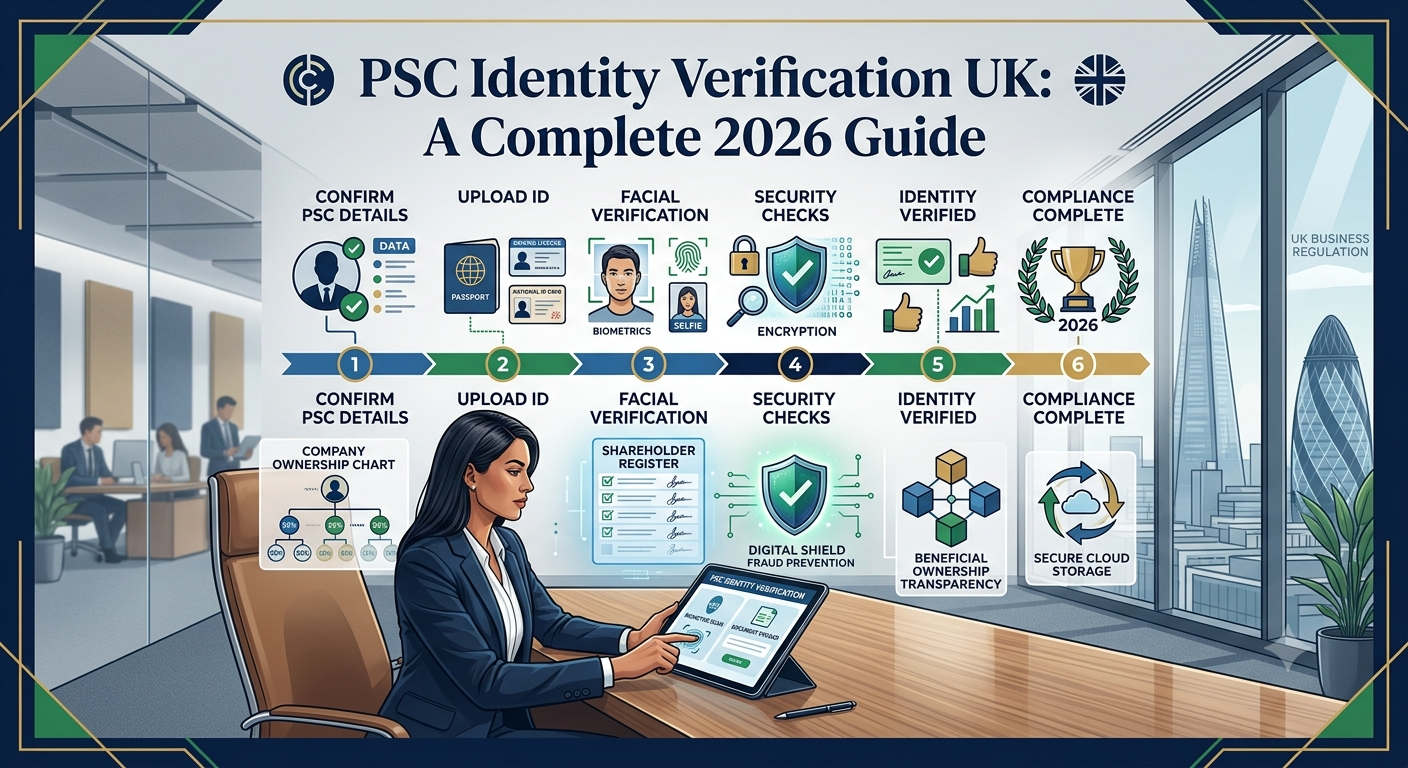
There are two ways to complete PSC identity verification:
Route 1: Direct verification with Companies House.
You verify directly with Companies House using the GOV.UK One Login service. This is done either:
- Through the One Login app on a mobile device
- In-person at a UK post office (which is free but only practical for UK residents)
This route works well for UK-resident PSCs with standard biometric passports.
Route 2: Verification through an Authorised Corporate Service Provider (ACSP).
An ACSP handles the verification on your behalf and confirms it to Companies House. This route is often smoother when:
- You’re a non-resident PSC. International passports and unusual document types are handled more reliably through ACSPs.
- You have edge cases in your documents. Name changes, unusual document formats, or minor mismatches can trip up the standard app.
- You want combined services. ACSPs often bundle PSC verification with director verification, formation, or ongoing compliance, keeping everything in one place.
- You’re catching up before a birth-month deadline. ACSPs can typically process verifications quickly and directly, which matters when you’re close to a deadline.
- You have PSC status in multiple entities. A single ACSP relationship can efficiently handle verification for multiple roles.
Both routes produce the same verified status and give you the same unique personal code.
What You Need to Verify as a PSC
Whichever route you take, you’ll typically need:
- A valid, in-date government-issued photo ID. A biometric passport is the most widely accepted document. UK driving licences and some national IDs may also work depending on the route.
- Biometric verification. Usually a selfie or short video prompt through a mobile app, confirming you’re a real person matching your ID.
- Personal details. Your full legal name (matching your ID exactly), date of birth, and residential address (held privately by Companies House).
- Confirmation of your PSC status. Which company (or companies) you’re a PSC of.
- Consistent information. Everything must match across your ID, Companies House record, and any supporting documents.
For non-resident PSCs, a biometric passport is usually the safest choice.
What Happens If a PSC Doesn’t Verify
The consequences of non-compliance are significant:
- Filing restrictions. Companies where PSCs haven’t verified may face restrictions on statutory filings, disrupting confirmation statements, accounts, and other Companies House interactions.
- Personal penalties. Fines of up to £30,000 per offence can apply.
- Companies House enforcement. Enhanced Companies House powers under the ECCTA include actively pursuing non-compliance.
- Criminal sanctions. Deliberate evasion can lead to criminal prosecution.
- Company strike-off risk. In serious cases, sustained non-compliance can contribute to strike-off proceedings.
- Practical business disruption. Companies with unverified PSCs may face difficulty with banking, contracts, and other business relationships that check Companies House records.
Not being a director doesn’t exempt PSCs from verification, and it doesn’t reduce the consequences of missing the deadline.
PSC Verification for Non-Residents
For non-resident PSCs, the same requirements and deadlines apply, but a few practical points matter:
- No exemption for non-residents. UK law doesn’t distinguish between resident and non-resident PSCs for verification purposes.
- Biometric passport is essential. Most non-residents verify using their national passport.
- The ACSP route is usually smoother. For handling international documents remotely.
- Time zones affect the process. For direct verification through the app, the process is 24/7. For ACSPs, response times align with UK business hours.
- Coordinate with director verification. If you’re both a PSC and a director, a single verification typically covers both roles.
- Home country tax implications may differ. UK verification is a UK matter and doesn’t affect your home country tax position, but for cross-border tax generally, professional advice is worth having.
For non-residents especially, an ACSP that handles PSC verification remotely means you can meet the requirement without visiting the UK or navigating unfamiliar UK government services.
Common Mistakes to Avoid
A few issues come up repeatedly:
- Missing the birth-month deadline. For existing PSCs who aren’t directors, the 14th of your birth month is easy to overlook. Set calendar reminders now.
- Assuming director verification covers PSC status. If you’re both, one verification usually covers both. But if you’re only a PSC (not a director), you have your own deadline and process.
- Confusing PSC identity verification with PSC declaration. They’re separate: you must both be declared as PSC on the register (which most people do at formation) and verify your identity (the new requirement).
- Forgetting existing companies you’re a PSC of. People who set up UK companies years ago sometimes forget they’re still PSCs and haven’t verified. Check your Companies House record for every UK entity you own or control.
- Waiting until the last minute. Verification is usually quick, but occasional complications can occur. Well ahead of your deadline is better.
- Not updating your Companies House record if details have changed. If your name, address, or nature of control has changed since you were recorded as a PSC, update Companies House first so verification matches.
- Overlooking PSC status through corporate structures. If you exercise significant influence through a chain of entities, you may still be a PSC of the ultimate UK company even if you don’t directly hold shares.
Coordinating PSC Verification with Wider Compliance
For most UK company owners, PSC verification is one piece of a broader annual compliance picture:
- Annual confirmation statement. Which includes confirming PSC details are accurate.
- Annual accounts. Whether full or dormant.
- Corporation Tax with HMRC. Which is separate but related.
- Director verification. If you’re also a director.
- Registered office and service address obligations. Which affect where correspondence goes.
Handling all of these together is what an ongoing compliance service provides. For non-residents especially, coordinating PSC verification with other compliance means nothing gets missed.
How Form My Company Helps
As an Authorised Corporate Service Provider (ACSP), we handle PSC identity verification alongside director verification, formation, and ongoing compliance. We can:
- Complete PSC identity verification remotely, wherever you’re based
- Handle verification for multiple PSCs of the same company in one process
- Coordinate PSC verification with director verification if you hold both roles
- Bundle PSC verification with company formation, ongoing filings, and Companies House interactions
- Support non-resident PSCs with international identity documents
- Help you catch up if you’re approaching or have missed a birth-month deadline
- Coordinate with confirmation statement filings and other compliance
- Provide a compliant UK registered office address and director’s service address as part of a wider compliance package
For non-resident PSCs especially, our ACSP service turns what can otherwise be a fiddly cross-border requirement into a straightforward remote process.
Meet Your PSC Verification Requirement Today
PSC identity verification is a legal requirement that applies to every Person with Significant Control of a UK company, whether you’re a director or not, and whether you’re UK-based or non-resident. Missing the deadline (particularly the birth-month deadline for existing PSCs) can lead to real consequences for you and your company. With Form My Company, PSC verification is quick, remote, and fully supported as part of our ACSP services. Get in touch today and meet the requirement without any complications.
Frequently Asked Questions
What is PSC identity verification?
It’s a legal requirement introduced under the ECCTA that every Person with Significant Control of a UK company must verify their identity with Companies House. It’s mandatory as of 18 November 2025 and applies whether you’re also a director or not.
Who counts as a PSC?
Anyone who owns or controls more than 25% of a UK company’s shares or voting rights, has the right to appoint or remove a majority of the board, or otherwise exercises significant influence or control. Beneficial owners behind nominee shareholder arrangements are also PSCs if they meet the criteria.
When is my PSC verification deadline?
For existing PSCs who aren’t also directors of the same company, the deadline is the 14th of the month of your birth month. So if you were born in March, verify by 14 March 2026. For new PSCs from 18 November 2025 onwards, verification must be complete before the appointment is filed. Directors have separate deadlines aligned with the confirmation statement.
What if I’m both a PSC and a director?
One verification usually covers both roles. You receive a single unique personal code that applies to all your UK company involvements. Your verification deadline is typically the earlier of any applicable director or PSC deadlines.
Do non-resident PSCs need to verify?
Yes. There’s no residency-based exemption. All PSCs of UK companies must verify regardless of where they live. The ACSP route is often smoother for non-residents with international documents.
What happens if I miss the PSC verification deadline?
Personal fines up to £30,000 per offence can apply, filing restrictions can affect the company, and criminal sanctions are possible for deliberate evasion. Companies with unverified PSCs may also face practical difficulties with banking, contracts, and other business relationships.
Can Form My Company handle PSC verification for me?
Yes. As an ACSP, we handle PSC identity verification remotely, whether you’re UK-based or non-resident. We can coordinate PSC verification with director verification, formation, and ongoing compliance so everything is handled in one place.