VAT Return Filing Service
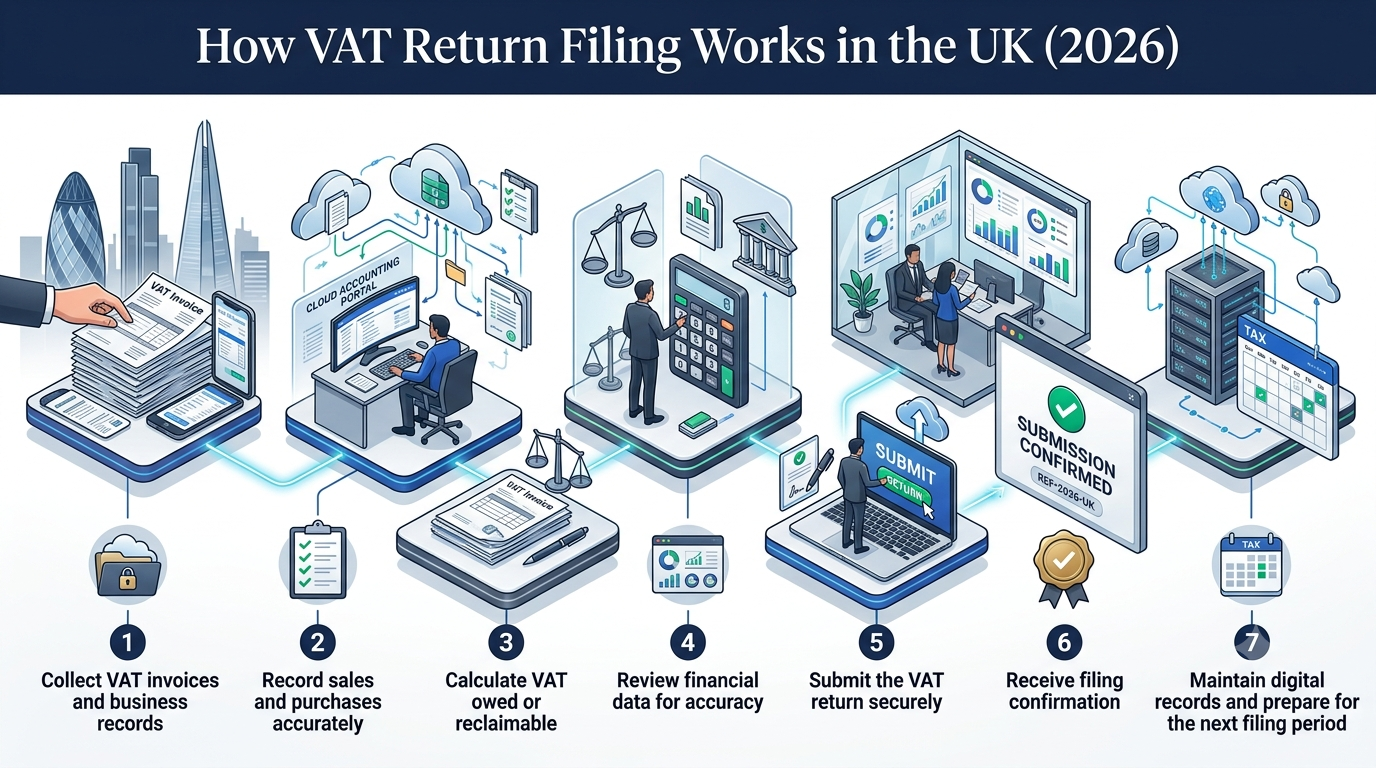
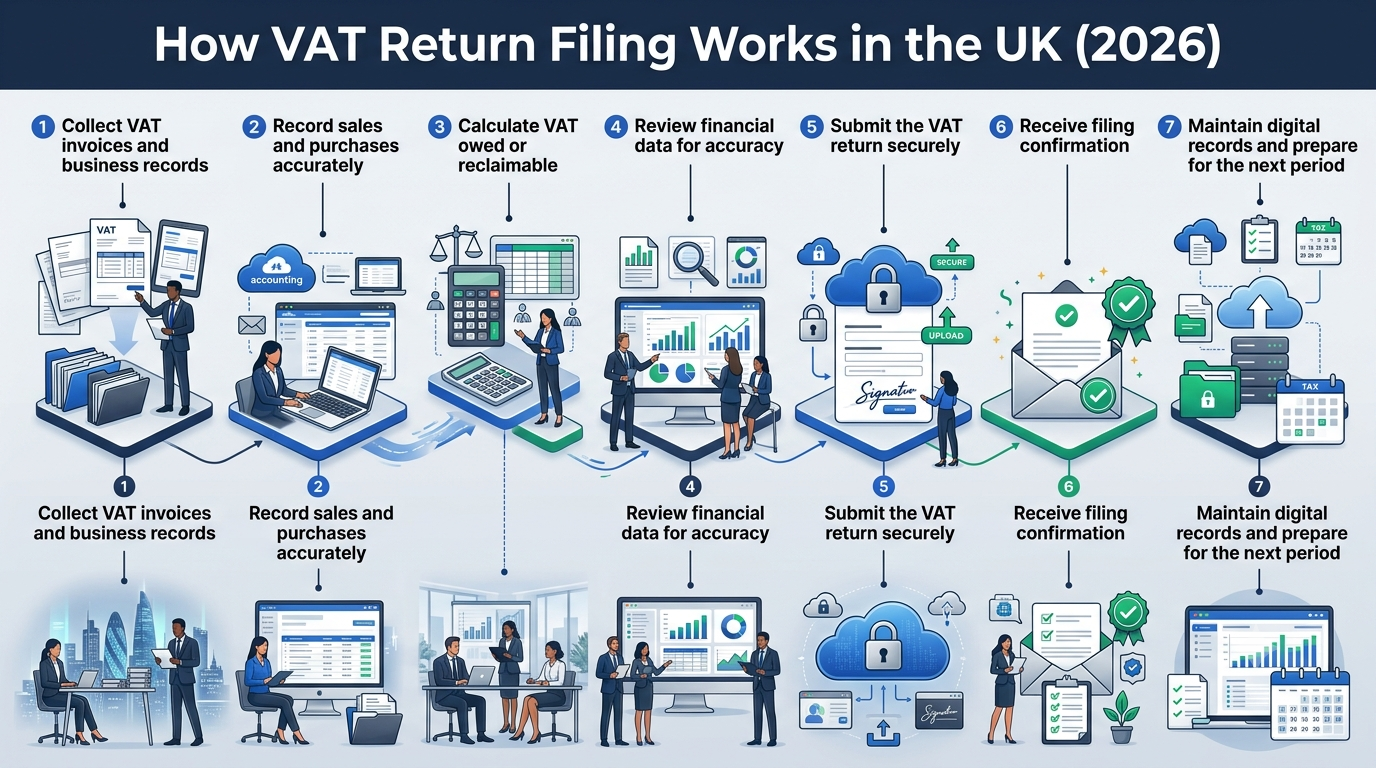
VAT return filing is one of the most important ongoing tax obligations for any UK VAT-registered business. Every quarter (or annually, depending on your scheme), you must file a return with HMRC showing VAT charged on sales, VAT reclaimed on purchases, and the net position. Under Making Tax Digital rules, this must be done through compatible software, and getting it right matters for both compliance and cash flow. At Form My Company, we help UK businesses coordinate their VAT registration with wider compliance and can point you toward qualified accountants for ongoing VAT return filing. This guide explains what a VAT return filing service is, what to look for, and how it fits with your wider compliance.
What Is VAT Return Filing?
VAT return filing is the periodic submission of your business’s VAT information to HMRC. For most VAT-registered businesses, this happens quarterly, though annual accounting is an option for some. The return shows:
- Output VAT. Total VAT you’ve charged customers on sales during the period.
- Input VAT. Total VAT you’ve paid on business expenses that you’re eligible to reclaim.
- Net VAT position. Either VAT owed to HMRC (output higher than input) or VAT reclaimable from HMRC (input higher than output).
- Adjustments. Any corrections, bad debt relief claims, or other adjustments.
- Total transactions. Some summary figures HMRC requires.
Once filed, you pay any VAT owed to HMRC (or receive a refund) typically within one calendar month plus 7 days of the end of the VAT period.
Why VAT Return Filing Is a Real Ongoing Workload
For UK businesses, VAT return filing isn’t a one-off task. It’s an ongoing quarterly discipline that requires:
- Accurate bookkeeping. All transactions during the period need to be recorded correctly with the right VAT treatment.
- Correct VAT rate application. Standard rate (20%), reduced rate (5%), zero rate (0%), or exempt for each transaction type.
- Making Tax Digital software. Under MTD rules, records must be kept digitally and returns filed through compatible software (like Xero, QuickBooks, Sage, or FreeAgent).
- Understanding VAT rules. For your specific sector, scheme, and business circumstances.
- Timely filing. Deadlines are strict, and late filing carries penalties.
- Cash flow management. VAT is essentially a pass-through tax, but timing differences affect your cash position.
- Recordkeeping. VAT records must be kept for 6 years, and HMRC can audit at any time.
For growing businesses, this workload can become substantial. Many businesses outsource VAT return filing to focus on their actual operations.
What a VAT Return Filing Service Actually Does
A VAT return filing service typically covers:
- Preparing the VAT return. Analyzing transactions, categorising VAT, and calculating the net position.
- Verifying accuracy. Checking for errors, missing invoices, or incorrect VAT treatments.
- Filing with HMRC. Through Making Tax Digital-compatible software.
- Managing deadlines. Tracking VAT periods and ensuring returns are filed on time.
- Handling HMRC queries. If HMRC contacts you about the return, the service responds on your behalf.
- Providing you with copies. Of filed returns for your records.
- Advising on VAT issues. Any concerns about specific transactions, scheme changes, or business developments.
- Tracking payment obligations. So you know what VAT you owe and when.
- Coordinating with your bookkeeping. Either using your existing records or providing bookkeeping services alongside filing.
- Advising on scheme optimisation. Whether your current scheme is still right for your business.
For businesses that want VAT filing handled professionally, a service takes this ongoing burden off your plate.
Who Provides VAT Return Filing Services
VAT return filing services are typically provided by:
- Qualified accountants. Firms of Chartered Accountants (ACA/ACCA) or Chartered Institute of Taxation members are the most common providers. They combine VAT filing with wider tax and financial services.
- Bookkeeping practices. Specialist bookkeeping firms often handle VAT return filing as part of ongoing bookkeeping services, sometimes overseen by qualified accountants.
- Cloud accounting specialists. Firms specialising in Xero, QuickBooks, or FreeAgent handle VAT filing within cloud accounting workflows.
- Tax consultancies. Some specialist tax firms focus specifically on VAT and related matters.
- Online accounting platforms. Some online accountancy platforms provide VAT return filing as a bundled service alongside broader accounting.
Corporate service providers and ACSPs (like Form My Company) typically don’t provide ongoing VAT return filing themselves, though they can coordinate VAT registration and point you toward qualified accountants for the ongoing filing.
The Making Tax Digital Requirement
All VAT-registered UK businesses must comply with Making Tax Digital for VAT:
- Digital records. Business records must be kept digitally, not on paper.
- MTD-compatible software. VAT returns must be filed through software approved for MTD (Xero, QuickBooks, Sage, FreeAgent, and others).
- Digital links. Where records are held in multiple systems, links between them must be digital.
- No manual transcription. You can’t type figures from paper records into filing software; the data must flow digitally.
- Making Tax Digital for Income Tax. Some businesses will also need to file quarterly returns for Income Tax under MTD for Income Tax rules, which are separate from VAT.
For VAT return filing services, MTD compliance is fundamental. Any legitimate service will use MTD-compatible software.
Common VAT Schemes and How They Affect Return Filing
Different VAT schemes affect how return filing works:
- Standard accounting. Default scheme. You account for VAT based on invoice dates, file quarterly returns, and reconcile against invoices.
- Cash Accounting Scheme. You account for VAT based on payments made and received, not invoice dates. Simpler for businesses with cash flow considerations.
- Flat Rate Scheme. You pay HMRC a fixed percentage of turnover based on your business type, rather than the detailed input/output calculation. Can be simpler but restricts VAT reclaim on most purchases.
- Annual Accounting Scheme. You file one annual return instead of quarterly, with monthly or quarterly instalments. Reduces filing frequency but requires cash flow monitoring.
- Retail Schemes. For high-transaction-volume retail businesses, various schemes simplify VAT calculations.
The choice of scheme affects both the complexity of return filing and what a service provider does. Some schemes require less detailed transaction analysis; others require more.
VAT Return Filing Deadlines
VAT return filing is time-sensitive:
- Standard quarterly returns. Filed within one calendar month plus 7 days after the end of the VAT period. For example, a return for the period ending 31 March must be filed and paid by 7 May.
- Annual accounting returns. Filed within 2 months of the end of the annual accounting period, with monthly or quarterly instalments due before that.
- Payment deadline. Same as the filing deadline. VAT owed must be paid by that date.
- Refund timing. VAT refunds typically arrive within 10 to 14 working days of the filed return.
- Late filing penalties. Automatic penalties start from £100 for late returns, escalating for repeat lateness or non-payment.
Meeting deadlines is essential. Regular filing schedules and reliable software help keep businesses on track.
What to Look For in a VAT Return Filing Service
Not every provider is equal. Key factors when choosing:
- Qualification and regulation. Accountants qualified with ACCA, ACA, or CIMA offer professional standards. Chartered Tax Advisers add specific tax expertise. Ensure the provider is regulated.
- MTD compatibility. All legitimate services use MTD-compatible software.
- Sector experience. If your business is in a specific sector (e-commerce, hospitality, professional services), a provider familiar with sector-specific VAT rules is valuable.
- Software integration. How the service works with your existing bookkeeping (or if they provide bookkeeping too).
- Communication and responsiveness. Regular updates on deadlines, any issues, and questions.
- Timeliness. Reliable filing well before deadlines to avoid last-minute stress.
- Wider tax expertise. For businesses that want ongoing tax planning alongside VAT filing, a provider offering broader tax services adds value.
- Client size fit. Some providers serve micro-businesses; others focus on larger clients. Match the provider to your scale.
- Fee transparency. Clear pricing without surprises.
- Pointing to specialist help. Good providers acknowledge when a client’s situation is unusual and refer to specialists.
VAT Return Filing for Non-Resident Sellers
For non-resident owners of UK businesses, VAT return filing has specific considerations:
- Same MTD requirements. All VAT-registered businesses must comply with Making Tax Digital, regardless of owner residency.
- Time zones and communication. A UK-based accountant is often easier to work with than trying to file remotely from abroad.
- Coordination with Companies House compliance. VAT filings and Companies House filings run on different timelines. Coordination matters.
- Cross-border implications. Non-resident sellers may have specific rules affecting how VAT applies to their sales.
- Bank account for payments. Paying VAT to HMRC from a non-UK bank account is possible but can add complexity.
- Working with a UK accountant. For non-residents specifically, working with a UK accountant who understands both VAT and cross-border tax issues is usually well worth the cost.
Form My Company doesn’t provide ongoing VAT return filing directly, but we can help non-resident owners coordinate their VAT registration through our services and point them toward qualified UK accountants for the ongoing filing work.
Costs of VAT Return Filing Services
Costs vary significantly by provider and business complexity. Typical ranges:
- Simple quarterly filing. £50 to £150 per quarter for straightforward businesses.
- Medium complexity. £150 to £400 per quarter for growing businesses with more transactions.
- Complex businesses. Higher amounts for businesses with cross-border activity, complex ownership, or specific sector rules.
- Bundled with bookkeeping. Often better value than separate services.
- Annual retainer. Some providers charge an annual retainer covering VAT and other services.
- Setup fees. For onboarding, some providers charge one-off setup costs.
The right price depends on your business complexity and what’s included. Ask for clear quotes.
VAT Return Filing and Wider Compliance
VAT return filing is one part of wider UK business compliance:
- Companies House filings. Confirmation statement, accounts, director changes. Separate from VAT but interacting with your overall compliance.
- Corporation Tax. Filed annually with HMRC. VAT and Corporation Tax are separate but related.
- PAYE. If you have employees, separate ongoing filings.
- Making Tax Digital for Income Tax. May affect sole traders and landlords with quarterly income filings.
- Auto-enrolment. For pension obligations if you have staff.
- Employer obligations. Various if you have employees.
Coordinating all of these efficiently is what a good tax and compliance setup does. VAT filing sits within this broader picture.
Common Mistakes in VAT Return Filing
A few issues come up regularly:
- Late filing. Missing the filing or payment deadline results in penalties.
- Incorrect VAT rate application. Applying the wrong rate to transactions.
- Missing input VAT reclaims. Not claiming VAT paid on eligible expenses.
- Timing errors. Recording transactions in the wrong VAT period.
- Failing MTD requirements. Manual transcription or non-compliant software.
- Scheme choice errors. Being in the wrong scheme for your business.
- Poor record-keeping. Missing invoices, incomplete records, or unclear categorisation.
- Ignoring HMRC correspondence. Not responding to queries promptly.
- Bad debt relief errors. Missing legitimate claims.
- Cross-border transaction errors. Non-resident sellers, imports, exports, and reverse charge situations can be tricky.
Professional support significantly reduces these risks.
How Form My Company Fits with VAT Return Filing
We help UK businesses coordinate their VAT registration and wider Companies House compliance. Our role in the VAT ecosystem:
- VAT registration. We handle the registration application with HMRC, particularly for new UK companies and non-resident sellers.
- Coordination with Companies House. VAT registration works alongside confirmation statements, director filings, and other Companies House work.
- UK correspondence address. As part of our Non-Residents package, we provide a UK address for HMRC correspondence.
- Guidance on scheme choice. During registration, we can help you understand which VAT scheme fits your business.
- Referral to qualified accountants. For ongoing VAT return filing, we point you toward accountants with sector-specific expertise and MTD-compliant workflows.
- Compliance coordination. We help make sure VAT registration timing aligns with your wider UK compliance calendar.
This positioning means we handle what we’re genuinely good at (Companies House compliance, ACSP services, VAT registration coordination) while pointing you toward accountants for the ongoing tax work that requires their specialist expertise.
Get the Right VAT Return Filing Support Today
VAT return filing is an ongoing compliance obligation that most UK businesses need professional support for, particularly under Making Tax Digital rules. For non-residents especially, working with a qualified UK accountant is usually essential rather than optional. If you’re setting up VAT registration or need to coordinate VAT with wider Companies House compliance, Form My Company can help with the registration and coordination side while pointing you toward qualified accountants for ongoing filing. Get in touch today to discuss your situation.
Frequently Asked Questions
What is a VAT return filing service?
It’s an ongoing service handling the periodic (usually quarterly) submission of your business’s VAT information to HMRC through Making Tax Digital-compatible software. A good service prepares the return, verifies accuracy, files on time, and handles any HMRC queries.
Does Form My Company handle ongoing VAT return filing?
No. We handle VAT registration coordination and Companies House compliance, but ongoing VAT return filing is genuinely a job for qualified accountants. We can help with registration and point you toward accountants for ongoing filing.
How often do I file a VAT return?
Most businesses file quarterly returns, with the return due one calendar month plus 7 days after the end of the VAT period. Some businesses can use the Annual Accounting Scheme with one annual return and instalments.
What is Making Tax Digital and how does it affect VAT return filing?
Making Tax Digital (MTD) requires all VAT-registered businesses to keep digital records and file returns through MTD-compatible software. It’s mandatory for all VAT-registered businesses.
How much does a VAT return filing service cost?
Typically £50 to £400 per quarter depending on business complexity. Bundled with bookkeeping often offers better value than separate services. Non-resident businesses may have higher costs due to complexity.
What if I miss a VAT return deadline?
Automatic penalties start from £100 and escalate for repeat lateness. Interest charges apply to unpaid VAT. Filing late once is manageable; consistent lateness compounds quickly.
Can Form My Company help me choose the right VAT scheme?
Yes, during VAT registration coordination. We can discuss whether standard accounting, Flat Rate, or another scheme fits your business. For detailed ongoing scheme decisions once you’re trading, a qualified accountant provides deeper guidance.