
UK companies must identify, confirm, and report all Persons with Significant Control (PSCs) to Companies House to maintain legal transparency. Failing to maintain an accurate PSC register leads to severe financial penalties, operational restrictions, and corporate prosecution under updated UK company law.
What Is a PSC Register under UK Company Law?
A PSC register is an official corporate record listing individuals or legal entities that hold significant ownership or voting control over a UK company. Companies House requires this register to identify real beneficial owners and prevent corporate fraud.
Every UK limited company and limited liability partnership must identify its beneficial owners under the Companies Act 2006. The Persons with Significant Control framework mandates that businesses maintain an accurate record of individuals who exert substantial influence over corporate operations. Companies store this register at their registered office address or submit it directly to the central public register at Companies House.
A Person with Significant Control meets one or more legal conditions within the enterprise structure. These conditions include holding more than 25% of company shares, controlling more than 25% of voting rights, or possessing the right to appoint or remove the majority of the board of directors. Persons exercising significant influence or control through informal arrangements or trust structures also qualify as PSCs under regulatory guidelines.
Maintaining this register ensures complete corporate transparency across the UK business sector. Regulatory bodies, financial institutions, and law enforcement agencies use these public disclosures to track company ownership structures. Failure to identify beneficial owners creates significant compliance vulnerabilities that undermine corporate legitimacy across the UK market.
Why Has PSC Compliance Changed in 2026?
PSC compliance changed in 2026 due to enforced Companies House identity verification mandates that require every registered PSC to verify their identity before filing company records. These rules eliminate anonymous corporate ownership and strengthen business transparency across the United Kingdom.
The Economic Crime and Corporate Transparency Act introduced stringent identity verification requirements for all active company directors and PSCs. Identity verification ensures that the individual named on the public register matches official government credentials. Unverified individuals cannot complete mandatory filings, which halts routine corporate activities and compromises business standing.
Companies House now cross-references corporate filings directly against public databases to identify fraudulent ownership claims. Automated compliance systems verify corporate records against official tax registers, identity databases, and law enforcement monitoring lists. Misrepresenting PSC details or filing incomplete operational data triggers automated compliance audits and immediate administrative penalties.
Regulatory agencies enforce stricter oversight protocols to disrupt illicit financial activities and corporate impersonation. Business owners must implement proactive compliance measures to safeguard corporate documentation against unauthorized updates. Utilizing specialized fraud protection services prevents unauthorized filings and protects corporate records from identity manipulation.
How Do You Identify Persons with Significant Control in Your Business?
Identifying PSCs requires evaluating shareholding percentages, voting allocations, board appointment powers, and informal control structures against official statutory criteria. Businesses must audit their equity structure to confirm every individual who exceeds the 25% ownership threshold.
Companies determine PSC status by systematically assessing corporate ownership data against five specific statutory conditions. The first condition applies to individuals holding more than 25% of total issued shares. The second condition identifies individuals controlling more than 25% of total voting rights during shareholder decisions. The third condition covers individuals who hold the legal authority to appoint or remove a majority of board members.
The fourth condition involves individuals who exercise significant influence or control over company decisions without direct shareholding. This includes shadow directors, dominant advisors, or individuals managing operational directions behind formal corporate structures. The fifth condition applies to trustees or firm members who meet any of the first four conditions through complex trust mechanisms.
Business structures must document every step of the identification process within official company records. If an individual qualifies under multiple criteria, the company register must record every applicable condition. Corporate leaders who fail to issue formal legal notices to identify unknown beneficial owners commit an official legal offense under corporate legislation.
What Information Must Be Recorded in the PSC Register?
The PSC register must contain full legal names, service addresses, residential addresses, nationality, date of birth, and the specific nature of corporate control. Accurate entry of this data ensures complete compliance with UK corporate reporting standards.
Every entry in the corporate register must record mandatory personal details using verified legal documents. Official entries include the full legal name, date of birth, nationality, and main country of residence. Companies must record a official service address for public display and a private residential address for restricted regulatory access.
The register must specify the exact date the individual became a Person with Significant Control within the organisation. Records must detail the precise percentage band of shares or voting rights controlled by the PSC. The three statutory percentage bands are:
Exceeding 25% up to 50%
Exceeding 50% up to 75%
Reaching 75% or higher
Changes to PSC information require immediate updates in both the internal register and the central database. If an individual updates their residential address or legal name, the company must update internal records within 14 days. Companies must report these updates to Companies House within 14 days of updating internal documentation.
How Do DIY Record Keeping and Professional Archive Services Compare?
DIY record keeping relies on internal administrative manual management, whereas professional archive services automate tracking, secure corporate files, and guarantee regulatory compliance. Manual management frequently causes filing delays, missing documentation, and statutory compliance errors.
Small business owners often manage regulatory registers manually using basic spreadsheets or paper filings. Manual record-keeping methods increase human error risks during routine corporate record updates. Missing legal deadlines or filing incorrect personal data triggers financial penalties and delays corporate transactions. For detailed operational comparisons, evaluate Company Documents: DIY Record Keeping vs. Professional Archive Services.
Professional compliance archives provide secure digital storage systems designed specifically for legal document management. Automated tracking systems alert company directors before mandatory confirmation statements or PSC updates fall due. Professional services secure sensitive personal details against unauthorized access while ensuring instant retrieval for regulatory inspections.
| Compliance Feature | DIY Internal Record Keeping | Professional Archive Services |
| Data Accuracy | High risk of manual entry errors | Automated validation and verification |
| Filing Tracking | Manual calendar reminders | Automated deadline alerts |
| Security Standards | Basic digital or paper storage | Encrypted digital record vaults |
| Regulatory Risk | Direct exposure to missed deadlines | Continuous statutory compliance monitoring |
What Are the Penalties for Non-Compliance with PSC Rules?
Non-compliance with PSC rules results in unlimited financial fines, criminal prosecution of company officers, and severe restrictions on share transfer rights. Regulators treat deliberate failure to maintain an accurate register as a serious criminal offense.
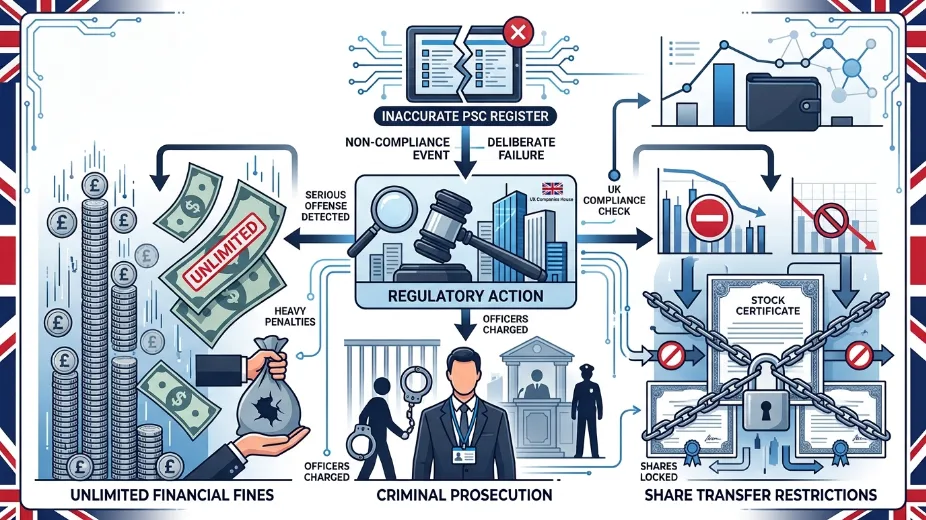
Companies House holds both the corporate entity and individual directors accountable for PSC compliance failures. Failing to keep an accurate internal register leads to immediate statutory notices and administrative fines. Persistent failure to supply accurate beneficial ownership information results in corporate prosecution under UK criminal courts.
Companies can restrict the rights attached to shares held by unidentified PSCs who refuse to respond to official information requests. Issuing a restrictions notice freezes dividend payments, cancels voting rights, and blocks share transfers associated with the affected equity. These legal restrictions remain active until the individual completes identity verification and supplies required disclosures.
Uncompliant corporate records prevent businesses from securing commercial loans, opening merchant accounts, or completing equity sales. Financial institutions terminate banking relationships when corporate registers contain unverified ownership data or overdue filings. Maintaining precise corporate disclosures prevents severe commercial disruptions and protects business valuation.
How Do You Submit and Update PSC Details with Companies House?
Updating PSC details requires submitting official filing forms to Companies House electronically within statutory time limits following any corporate change. Prompt electronic reporting ensures your public records reflect actual corporate ownership structures accurately.
Companies report PSC information during initial company formation or through annual confirmation statement filings. When beneficial ownership shifts, businesses must submit specific notification forms detailing the operational change. Form PSC01 registers a new individual PSC, while Form PSC02 registers a relevant legal entity.
Modifications to existing PSC details require submitting Form PSC04 within 14 days of updating the internal company register. If an individual ceases to act as a PSC, the business must file Form PSC07 to notify Companies House. Electronic filing platforms process these updates rapidly, reducing administrative delay and ensuring instant public compliance.
Organizations must maintain complete audit trails detailing every modification made to ownership structures over time. Archiving historical PSC notifications proves compliance during regulatory reviews or third-party due diligence assessments. Partnering with compliance experts simplifies document management and ensures every statutory notification meets strict legal formats. Learn how to Maintain your PSC Register compliance with Form My Company to ensure continuous regulatory alignment.
How Does PSC Transparency Protect Business Security?
PSC transparency prevents corporate hijacking, minimizes money laundering risks, and reinforces commercial credibility across global supply chains. Public clarity regarding beneficial ownership deters fraudulent activities and protects genuine enterprise stakeholders.
Clear corporate ownership disclosure deters bad actors from using corporate entities for illegal financial operations. When beneficial owners verify their identities, fraudulent business registrations decline significantly across the corporate sector. Transparent corporate records allow business partners to conduct accurate due diligence before entering commercial agreements.
Public availability of verified PSC data builds instant trust with global suppliers, enterprise clients, and institutional lenders. Commercial partners review public ownership records to confirm company stability and regulatory legitimacy. Transparent organisations secure financing faster because lending institutions clear compliance reviews without administrative delays.
Implementing robust corporate governance frameworks safeguards your enterprise against corporate identity theft. Combining verified PSC documentation with automated record monitoring blocks unauthorized attempts to alter corporate ownership structures. Maintaining legal compliance ensures business continuity and reinforces long-term market reputation.
Explore our Fraud Protection guide,
How to Minimize Distractions During Your Next Corporate Team Training Program Session
The Impact of Unfiled Dormant Accounts on Your Personal Director Credit Rating
Frequently Asked Questions
How does UK company fraud protection work?
Form My Company provides automated monitoring tools that connect directly with the Companies House public register to detect unauthorized filings in real time. When fraudulent changes are attempted—such as unauthorized director appointments or registered address modifications—our fraud protection alert system notifies directors instantly so they can block identity theft.
Can someone steal my limited company identity?
Yes, corporate hijacking occurs when fraudsters submit false filing forms to Companies House to change your company details and divert corporate assets. Using a dedicated fraud protection service from Form My Company protects your legal records through active 24/7 registration monitoring and instant filing notifications.
What notifications do I receive with company fraud monitoring?
Our fraud protection platform alerts you immediately whenever any change is recorded against your official company registration number. Form My Company sends real-time email notifications for updates involving directors, shareholders, registered addresses, accounts, and PSC register filings.
Why is corporate fraud protection important for UK businesses in 2026?
Enhanced enforcement under the Economic Crime and Corporate Transparency Act makes businesses vulnerable to unauthorized registry changes and non-compliance fines. Implementing fraud protection through Form My Company protects company credibility, ensures accurate statutory filings, and shields directors from identity theft risks.
What should I do if an unauthorized filing is made against my company?
If an unauthorized filing occurs, immediately notify Companies House and utilize Form My Company to file administrative correction forms. Our fraud protection support team assists directors in verifying statutory entries, updating public records, and restoring authorized legal ownership.