
UK companies maintain PSC register compliance by identifying all Persons with Significant Control, recording their personal details, verifying identity credentials, and submitting accurate updates to Companies House within strict statutory deadlines. Non-compliance leads to severe financial fines, restrictions on share transfers, and potential criminal prosecution for company directors.
What Is a PSC Register and Why Must UK Companies Maintain It?
A PSC register is an official statutory record that details every individual or legal entity holding significant control over a UK company. Maintaining this register ensures total corporate transparency, upholds legal accountability, and fulfills statutory obligations under UK company law.
Under the Companies Act 2006, every UK private limited company, limited liability partnership (LLP), and eligible status entity must maintain an accurate record of individuals who exert ultimate ownership or influence. A Person with Significant Control typically holds more than 25% of company shares, controls over 25% of voting rights, holds the right to appoint or remove a majority of the board of directors, or otherwise exercises significant influence over management.
Transparency laws exist to prevent corporate vehicles from being used for illicit financial activities, money laundering, or fraudulent operations. When business owners maintain precise records, regulatory authorities and financial institutions can easily verify ultimate beneficial ownership. To understand the underlying legal responsibilities governing operational transparency, review our comprehensive guide on PSC Register Explained: Your Responsibilities for Transparency. Failing to maintain this register accurately damages commercial credibility and triggers immediate regulatory intervention.
How Do You Identify and Verify Persons with Significant Control?
Companies identify PSCs by analyzing share registries, voting rights, and governance structures, then verifying each individual’s identity using official government-issued documentation. Verification requires confirming personal details against statutory criteria before entering information into the official register.
To correctly identify qualified individuals, company officers must review five specific statutory conditions established by UK corporate regulations. An individual meets the criteria if they fulfill one or more of the following conditions:
Hold more than 25% of company shares
Hold more than 25% of company voting rights
Hold the right to appoint or remove the majority of the board
Exercise significant influence or control over the company
Exercise significant influence or control over a trust or firm that meets any of the first four conditions
Once an individual is identified, company officers must issue formal requests to confirm personal data. Mandatory details include full legal name, service address, residential address, date of birth, nationality, country of residence, and the exact date control was acquired.
When corporate fraud risks arise, administrative errors during verification can expose corporate officers to severe liabilities. Securing corporate identity integrity requires robust monitoring tools, which is why business owners rely on Fraud Protection services to safeguard register details from unauthorized alterations and fraudulent filings.
What Are the Key Statutory Deadlines for Updating PSC Records?
UK companies must update their internal PSC register within 14 days of receiving confirmed control changes, and file these updates with Companies House within a further 14 days. The total statutory window for public registration cannot exceed 28 days.
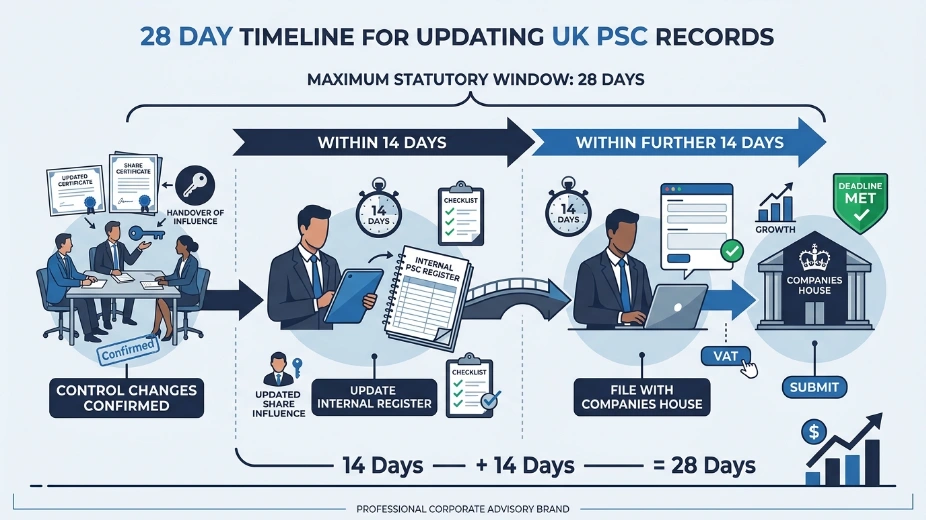
Timing is critical when maintaining statutory corporate compliance. When changes occur—such as a transfer of shares, an appointment of a new director with significant voting rights, or a change in a PSC’s residential address—the company clock begins immediately.
If a company fails to update internal records within the initial 14-day period, corporate officers commit an operational offense. If the subsequent 14-day public filing deadline with Companies House is missed, the entity faces legal defaults. Regular statutory audits ensure that corporate registers match actual control structures. Managing physical and digital corporate records systematic prevents these compliance gaps. Businesses seeking structured record management can explore our analysis on Company Documents: DIY Record Keeping vs. Professional Archive Services to streamline document workflows.
What Are the Penalties for Non-Compliance with PSC Regulations?
Non-compliance results in automatic statutory fines, daily default penalties for corporate officers, restrictions on share transfers, and potential custodial sentences up to two years. Companies House can also initiate proceedings to strike non-compliant businesses off the public register.
The enforcement mechanisms governing beneficial ownership reporting are strict and financially severe. Penalties apply directly to both the corporate entity and individual company officers who fail to act with due diligence.
| Penalty Type | Target Entity / Role | Financial / Legal Consequence |
| Fixed Statutory Fines | Company Officers & Directors | Unlimited financial penalties based on court conviction level |
| Daily Default Fines | Corporate Entity | Accumulating daily fines for each day the register remains uncorrected |
| Restrictions Notice | Shareholder / PSC | Freezes share transfers, dividends, and voting rights linked to shares |
| Criminal Prosecution | Managing Directors / Company Secretaries | Up to two years imprisonment for knowingly filing false details |
| Company Strike-Off | Entity Public Status | Permanent dissolution of the legal corporate entity from the public register |
When individuals fail to reply to statutory notices sent by a company, officers must issue a formal Warning Notice followed by a Restrictions Notice. A Restrictions Notice effectively freezes all rights attached to those shares, preventing the owner from selling, transferring, or receiving dividend income until full compliance is achieved.
How Does Form My Company Ensure Seamless PSC Register Compliance?
Form My Company manages full statutory PSC compliance by conducting rigorous ownership audits, verifying identity credentials, maintaining secure digital registers, and executing timely filings directly with Companies House to prevent legal default.
Maintaining statutory records manually creates administrative friction and elevates the risk of human error. Form My Company eliminates compliance uncertainty by providing structured corporate maintenance services that automate identification, verification, and filing protocols.
Through dedicated statutory tracking tools, Form My Company monitors corporate change events and prompts company officers before compliance deadlines expire. When corporate records require updating, Form My Company prepares all statutory notices, collects verified beneficial ownership data, and submits official records using direct regulatory APIs. Integrating professional statutory support with continuous monitoring ensures corporate records remain fully compliant, accurate, and completely protected against regulatory penalties.
Explore our Fraud Protection guide,
Get a Payment-Ready UK Company from Cambodia with Form My Company
Form Your UK Company from Canada with Form My Company
Frequently Asked Questions
How does the Form My Company Fraud Protection service work?
Form My Company provides an automated monitoring service that syncs directly with Companies House to protect UK limited companies from unauthorised alterations. The system instantly alerts business owners to any registered modifications, such as changes to directors, shareholdings, or registered addresses, enabling immediate detection of potential corporate identity theft.
What is corporate identity theft and how can UK companies prevent it?
Corporate identity theft occurs when unauthorised individuals file fraudulent documents with Companies House to alter official company records, change director information, or redirect corporate mail. UK businesses prevent this hijacking by securing their webfiling authentication codes, enrolling in official filing protection systems, and using Form My Company Fraud Protection for real-time filing alerts.
Why is Companies House monitoring necessary for small business owners?
Companies House processes filings under a good-faith model without manually verifying every submission beforehand, leaving businesses exposed to fraudulent record changes. Form My Company Fraud Protection acts as an continuous watchdog service that tracks the public register 24/7, ensuring company directors can intercept illegal entries before fraudulent loans or contracts are created in their name.
What forms of corporate fraud does the Form My Company service detect?
The Form My Company Fraud Protection service detects unauthorised filings related to director appointments, officer resignations, registered office address changes, and share structure alterations. Immediate digital notifications allow officers to quickly contact law enforcement and Companies House to prevent financial damage or supply chain scams.
Can existing UK limited companies register for Form My Company Fraud Protection?
Yes, any existing UK limited company or Limited Liability Partnership (LLP) can register for the Form My Company Fraud Protection service regardless of where or when it was incorporated. Business owners simply connect their official Company Registration Number to activate ongoing corporate monitoring and filing safeguards.