
Fraud protection actively monitors, detects, and blocks unauthorized changes to your company’s public records, while business insurance financially compensates your firm after a loss occurs. Combining proactive identity defense with insurance coverage creates a complete shield against corporate identity theft and legal liabilities.
What Is Corporate Identity Theft in the UK?
Corporate identity theft occurs when criminals hijack a company’s legal details at Companies House to commit financial fraud, secure unauthorized loans, or buy goods under the business name. Attackers alter registered offices, falsify filings, or impersonate company officers.
Corporate identity theft targets public company registers across the United Kingdom. Attackers manipulate official public records to assume control over legitimate corporate structures. Criminals submit fraudulent forms to change director appointments, alter registered office addresses, or amend shareholder details.
Once identity thieves gain access to registered details, they execute illegal financial transactions. Fraudsters apply for corporate lines of credit, order high-value equipment, or open unauthorized merchant accounts. Suppliers send goods to fake delivery addresses while billing the victimized business.
Traditional cybersecurity tools like firewalls or antivirus software cannot stop registry tampering. Criminals bypass internal network defenses by targeting government databases directly. Companies House processes millions of filings annually, making public records a primary target for identity hijackers.
How Does Business Insurance Handle Identity Fraud?
Business insurance provides post-incident financial reimbursement for financial losses, legal defense fees, and recovery costs resulting from fraud. It does not monitor public registers or prevent unauthorized changes to corporate details at Companies House.
Commercial insurance policies operate strictly as financial recovery mechanisms. Crime insurance policies or management liability cover compensates policyholders for direct economic losses caused by deceptive acts. Insurance payouts reimburse funds stolen through fraudulent transactions or cover legal expenses needed to clear corporate names.
Insurance policies require detailed proof of loss before paying claims. Claims adjusters review financial records, police reports, and audit trails to verify fraudulent activity. Investigations often require months to complete, leaving business cash flow restricted during the review period.
Standard indemnity cover contains strict policy exclusions and financial limits. Policies rarely cover non-material damage like destroyed credit ratings, lost customer trust, or reputational damage. Insurance reimburses direct monetary losses but cannot restore compromised business credentials on official public registers.
What Is Companies House PROOF and Identity Monitoring?
Companies House Protected Online Filing (PROOF) scheme restricts paper submissions, ensuring changes to corporate records occur electronically via secure authentication codes. Fraud protection services build on PROOF by monitoring filings continuously for suspicious register modifications.
The PROOF scheme neutralizes paper-based identity theft at Companies House. Criminals historically submitted paper filings using stolen director signatures to hijack corporate records. Enrolling in PROOF forces Companies House to reject paper submissions like Form AP01 or Form AD01 automatically.
Digital defense mechanisms rely on secure electronic authentication codes. When a company registers for PROOF, Companies House issues a unique security code required for all statutory filings. Without this code, unauthorized third parties cannot alter company details online.
Advanced corporate monitoring systems scan public records continuously for unauthorized activity. When changes occur on the public register, monitoring systems alert company officers immediately. Early detection enables corporate directors to object to unauthorized filings before third parties act on false records.
Why Is Business Insurance Alone Insufficient for Identity Protection?
Insurance fails to prevent identity theft because it responds only after financial theft occurs, leaving corporate registers exposed to unauthorized changes. While insurance covers direct losses, it leaves companies vulnerable to credit damage and operational disruption.
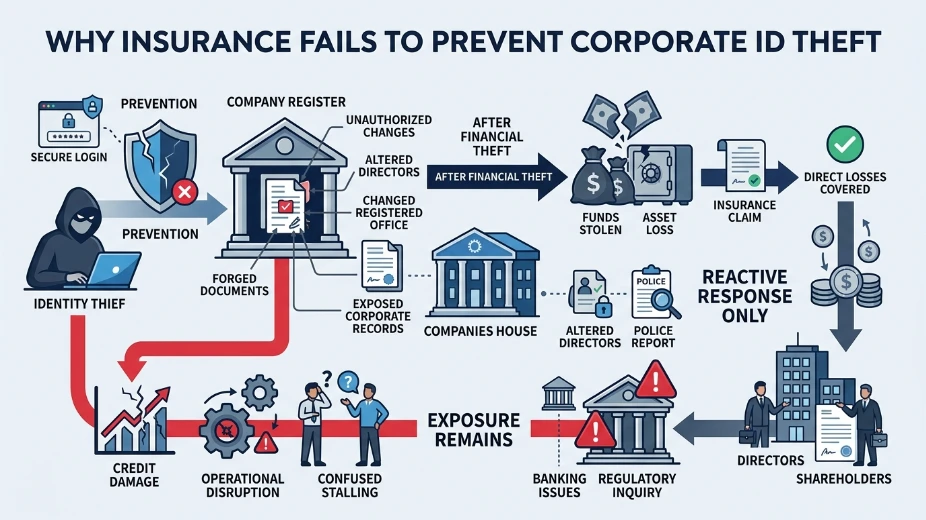
Relying solely on insurance creates dangerous gaps in corporate governance. Insurance policies activate after harm occurs, functioning as a financial safety net rather than a preventative shield. Insurance adjusters process claims only after fraudulent transactions occur, leaving public records corrupted in the interim.
Filing fraudulent records ruins corporate credit ratings within days. Credit reference agencies update business risk scores immediately when suspicious changes occur at Companies House. Reduced credit scores block access to trade credit, freeze bank lines, and halt supply chain operations.
Restoring corporate standing requires extensive administrative intervention. Directors must petition Companies House or obtain court orders to remove fraudulent filings from public registers. Insurance policies pay legal expenses but do not relieve management from the labor-intensive restoration process.
To evaluate overall organizational vulnerabilities across your operating structure, read our guide on Understanding Corporate Fraud: The Modern Threats to UK Small Businesses.
How Does Fraud Protection Work to Secure Corporate Details?
Fraud protection operates through continuous public register tracking, automated filing verification, immediate alert notifications, and restricted access protocols. These measures detect unauthorized record changes instantly, allowing management to halt corporate identity hijacking.
Active identity defense begins with automated corporate monitoring. Security software connects directly to Companies House electronic data feeds. The system tracks every pending filing, address change, and officer modification linked to the business registration number.
Systematic identity management validates filings against pre-authorized director credentials:
Verify incoming filing requests against authorized corporate officer lists
Block physical paper submissions by enforcing mandatory electronic filing protocols
Issue instant notifications to designated directors when changes reach public records
Audit company register data weekly to confirm information matches internal records
Immediate notification allows corporate officers to act before fraudsters use compromised details. When unauthorized filings trigger security alerts, directors contact Companies House to reject fraudulent submissions. Rapid intervention prevents lenders and suppliers from relying on invalid register details.
Businesses can deploy robust identity security protocols using Fraud Protection services to lock down corporate filings.
How Do Fraud Protection and Insurance Work Together?
Fraud protection prevents unauthorized record modifications, while insurance covers financial recovery if criminals bypass security controls. Together, they form a defense-in-depth framework that safeguards corporate identity, financial assets, and reputation.
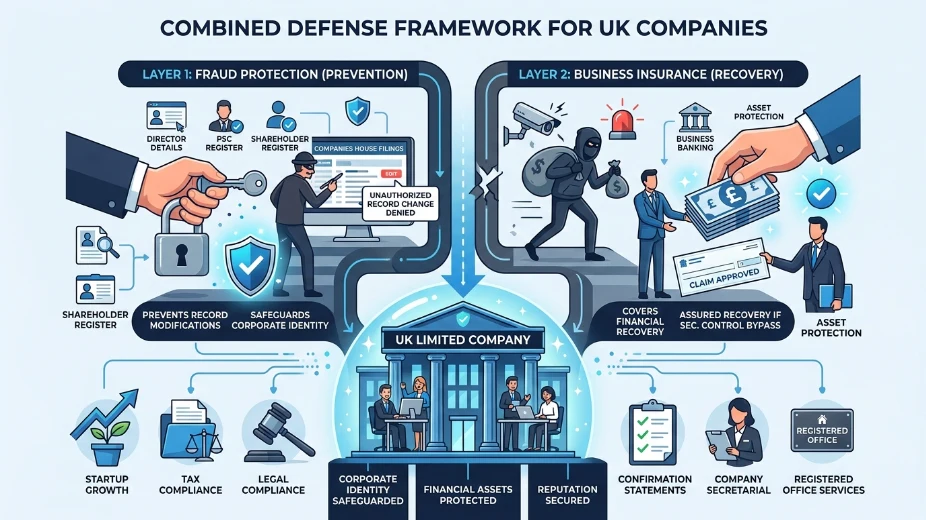
Combining active monitoring with financial coverage creates a complete corporate risk mitigation strategy. Defense-in-depth principles require multiple protective layers to guard critical assets. Fraud protection guards public corporate infrastructure, while commercial insurance mitigates balance sheet damage.
Preventative controls lower overall commercial insurance costs. Insurance underwriters evaluate corporate risk management practices during policy pricing. Companies using active monitoring services demonstrate lower risk profiles, securing better terms and lower policy deductibles.
Integrated protection secures every phase of an identity attack. If criminals bypass monitoring controls to commit financial fraud, insurance policies cover resulting legal fees and liabilities. This combined approach minimizes financial loss, administrative downtime, and structural damage to the business.
How Can UK Businesses Prevent Corporate Identity Fraud?
UK businesses can prevent corporate identity fraud by enrolling in the PROOF scheme, setting up register monitoring, auditing filings regularly, and securing statutory records. Implementing strict internal governance controls ensures unauthorized parties cannot modify company details.
Securing company identity requires structured governance protocols. Directors must audit official company records regularly to verify registered office details, officer names, and PSC (Persons with Significant Control) registers. Consistent oversight ensures erroneous filings are caught quickly.
Key operational practices protect corporate standing across public channels:
Enroll in the Companies House PROOF scheme to reject paper filings
Restrict access to company authentication codes to authorized personnel only
Monitor registered office address mail daily for official government correspondence
Maintain electronic logs of all statutory filings and corporate resolutions
Review credit reference agency profiles quarterly for unapproved credit inquiries
Internal administrative security reinforces public register protections. Organizations must restrict company authentication codes to trusted officers. Changing authentication credentials whenever administrative staff leave prevents former employees from accessing official filing systems.
To deploy enterprise-grade identity defense for your organization, Protect Your Business Identity with Form My Company Fraud Tools.
Summary of Key Differences
Corporate identity security requires both proactive risk prevention and reactive financial protection. While insurance shields your balance sheet after an event, fraud protection preserves the integrity of your corporate identity on official public registers.
| Defense Dimension | Fraud Protection | Business Insurance |
| Primary Focus | Public record monitoring and prevention | Financial recovery and indemnity |
| Mechanism | Real-time electronic monitoring & PROOF | Policy claims and cash payouts |
| Timing | Proactive (pre-incident) | Reactive (post-incident) |
| Coverage Scope | Companies House records, filings, credentials | Monetary losses, legal fees, liabilities |
| Credit Impact | Prevents corporate credit rating damage | Pays out after credit damage occurs |
| Operational Goal | Blocks identity hijacking entirely | Reimburses losses from identity hijacking |
Deploying both protective layers gives UK businesses total operational resilience. Proactive registry security stops identity hijackers before damage occurs, while business insurance provides peace of mind against unforeseen financial exposure.
Explore our Fraud Protection Guide,
Understanding the Benefits of Using a Specialist Dormant Company Filing Assistance Service
How to Quickly Resolve Past Due Dormant Account Filings with Professional Help
Frequently Asked Questions
What is UK corporate identity theft and how does it happen?
Corporate identity theft occurs when unauthorized parties alter a business’s legal register details at Companies House to impersonate the company or its directors. Fraudsters submit unauthorized filings—such as changing the registered office address or replacing officers—to secure loans, obtain trade credit, or divert supplier shipments fraudulently.
How does the Form My Company Fraud Protection service work?
The Form My Company Fraud Protection service monitors your official record at Companies House continuously for changes. The automated watchdog service instantly sends email alerts whenever a new filing is recorded against your corporate registration number, enabling management to identify and stop unauthorized modifications immediately.
How does Fraud Protection differ from the Companies House PROOF scheme?
The free Companies House PROOF (Protected Online Filing) scheme prevents physical paper submissions by enforcing mandatory electronic filing protocols with digital passcodes. Form My Company Fraud Protection enhances this baseline defense by providing real-time digital monitoring and instant email alerts for all electronic filings, including those submitted online.
What specific filings trigger real-time identity alerts?
The system sends immediate notifications for any public register amendment linked to your company identification number. Alerts are triggered by officer appointments or resignations, registered office address changes, share capital adjustments, and modifications to the Persons with Significant Control (PSC) register.
What steps should a business take if unauthorized filings occur?
When an unauthorized filing alert is received, the company directors must immediately notify Companies House and report the identity hijack to law enforcement. Early detection using Form My Company Fraud Protection allows business owners to object to fraudulent filings before cybercriminals impact corporate credit scores or open unauthorized accounts.