
Standardising company records requires centralising statutory registers, updating Companies House filings promptly, and implementing secure identity verification. UK businesses must audit corporate files, establish structured compliance workflows, and monitor statutory documentation to mitigate corporate identity theft and legal non-compliance risks.
Why Is Standardising Company Records Essential for UK Business Security?
Standardising company records establishes an immutable, accurate paper trail that prevents unauthorized corporate modifications, protects statutory credibility, and secures business assets. Clean statutory documentation ensures full regulatory compliance with Companies House requirements and shields directors from personal liability during official audits.
Corporate record management directly impacts legal standing and operational continuity for registered UK entities. Discrepancies between internal registers and official filings create vulnerabilities that fraudulent actors exploit to alter corporate structures. Maintaining uniform, verified documentation eliminates administrative gaps, ensures smooth due diligence during commercial transactions, and preserves bank confidence.
Companies House registers contain public data that third parties, credit agencies, and lenders use to evaluate corporate legitimacy. Incontinuous, outdated, or conflicting corporate records invite regulatory scrutiny, trigger statutory fines, and undermine commercial credibility. When internal documentation aligns seamlessly with central register entries, businesses maintain control over their corporate identities and legal obligations.
Failure to standardise registers leaves businesses exposed to corporate hijacking, unauthorized director appointments, and illegal address modifications. UK firms that actively reconcile statutory records build a resilient operational foundation. Systematic record management protects key corporate functions, verifies beneficial ownership details accurately, and secures the enterprise against domestic identity theft attempts.
What Are the Primary Risks of Disorganized Statutory Documentation?
Disorganized statutory documentation exposes UK firms to corporate identity theft, financial losses, regulatory penalties, and compromised legal transactions. Inaccurate filings allow fraudsters to hijack corporate profiles, secure illegal credit facilities, alter registered office details, and displace legitimate directors from official Companies House entries.
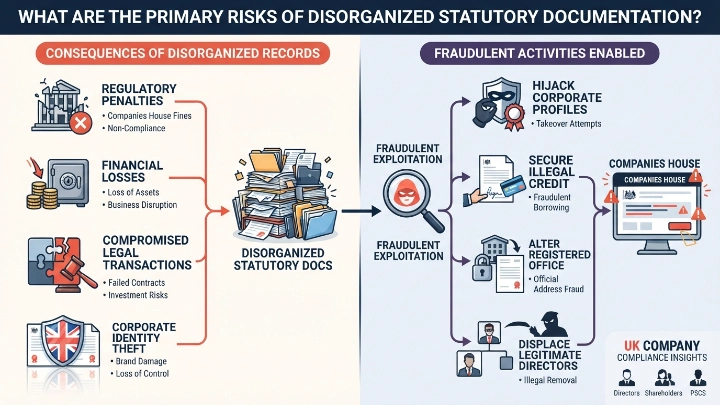
Incomplete or delayed statutory filings weaken corporate governance and invite fraud. Attackers regularly scan public registries for vulnerabilities, targeting companies with inconsistent records to file falsified forms. Once unauthorized changes occur, bad actors take out loans, order goods, or drain bank accounts under the corporate name.
Legal liability extends directly to company officers when statutory registers fail to match active operational realities. UK company law mandates accurate registers of directors, secretaries, shareholders, and persons with significant control. Five specific compliance risks threaten poorly managed firms: corporate identity fraud, missed statutory filing deadlines, personal fines for directors, rejected banking applications, and invalidated commercial contracts.
Resolving fraudulent filings requires complex legal proceedings, substantial financial expenditure, and extensive regulatory correspondence. Preventing these disruptions demands proactive document management and robust verification protocols. Companies must secure their public profiles by resolving inconsistencies early. Reviewing The Risks of Incomplete Statutory Documentation for UK Firms enables directors to identify compliance gaps before fraudulent actors exploit public registry vulnerabilities.
How Does Centralised Record Management Prevent Corporate Identity Theft?
Centralised record management prevents corporate identity theft by establishing a single, verified source of truth for all statutory documentation. Restricting administrative access, digitising registers, and deploying real-time registry monitoring immediately alerts officers to unauthorized attempts to alter public Companies House records.
Fragmented administrative processes create security gaps across corporate structures. When individual departments maintain separate corporate records, verifying the legitimacy of changes becomes difficult. A centralised framework unifies statutory registers, share certificates, board minutes, and filing histories within an audited repository.
Digital centralisation enables access controls and tracking mechanisms. Only designated compliance officers receive authorization to modify corporate data or submit filings. Restricting permissions limits internal human error and blocks unauthorized external submissions before public databases record fraudulent entries.
Effective centralisation relies on modern corporate protection infrastructure. Integrating proactive registry alerts ensures immediate notification whenever anyone files documents against your company number. Leveraging specialized solutions like Fraud Protection shields statutory data by preventing bad actors from registering fake office addresses or removing legitimate company officers.
Continuous data monitoring pairs with internal compliance checks to verify every corporate submission. When management centralises record storage, verifying beneficial ownership, board changes, and share allocations becomes straightforward. Systemic tracking protects legal identity while reducing administrative friction across daily operations.
What Key Statutory Files Must Every UK Business Maintain?
UK businesses must maintain registers of directors, director residential addresses, secretaries, shareholders, and persons with significant control. Companies must also preserve accurate board meeting minutes, historic articles of association, confirmation statements, and annual statutory accounts to satisfy legal audit requirements.
Statutory books reflect a company’s internal legal structure and ownership distribution. Maintaining these files is a statutory obligation under the UK Companies Act 2006. Internal records must remain up to date at the registered office or a single alternative inspection location.
Discrepancies between physical statutory books and online registry submissions create severe legal exposure. Registers must detail exact allocation dates, share classes, voting rights, and personal details of all beneficial owners. Four core registers demand continuous updating: Register of Directors, Register of Shareholders, Register of Persons with Significant Control, and Register of Charges.
Organising these files protects corporate governance standards during external reviews. Lenders, investors, and auditors inspect statutory registers during commercial transactions. Understanding Statutory Documentation: Essential Files Every UK Business Must Maintain helps company secretaries systematically structure compliance records to ensure readiness for official audits.
How Can Form My Company Solutions Standardise Your Business Records?
Form My Company solutions standardise business records through automated registry auditing, secure statutory document storage, and continuous filing monitoring. Form My Company validates corporate entries, updates official filings accurately, and implements robust security measures to protect UK businesses from identity fraud.
Systematic compliance requires specialized tools designed for UK corporate frameworks. Form My Company provides direct administrative support to standardise statutory registers across corporate structures. Expert management aligns internal documentation with official Companies House records seamlessly.
Professional auditing pinpoints missing registers, outdated director addresses, and unverified beneficial ownership details. Resolving inaccuracies early prevents regulatory penalties and protects corporate credit ratings. Structured workflows automate confirmation statements, PSC filings, and board record updates without operational delays.
Form My Company delivers full-spectrum governance services tailored to growing UK enterprises. By securing official records against unauthorized filings, businesses protect operational integrity. Partnering with Form My Company ensures complete compliance, robust fraud prevention, and standardized corporate record management for total peace of mind.
How Do You Implement a Step-by-Step Compliance Workflow?
Implementing a compliance workflow requires auditing existing statutory records, reconciling internal files with Companies House, establishing secure digital access, and scheduling regular filing reviews. Structured workflows ensure accurate record keeping, timely statutory updates, and continuous protection against corporate record manipulation.
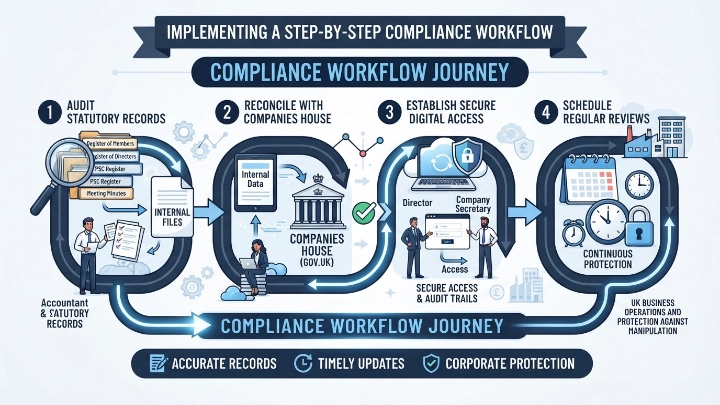
Following a structured compliance process reduces administrative vulnerabilities. Systematic record management ensures your business maintains verified, audit-ready statutory records while minimizing corporate fraud risks.
Explore our Fraud Protection guide,
Ensure Your Business Standing is Verified by Form My Company
Prevent Corporate Fraud with Form My Company’s Security Suite
Frequently Asked Questions
How does corporate fraud protection work for UK companies?
Corporate fraud protection continuously monitors official registry databases like Companies House to detect unauthorized changes to registered office addresses, officer appointments, or shareholder details. Services like Form My Company’s Fraud Protection block bad actors from using stolen corporate credentials to access business credit facilities or hijack legal entities. Instant alerts allow company directors to flag and reverse fraudulent filings before commercial harm occurs.
Why do UK businesses need statutory filing monitoring?
Public registry profiles are susceptible to fraudulent document submissions because regulatory bodies accept web filings in good faith without extensive identity verification checks. Statutory filing monitoring safeguards company records by tracking all filed forms, officer updates, and structural alterations in real time. Utilizing Form My Company corporate fraud protection ensures any unauthorized record modification is immediately identified, protecting the enterprise from corporate identity theft.
What are the consequences of corporate identity theft for a UK business?
Corporate identity theft can lead to severe financial losses, fraudulent credit applications in the company’s name, frozen bank accounts, and damage to commercial reputation. Fraudsters often replace legitimate directors on official public registers to secure lines of credit or divert supplier payments. Implementing robust record management and Form My Company security solutions mitigates these operational vulnerabilities and preserves institutional credibility.
Can fraudsters change my company’s registered address without permission?
Yes, unauthorized individuals can alter a registered office address by submitting fraudulent statutory forms to Companies House using compromised web authentication codes. Once the address is changed, bad actors intercept official legal notices and intercept financial mailings. Form My Company Fraud Protection prevents unauthorized registry manipulation by maintaining strict administrative oversight and providing immediate notifications upon any filing activity.
How do I protect my Companies House web filing code from unauthorized access?
Protecting your web filing authentication code requires restricting administrative access to verified compliance officers, establishing strict internal controls, and monitoring registry updates closely. Combining these internal administrative safeguards with Form My Company corporate fraud protection services ensures your authentication credentials and statutory documentation remain secure against internal error and external cyber threats.