Form My Company’s Fraud Protection stops corporate identity theft by securing official UK filing records, monitoring Companies House submissions in real time, and preventing unauthorized changes to director details or registered addresses.
Corporate identity theft poses a critical threat to UK businesses. Bad actors hijack corporate profiles by submitting fraudulent documents to official registers. Changing director details or registered office addresses allows criminals to secure lines of credit, order goods, or drain business accounts. Securing official filing profiles forms the frontline defense against corporate fraud.
Understanding the mechanics of corporate identity theft allows business owners to implement proactive controls. UK companies must monitor their filing histories continuously. Implementing automated alerts ensures immediate detection when unauthorized filings occur. Rapid intervention stops fraudulent activity before financial institutions or suppliers accept fake corporate credentials.
What Is Corporate Identity Theft in the UK?
Corporate identity theft occurs when unauthorized individuals alter company records at Companies House to impersonate business officers, fraudulently obtain lines of credit, or misappropriate commercial assets.
Identity theft targets registered corporate entities rather than individuals. Fraudsters alter director profiles, PSC (People with Significant Control) registers, or registered office addresses. Updating these details enables criminals to redirect official mail and bank statements to fraudulent drop locations.
Lenders rely on public register data to approve loans and financing agreements. When fake directors gain control of official records, they contract debts under the business name. The legitimate owners often remain unaware of the compromise until debt collection agencies demand payment for unauthorized liabilities.
Preventing identity theft requires strict documentation control and continuous profile oversight. Organizations must secure physical and digital documentation to protect corporate assets. Maintaining secure documentation prevents corporate fraud by ensuring bad actors cannot replicate corporate credentials or forge official signatures on regulatory filings.
How Do Fraudsters Hijack UK Registered Companies?
Fraudsters hijack UK registered companies by submitting forged paper forms to Companies House, exploiting administrative delays to register fake directors and alter official company addresses.
Companies House historically processed paper filings without performing strict identity checks on submitted forms. Criminals exploit this administrative loophole by submitting physical paper forms, such as Form AP01 for appointing directors or Form AD01 for changing registered addresses.
When Companies House processes these paper submissions, the public register updates automatically. Fraudsters then present the updated public record to credit providers, mobile phone networks, and equipment leasing firms to secure contracts.
Protecting a business requires monitoring register updates constantly. When companies track official records, they spot unauthorized filings within minutes of publication. Early detection enables directors to notify law enforcement, alert credit bureaus, and initiate legal rectification procedures at Companies House immediately.
What Key Security Measures Stop Corporate Identity Theft?
Corporate identity theft stops through electronic filing locks, automated register monitoring, electronic identity verification for directors, and address protection services that obscure private locations.
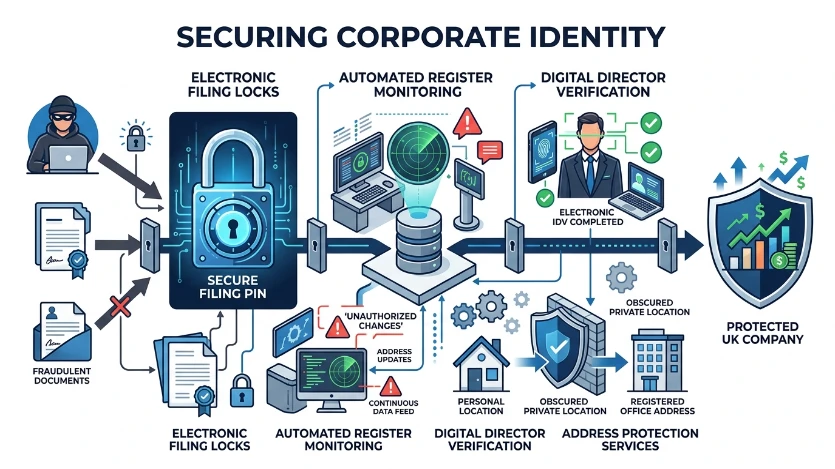
Implementing a proprietary filing lock blocks physical paper submissions completely. When companies activate this protocol, Companies House rejects all paper-based filings automatically. The registry accepts updates submitted exclusively through secure digital portals using encrypted authentication codes.
Three primary verification methods authenticate corporate updates:
Validate director identities using government-issued passports or driving licenses.
Match biometric data with official passport database records.
Verify residential address documentation using recent utility statements.
Director privacy protection keeps personal information off public databases. Obscuring private residential addresses prevents fraudsters from harvesting personal identity data for targeted spear-phishing attacks or impersonation attempts.
How Does Form My Company Block Corporate Hijacking?
Form My Company blocks corporate hijacking through its integrated Security Suite, combining real-time Companies House monitoring, paper filing locks, and professional identity verification.
The Security Suite acts as an automated monitoring firewall for corporate profiles. The system interfaces directly with Companies House APIs to track every pending update. If an unauthorized party attempts to file an annual confirmation statement or change company officers, the platform alerts business administrators instantly.
Businesses access comprehensive corporate safeguards using the Fraud Protection platform. This service installs digital filing controls, monitors register changes, and secures corporate profiles against illicit modification.
The system provides complete operational coverage:
Monitor official filing registers continuously for unauthorized changes.
Block paper submissions using electronic authentication keys.
Validate corporate officer credentials during statutory updates.
Alert administrators immediately when third parties view or query filings.
Enabling continuous monitoring eliminates blind spots in corporate oversight. When organizations deploy automated monitoring tools, they ensure complete visibility over statutory records without requiring manual portal checks.
Why Is Official Identity Verification Essential for Directors?
Official identity verification validates that corporate officers possess verified legal credentials, ensuring bad actors cannot register fictitious directors or hijack control of legitimate UK entities.
Identity verification forms the foundation of modern corporate governance standards. Verifying director identities prevents bad actors from creating dummy officers to shield illicit activities. Official verification protocols check submitted details against government databases, international sanction lists, and anti-money laundering registries.
Confirming corporate standing requires comparing public filings against internal corporate records. Companies must routinely check official filings to ensure register accuracy. Directors can learn how to verify your company’s standing with official UK records to confirm that their filing history remains uncompromised and fully compliant.
Digital identity checks use advanced optical character recognition and facial biometrics. When a director submits documentation, the system checks security features embedded inside identity cards and passports. This prevents forged credentials from entering the official corporate record.
How Do Address Protection Services Prevent Targeted Fraud?
Address protection services replace private residential details on public registers with official corporate service addresses, stopping bad actors from harvesting director personal data.
Public registers publish registered office and director service addresses for public inspection. Fraudsters scrape these public databases to harvest personal details, physical addresses, and officer names. They use this information to execute sophisticated social engineering scams against company personnel.
Using professional address protection prevents personal identity exposure:
Replace home addresses with professional London-based office addresses.
Filter incoming official mail to scan and digest correspondence digitally.
Hide personal location data from public search indices and automated scrapers.
When businesses hide residential locations, they prevent physical mail interception. Fraudsters cannot redirect mail, forge utility bills, or establish fictitious credit histories using a director’s home address. Address protection maintains a clean separation between personal identity and business operations.
What Steps Should You Take If Fraud Occurs?
If corporate fraud occurs, report the incident immediately to Action Fraud, notify your banking partners, and file corrective rectification forms with Companies House.
Rapid response minimizes financial exposure when fraud occurs. Business owners must isolate compromised accounts immediately to prevent unauthorized fund transfers. Notifying corporate banks allows risk management teams to freeze commercial lines and reverse fraudulent payment requests.
Correcting the public record requires formal legal filings:
Report the criminal incident directly to Action Fraud and obtain a crime reference number.
Issue formal notifications to primary business banks and credit reporting agencies.
Submit Form RP02 to Companies House to remove invalid registered office addresses.
Submit Form RP03 to object to unauthorized director appointments or removals.
Filing statutory rectification forms restores the legitimate corporate structure. When Companies House receives verified removal applications, officials expunge the fraudulent entries from the public history. Restoring the correct register status protects commercial reputation and maintains operational continuity.
Protect Your UK Business with Form My Company
Preventing corporate identity theft requires continuous vigilance, secure administrative processes, and robust filing controls. Fraudsters exploit public registry vulnerabilities to hijack established businesses, secure unauthorized credit, and disrupt commercial operations. Deploying proactive monitoring stops unauthorized changes before they harm financial standing or commercial reputation.
Form My Company delivers full-spectrum security for UK businesses. The platform combines automated filing locks, instant Companies House monitoring, professional address protection, and identity verification within a unified dashboard. Securing statutory filings ensures corporate continuity and protects organizational assets from identity theft.
Explore our Fraud Protection guide,
Complete Your Supplementary Company Documents with Our Experts
Get Your Professional Company Pack Managed by Form My Company
Frequently Asked Questions
How does Form My Company’s Fraud Protection service stop unauthorized filing changes at Companies House?
Form My Company’s Fraud Protection service activates real-time register monitoring and electronic locks to block fraudulent paper filings with Companies House. The service immediately alerts company officers whenever unauthorized attempts are made to alter director credentials, registered office addresses, or statutory records. This proactive system prevents bad actors from hijacking corporate details or securing unauthorized credit under your business identity.
What is corporate identity theft and how does it impact UK limited companies?
Corporate identity theft occurs when criminals submit fraudulent documentation to Companies House to alter official company records, such as appointing fake directors or changing registered office addresses. Once fraudsters modify public records, they can open commercial credit accounts, apply for loans, or redirect official mail in your business’s name. Deploying Fraud Protection from Form My Company prevents these illegal profile modifications before financial or reputational damage occurs.
Why do UK businesses need specialized corporate fraud protection alongside standard secretarial services?
Standard secretarial management handles statutory filings but does not continuously monitor public registries for unauthorized or malicious paper submissions. Form My Company’s Fraud Protection provides automated surveillance and electronic lock mechanisms that reject unauthenticated paper updates automatically. This creates an active security firewall that secures company officers, PSC registers, and official filings against identity hijacking.
How do electronic filing locks prevent fraudsters from changing company director details?
Electronic filing locks disable traditional paper form submissions at Companies House, requiring all statutory updates to be authenticated digitally. Enrolling in the Fraud Protection service through Form My Company ensures paper forms submitted by unauthorized third parties are automatically rejected by the official registry. Consequently, only verified corporate officers holding legitimate authentication credentials can execute changes to director appointments or business details.
What immediate steps does Form My Company take if suspicious activity is detected on a company register?
When potential corporate fraud or unauthorized register changes are flagged, Form My Company’s Fraud Protection system immediately sends real-time alerts to company administrators. The service assists business owners in rapidly filing rectification applications with Companies House, objecting to fraudulent entries, and contacting authorities like Action Fraud. This rapid response protocol minimizes financial liability and restores the accuracy of your official corporate profile.