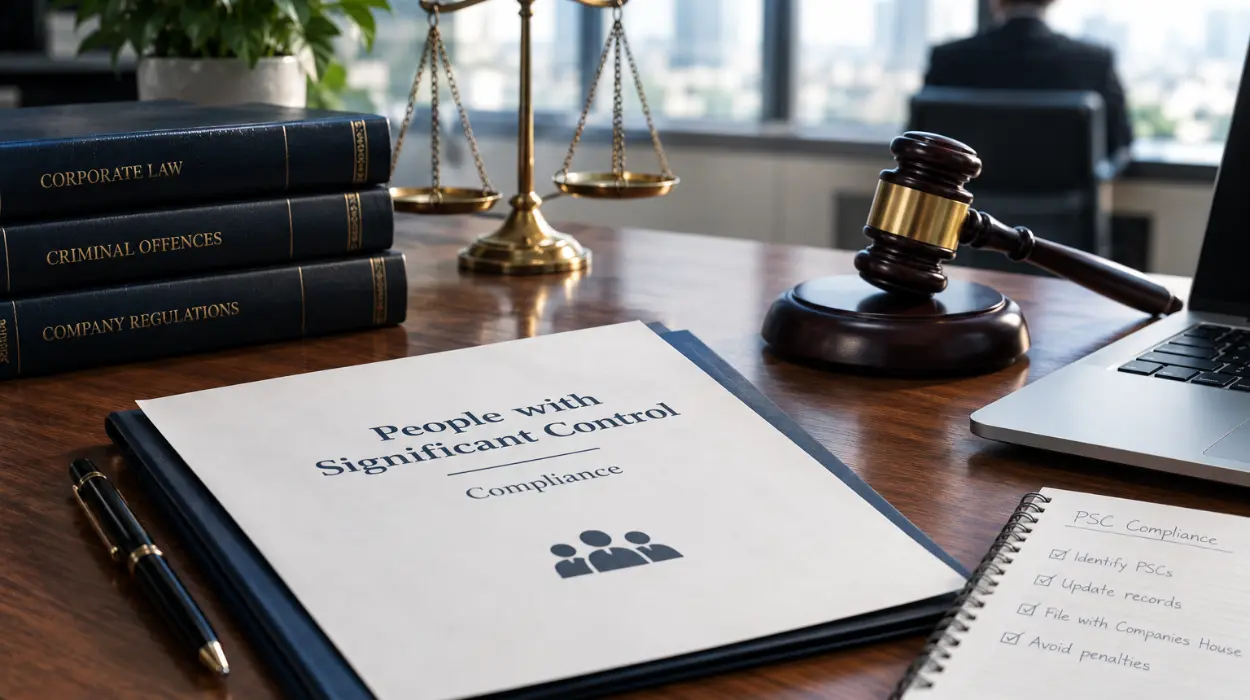
Secure documentation prevents corporate fraud by restricting unauthorized access, verifying director credentials, and establishing immutable records of legal filings. Cryptographic seals, encrypted digital storage, and real-time monitoring stop bad actors from falsifying company details, safeguarding operational continuity and business reputation.
What Is Corporate Fraud in Modern UK Business Operations?
Corporate fraud occurs when unauthorized individuals manipulate company records, misappropriate identities, or alter official filings for financial gain. Perpetrators exploit weak documentation workflows to falsify director details, hijack corporate identities, and access unauthorized lines of credit.
Corporate identity theft affects thousands of registered UK entities each year. Fraudulent actors target Companies House records to change registered office addresses without board approval. Once bad actors update the official register, they redirect physical mail and intercept banking statements.
Criminals use altered filings to apply for commercial loans and order high-value goods under the corporate name. The legitimate business owners often discover the breach only after credit agencies flag defaulted payments. Falsified documentation undermines legitimate operations, freezes trade credit lines, and triggers time-consuming legal remediation.
Companies lose revenue when legal teams work to reinstate accurate corporate filings. Operational continuity breaks down during identity recovery proceedings. Securing corporate documentation at the foundational level prevents unauthorized parties from making illicit alterations to official business profiles.
How Does Unauthorized Document Alteration Risk Company Stability?
Unauthorized document alteration destabilizes companies by corrupting legal ownership records, invalidating commercial contracts, and exposing businesses to regulatory penalties. Unmonitored changes to corporate files destroy stakeholder trust and stall day-to-day business operations.
Unchecked updates to statutory registers trigger immediate operational disruptions. Financial institutions freeze bank accounts when official records show conflicting director information. Payment gateways suspend credit card processing capabilities until the business proves legal ownership.
Regulatory bodies impose strict reporting requirements on UK corporate entities. Inaccurate or fraudulent filings breach statutory compliance mandates. These compliance failures lead to civil fines, director disqualifications, and potential criminal investigations for negligence.
Three common operational impacts follow undetected document tampering: contract termination by key suppliers, immediate withdrawal of commercial credit lines, and loss of professional liability insurance. Restoring corporate standing requires lengthy proceedings with official registries. Organizations face severe financial damage during these administrative recovery periods.
Why Are Traditional Paper Filing Systems Vulnerable to Identity Theft?
Traditional paper filing systems invite identity theft because they lack real-time access controls, cryptographic verification, and automated audit trails. Physical documents suffer from easy duplication, physical interception, and delayed detection of fraudulent modifications.
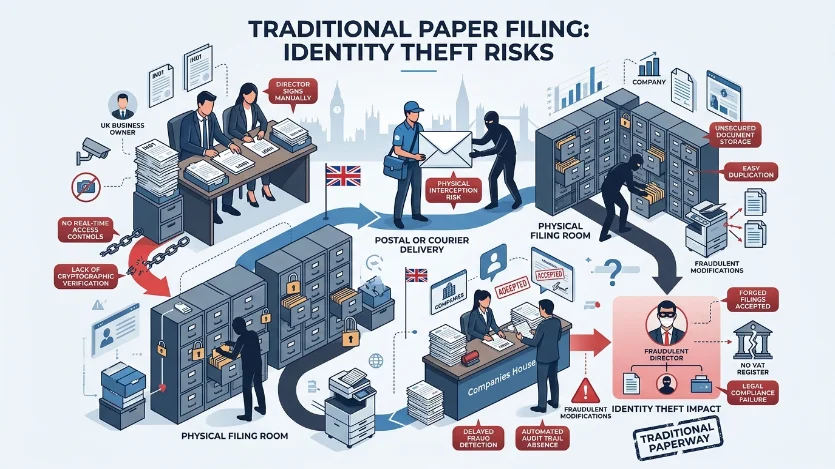
Paper-based statutory books rely on physical custody rather than technical security protocols. Unauthorized personnel can copy paper filings without leaving a digital footprint. Physical mail delivered to unmonitored registered addresses allows bad actors to steal official verification codes issued by corporate registries.
Manual document handling delays the identification of fraudulent updates. A company relying on paper records might check official registers only during annual confirmation statement filings. Bad actors operate in the intervening months, building liability under the stolen corporate identity.
Paper workflows introduce four distinct security vulnerabilities: lost physical stock transfer forms, forged physical director signatures, intercepted mail containing authentication keys, and untracked document destruction. Replacing manual paper storage with digital document infrastructure eliminates physical security gaps and provides immediate oversight over corporate changes.
How Do Digital Verification Frameworks Protect Corporate Identity?
Digital verification frameworks protect corporate identity by authenticating user credentials against government databases before permitting record modifications. Advanced encryption, biometric checks, and multi-factor authentication prevent unauthorized individuals from submitting false corporate filings.
Modern verification platforms validate user identities before granting access to sensitive company records. Systems cross-reference passport details, driver licenses, and live facial scans against official data sources. This multi-layered approach ensures that only verified directors approve changes to statutory registers.
Encrypted storage vaults hold sensitive corporate materials behind strict access protocols. Systems record every document download, edit, and submission in an immutable audit trail. Security administrators receive instant alerts when an unauthorized device attempts to view corporate records.
Organizations evaluate security solutions during operational reviews to strengthen internal controls. Evaluating proper statutory protections requires reviewing comprehensive service offerings. Businesses implement Fraud Protection services to establish proactive defenses against unauthorized registry modifications. Automated systems flag unusual activity instantly, stopping corporate hijacking attempts before filings complete.
What Role Does Real-Time Filing Monitoring Play in Fraud Prevention?
Real-time filing monitoring prevents fraud by tracking registry databases continuously and sending instant alerts whenever changes occur. Immediate notification allows business owners to challenge unauthorized updates and freeze fraudulent activity before financial damage occurs.
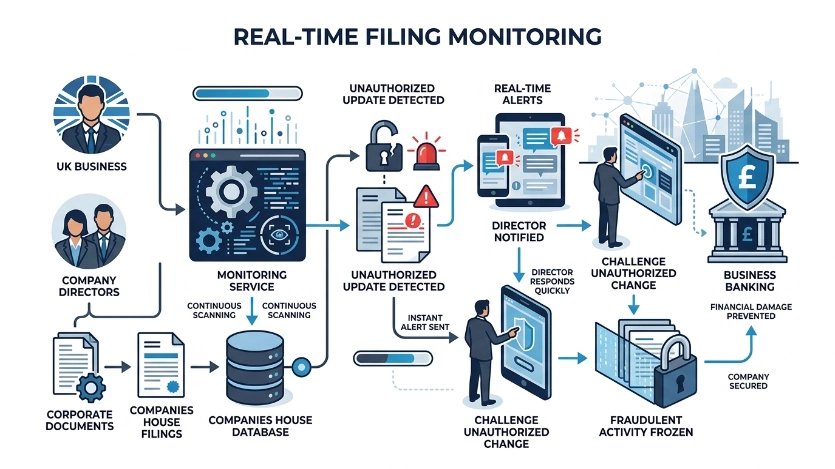
Continuous monitoring acts as an early warning system for corporate identity theft. Automated software queries registry databases every day for changes to company records. The system flags modifications to registered addresses, director appointments, and share allocations immediately.
Fast detection changes the outcome of a corporate hijacking attempt. When owners receive immediate alerts, legal counsel files immediate objections with registration authorities. Early intervention stops criminals from using hijacked details to open trade accounts or secure bank loans.
Three essential tracking mechanisms secure business continuity: automated daily registry scanning, instant email notifications for filed documents, and direct integration with official corporate databases. Real-time oversight reduces the window of vulnerability from months to minutes, preserving corporate integrity.
How Does Document Security Strengthen Business Continuity Plans?
Document security strengthens business continuity plans by maintaining data integrity, ensuring compliance, and preventing operational halts caused by identity theft. Secure documentation frameworks allow companies to recover quickly from administrative disruptions without losing commercial momentum.
Business continuity planning relies on operational readiness and secure data retention. Protecting statutory books, shareholder agreements, and board resolutions ensures legal operations proceed without interruption. Secure repositories maintain accessible, verified backups of vital corporate records at all times.
Lenders and commercial partners require proof of corporate stability before executing major transactions. Maintaining authenticated statutory files streamlines due diligence processes during funding rounds or commercial acquisitions. Verified documentation proves legal compliance and transparent ownership structures.
Companies analyze risk management strategies to secure operational longevity. Decision-makers learn How to Verify Your Company’s Standing with Official UK Records to maintain clean public filings. Clean public records ensure uninterrupted banking relationships, seamless supplier contracts, and predictable commercial expansion.
How Can Businesses Implement a Proactive Security Framework?
Businesses implement a proactive security framework by combining digital document encryption, strict access controls, and automated registry monitoring. Integrating these controls eliminates single points of failure and deters fraudulent filings.
Creating a secure corporate infrastructure starts with centralizing statutory management. Companies replace fragmented local files with cloud repositories featuring end-to-end encryption. Security policies must require multi-factor authentication for every employee accessing legal documentation.
Management teams must establish strict authorization protocols for company filings. Organizations restrict submission authority to designated legal representatives or compliance officers. Restricting filing permissions prevents rogue internal actors or external impersonators from submitting unauthorized changes.
Four operational steps complete the proactive defense framework: audit existing statutory files for inaccuracies, centralize document access within an encrypted portal, enable real-time registry alerts, and review access permissions quarterly. Business leaders Prevent Corporate Fraud with Form My Company’s Security Suite to enforce consistent document control standards across all subsidiary entities.
Corporate fraud disrupts operations, drains capital, and damages commercial reputations. Securing corporate documentation provides the foundation for operational continuity and long-term business stability. Protecting statutory registers against unauthorized edits stops identity thieves before they access corporate credit or alter legal records.
Implementing digital verification frameworks, continuous monitoring, and encrypted storage establishes total control over corporate filings. Form My Company delivers comprehensive document security tools, identity validation protocols, and real-time registry monitoring to protect UK businesses from identity theft. Secure documentation safeguards corporate identity, preserves stakeholder trust, and guarantees operational continuity.
Explore our Fraud Protection guide,
What Chinese Residents Must Navigate When Setting Up a UK Company Legally
Why Opening a UK Company Helps Colombian Freelancers Secure International Clients
Frequently Asked Questions
What is UK corporate fraud protection and how does it work?
Corporate fraud protection safeguards registered UK businesses from unauthorized alterations to their official Companies House records. Form My Company monitors corporate registries in real time to detect fraudulent director appointments, address changes, or falsified filings immediately. Automated alerts allow business owners to challenge unauthorized updates before financial damage or identity theft occurs.
How do secure digital documents prevent business identity theft?
Secure digital documents use encryption, digital signatures, and restricted access controls to prevent bad actors from tampering with statutory corporate files. By maintaining verified digital records, organizations eliminate the vulnerabilities associated with paper filings and unmonitored physical mail. Form My Company integrates secure document repositories with official registry tracking to ensure only verified directors can authorize corporate changes.
What are the signs that a company has fallen victim to corporate hijacking?
Key signs of corporate hijacking include unapproved changes to a registered office address, unexpected appointments of unknown directors, or frozen business banking accounts. Companies may also receive notices for credit facilities or goods they never requested. Form My Company’s Fraud Protection service continuously scans corporate registers to identify these discrepancies the moment they are filed.
Why is Companies House monitoring necessary for business continuity?
Companies House processes statutory filings, but it does not independently verify the legitimacy of every document submitted. Without active registry monitoring, fraudulent filings can remain undetected for months, exposing the business to unauthorized debt and legal liabilities. Form My Company provides continuous monitoring to preserve corporate standing and maintain uninterrupted business operations.
How can UK businesses secure their statutory records against unauthorized changes?
Businesses secure their statutory records by centralizing legal filings within encrypted repositories and enabling real-time monitoring on their corporate profiles. Restricting filing permissions to authenticated legal representatives prevents external impersonators from submitting rogue updates. Utilizing Form My Company’s Fraud Protection solution ensures instant notification and quick remediation if fraudulent changes are attempted.