
Company directors in the UK resign fast by submitting Form TM01 directly to Companies House online or through an authorized corporate service provider. Online submissions usually process within 24 hours, officially updating the public register and relieving the outgoing director of active statutory duties.
Why Must You File Your Director Resignation Promptly with Companies House?
Failing to register a director resignation promptly leaves your name on the public register, exposing you to legal liabilities and breach of statutory duties. Companies House requires notice within 14 days of your departure date under the Companies Act 2006.
When a director steps down, the resignation takes effect internally on the agreed resignation date. However, public records remain un-updated until Companies House processes the formal notification. Third parties, creditors, and legal entities rely on the public register to identify responsible officers. If your name remains on the register, financial institutions and regulatory bodies continue to view you as an active officer.
Delayed filings prolong your exposure to corporate liability. You remain vulnerable to claims regarding wrongful trading or compliance breaches occurring after your physical departure. Prompt filing protects personal credit ratings and prevents administrative disputes with remaining board members. Executing a fast transition requires complete alignment between internal board minutes and official public records.
To understand how internal board agreements differ from regulatory disputes during board exits, review our guide on voluntary vs forced director resignation differences. Clear documentation ensures smooth processing across both internal records and external filings.
What Documents Are Required to Submit Form TM01 Online?
Filing Form TM01 requires the full corporate name, unique eight-digit company registration number, current officer details, and the precise official date of resignation. Online filings also require authenticating credentials or authentication codes for rapid digital verification.
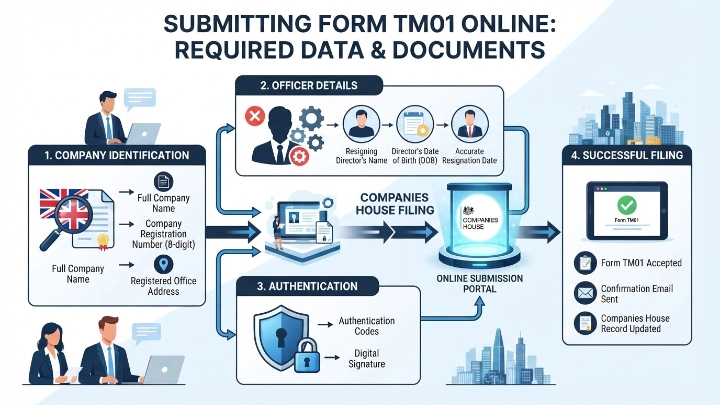
The Companies House Form TM01 serves as the universal document for terminating a directorship. You must provide the exact personal details currently recorded on the public register. Discrepancies between historical register records and your TM01 submission trigger automatic rejections.
Digital submissions streamline authentication. Submitting through web filing systems requires the six-character company authentication code. When authorized corporate agents manage the filing, digital identity checks replace manual signature protocols. The process eliminates postal delays, reducing approval times from weeks to hours.
Three essential records establish complete compliance:
Record formal approval within official board meeting minutes
Update internal registers of directors within 14 business days
Retain digital confirmation receipts issued by Companies House
How Does a Professional Service Provider Speed Up Director Resignation?
Professional corporate service providers accelerate director resignations by performing automated data validation, deploying electronic submission portals, and resolving validation flags before filing. Professional intervention eliminates paper submission delays and reduces processing turnaround times to under 24 hours.
Submitting compliance forms independently often leads to errors in dates or officer identification. Rejected forms force applicants to restart the notification process, creating dangerous liability windows. Professional corporate agencies use direct electronic data interchange (EDI) connections with Companies House to bypass routine manual queues.
Form My Company provides expedited filing tools that automate validation and guarantee regulatory accuracy. Using direct portal integrations eliminates data entry errors and ensures proper documentation formatting prior to transmission.
Beyond basic form processing, corporate changes require updated official communication channels. Board members frequently host final exit meetings or statutory compliance reviews in professional environments. You can easily access a professional UK conference room space to conduct final board transfers, record official minutes, and execute resignation deeds securely.
What Legal Liabilities End When Form TM01 Is Successfully Processed?
Form TM01 processing terminates statutory duties under Sections 171 to 177 of the Companies Act 2006, relieving directors of ongoing fiduciary responsibilities. Exiting officers no longer bear legal responsibility for future corporate debts, financial reporting errors, or board decisions.
A director owes strict fiduciary duties to the company, including promoting corporate success and exercising independent judgment. These legal obligations remain active until formal resignation records take effect. Once Companies House accepts Form TM01, your legal standing changes from active officer to historical affiliate.
Form TM01 processing removes your authority to sign contracts, bind the company legally, or access corporate bank accounts. The public update serves as legal notice to suppliers, lenders, and regulatory enforcement authorities. However, resigning does not erase liability for fraudulent actions, misfeasance, or wrongful trading committed during your active tenure.
To prevent dispute risks following your exit, maintaining accurate compliance records is essential. For step-by-step guidance on keeping corporate books audit-ready during officer changes, read our guide on director resignation compliance steps.
What Happens to Company Records After a Director Resigns?
Company records require immediate updates across internal registers, banking systems, and public records following a director’s resignation. Statutory regulations require companies to retain historical director details within the internal register of directors indefinitely.
Filing Form TM01 with Companies House satisfies public notification rules, but internal administrative duties remain. The company secretary or remaining board members must update the company’s internal statutory books within 14 days of the exit date.
Three mandatory post-resignation updates:
Revoke banking authorizations and corporate credit card privileges immediately
Update Persons with Significant Control (PSC) registers if ownership thresholds shift
Notify HMRC, insurance underwriters, and key trade partners of officer changes
Failing to update internal registers leads to administrative fines under UK company law. Maintaining clean records protects remaining board members and ensures seamless corporate governance during future audits or investments.
How Do You Ensure a Smooth Director Resignation Without Board Disputes?
Executing a smooth director resignation requires providing written notice, securing written board acknowledgement, agreeing on effective exit dates, and completing official handovers. Clear written agreements minimize corporate disruption and protect both the exiting officer and the business.
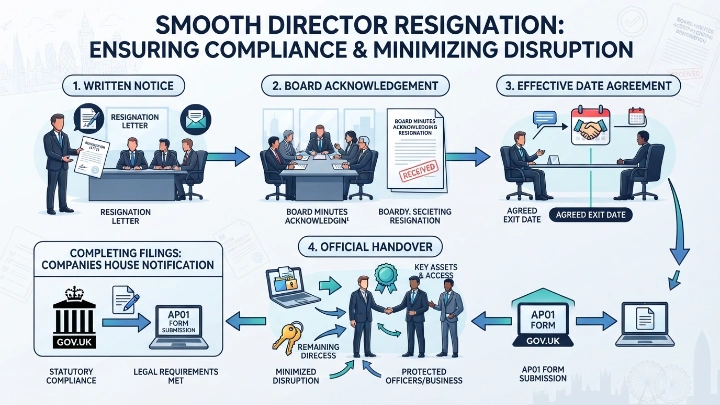
Board departures become problematic when communication breaks down or duties overlap during transitions. Exiting directors should submit a formal written letter of resignation detailing the precise resignation date. The remaining board members must formally accept the notice during an official meeting and record the decision in the meeting minutes.
Standardized steps for dispute-free officer exits:
Draft a clear letter of resignation free of ambiguous language
Secure signed acknowledgement from remaining active directors
Transfer company assets, digital access credentials, and documents promptly
Verify public register updates through Form My Company within 24 hours of filing
Structured exit procedures protect corporate stability and ensure compliance with UK statutory frameworks. Promptly updating public records allows both the company and the outgoing director to proceed with absolute legal certainty.
Strategic Summary & Corporate Guidance
Resigning as a UK company director requires strict compliance with statutory notice periods and accurate filing procedures. Relying solely on internal agreements leaves you vulnerable to third-party liabilities until public registers update. Utilizing Form TM01 via direct electronic portals eliminates filing delays, ensuring legal discharge from active duties within 24 hours.
Form My Company delivers streamlined corporate governance tools designed to process officer updates fast, maintain statutory compliance, and protect business leaders nationwide.
Explore our Conference Room guides,
Order Your Certificate of Good Standing via Form My Company
Fast Identity Verification Services: Secure Your Business Today
Frequently Asked Questions
How does a corporate fraud protection service protect UK limited companies?
A corporate fraud protection service prevents identity theft by restricting unauthorized changes to official records at Companies House. Form My Company provides robust fraud protection that opts businesses into secure digital filing protocols, requiring a six-character authentication code for any officer or address updates. This mechanism automatically rejects fraudulent paper submissions, keeping your company records accurate and tamper-proof.
What is the Companies House PROOF scheme for fraud prevention?
The PROOF (PROtected Online Filing) scheme is a Companies House security framework designed to prevent paper-based corporate identity theft. When managed through Form My Company, the fraud protection service ensures key filings—such as director appointments, resignations, and registered office changes—can only be submitted electronically using encrypted credentials. Any paper forms sent by unauthorized third parties are automatically flagged and rejected.
Why are limited companies vulnerable to corporate identity theft?
Limited companies become targets for identity theft when fraudsters submit unauthorized paper forms to change director credentials or registered office addresses. Once false details are recorded on the public register, criminals can apply for credit, order high-value goods, or take out loans in the company’s name. Implementing a targeted fraud protection service with Form My Company closes these administrative vulnerabilities by enforcing strict digital-only filing rules.
What statutory forms are covered under a digital fraud protection service?
A digital fraud protection service blocks unauthorized paper submissions of key Companies House forms, including AD01 (office address changes), AP01 (director appointments), and TM01 (director terminations). With Form My Company handling your statutory security, these critical filings must be authenticated digitally before any change reflects on the public register. This continuous monitoring safeguards your legal structure against silent administrative hijacking.
How do I activate fraud protection for my business register?
Enrolling in a fraud protection service involves linking your company number and electronic authentication code to direct filing management tools. Form My Company streamlines this setup by registering your business for electronic filing protocols and continuously monitoring public register changes. Active management ensures any unverified compliance filings are identified immediately before affecting business credit ratings or operations.