You submit your Confirmation Statement by filing Form CS01 online or by post with Companies House to verify your current corporate details. Every UK company must complete this annual filing within 14 days of their designated review period end date.
What Is a UK Confirmation Statement?
A Confirmation Statement is a statutory filing that verifies a company’s registered information with Companies House at least once every 12 months. It confirms official records are accurate, including director details, shareholder structures, registered office addresses, and persons with significant control.
Every limited company registered in the United Kingdom holds a legal obligation to complete this requirement. The filing informs Companies House that corporate details stored on the public register remain correct. Filing this document does not replace annual accounts, as it contains no financial figures or profit declarations.
Companies House requires this update under Section 853A of the Companies Act 2006. Directors must check all recorded details before final submission. If any information changed during the year without prior notice, directors must update the specific registers alongside or before delivering Form CS01.
Failing to deliver this document on time leads to severe regulatory outcomes. Companies House initiates strike-off proceedings against non-compliant entities. Directors also face personal criminal liability and financial penalties for late filings or omitted data.
When Is Your Confirmation Statement Due for Submission?
Your Confirmation Statement is due 14 days after the end of your 12-month confirmation period. The review period starts on the company formation date or the day after your last filed statement, creating an absolute deadline for compliance.
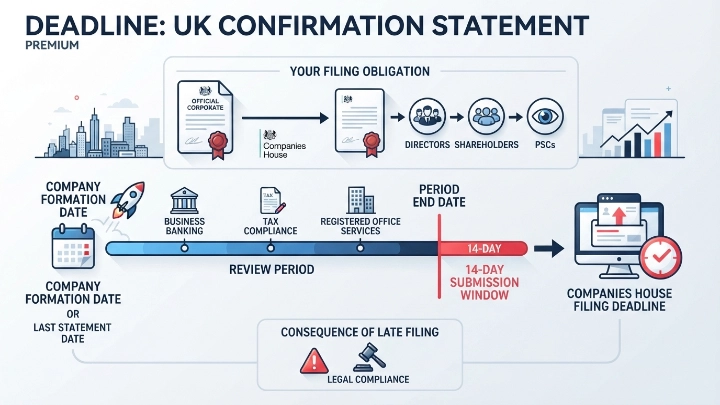
The initial confirmation period begins on the precise date of company incorporation. It runs for exactly 365 days. Subsequent confirmation periods begin on the day immediately following the previous statement date. Directors can check their exact deadline through the official Companies House online service.
Filing schedules remain strict regardless of trading status. Dormant companies and non-trading entities must submit Form CS01 annually alongside active commercial businesses. Early submissions are permitted and simply reset the 12-month review clock for the following year.
Missing the 14-day statutory delivery window triggers automatic compliance warnings. Continued failure to report updates results in prosecution of individual directors. Companies House eventually removes non-compliant entities from the official register, leading to asset forfeiture to the Crown.
What Data Must You Verify Before Submitting Form CS01?
You must verify five core data sets: registered office address, director and secretary records, shareholder details, People with Significant Control (PSC) registers, and Standard Industrial Classification (SIC) codes. Accurate data prevents automatic rejection by Companies House processors.
The verification process demands a systematic check of public records against internal registers. Directors must review every registered office detail to confirm valid address delivery. Any change requires submitting Form AD01 prior to completing the statement.
| Corporate Data Set | Key Verification Requirements | Associated Filing Updates |
| Registered Office & Service Address | Valid UK physical address; no P.O. Boxes without physical verification | Form AD01 / Form AD02 |
| Directors & Secretaries | Full names, service addresses, residential details, dates of birth, nationalities | Form AP01 / Form TM01 / Form CH01 |
| Shareholder Structure | Total share counts, nominal values, currency, voting rights, current transfers | Statement of Capital updates |
| Persons with Significant Control | Individuals holding over 25% shares or voting rights; right to appoint board | Form PSC01 to Form PSC09 |
| SIC Codes | Minimum of one 5-digit code classifying primary economic activities | Form CS01 Section 2 |
When share allocations change during the review period, directors must update the full Statement of Capital. Three specific values require validation: total number of issued shares, aggregate nominal value of shares, and unpaid amounts per share class.
Identifying changes to PSC records forms an essential compliance step. When individuals acquire or transfer more than 25% of corporate voting rights, update the PSC register immediately. Providing false or inaccurate officer information constitutes a criminal offense under UK company law.
How Do You File Your Confirmation Statement Online?
You file online by logging into WebFiling, selecting Form CS01, updating corporate registers, paying the statutory fee, and submitting the electronic file. Online submissions process within 24 hours, providing instant digital proof of compliance.
Digital filing remains the fastest method to fulfill statutory corporate responsibilities. Directors access the portal using their company authentication code and registered email credentials. The system pre-populates existing record details, simplifying the verification phase.
When reviewing the pre-populated screens, verify that your economic activity classification accurately reflects current trading. If your business model shifted, update your 5-digit SIC code directly within the portal. You can select up to four separate codes to cover diverse operational activities.
After validating all static data, complete the statutory payment section. The annual electronic filing fee is £34. Upon final submission, the system generates an immediate confirmation reference number for your legal archives.
For businesses seeking streamlined administrative management, engaging professional services eliminates compliance friction. You can efficiently Confirm Statement vs. Annual Accounts: The Difference Explained to guarantee total accuracy across all public registers.
What Common Pitfalls Cause Confirmation Statement Rejections?
Common pitfalls include mismatched director details, incorrect share capital math, omitted PSC updates, expired service addresses, and late statutory fee payments. Identifying these administrative errors early prevents costly submission rejections and compliance delays.
Filing errors trigger automated system rejections from Companies House processors. A frequent issue involves reporting officer address changes on Form CS01 without submitting the necessary notice forms first. Changes to personal officer details require prior submission of Form CH01.
Another persistent failure point stems from inaccurate share calculations. When completing share transfers or new share issuances, the aggregate nominal value must balance precisely against total issued stock. Miscalculations disrupt legal capital structures and require official amendments.
Omit mandatory updates regarding broad changes to ultimate beneficial ownership.
Submit post-dated changes that fall outside the current statutory confirmation period.
Use residential addresses publicly without arranging appropriate privacy protections.
Misclassify operational activities using inactive or withdrawn 5-digit SIC codes.
Directors who encounter complex compliance overlaps should review the structural rules outlined in our guide on Confirmation Statements: Avoiding the Common Pitfalls for UK Directors. Implementing structured oversight prevents administrative oversight from jeopardizing corporate standing.
How Does a Confirmation Statement Differ from Annual Accounts?
A Confirmation Statement verifies non-financial corporate structure data, whereas Annual Accounts report financial performance, balance sheets, and profit metrics. Both filings are legal requirements under the Companies Act 2006, but serve distinct public record purposes.
Understanding operational boundaries prevents confusion between non-financial reports and financial declarations. The Confirmation Statement acts purely as a snapshot of legal ownership, registered locations, and officer structures. It contains zero revenue figures, operational expense records, or asset valuations.
Conversely, Annual Accounts detail explicit financial transactions carried out during the financial year. Micro-entities, small businesses, and large corporations file varying account types based on asset thresholds and turnover numbers. Companies House processes both filings on entirely independent filing schedules.
How Can Form My Company Manage Your Annual Compliance?
Form My Company manages your annual compliance by auditing corporate data, processing legal updates, filing Form CS01 directly, and monitoring critical deadline calendars. Professional oversight eliminates regulatory risks and ensures complete accuracy on the Companies House register.
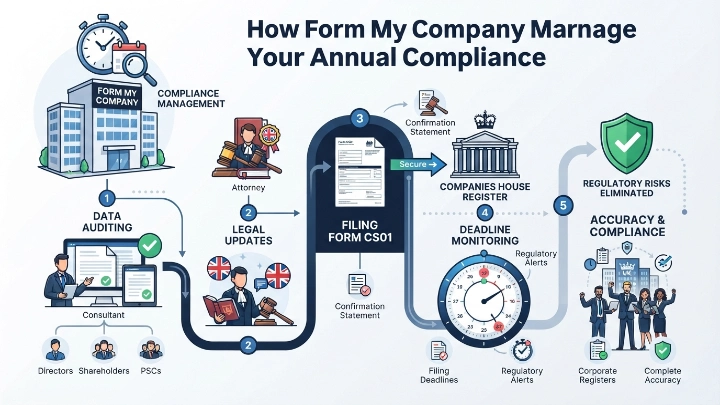
Maintaining active compliance demands ongoing attention to corporate changes and statutory deadlines. Form My Company offers dedicated administrative management for UK business owners, ensuring filings execute flawlessly year after year. Our compliance team verifies corporate data against official records before submitting any documentation.
Outsourcing corporate filing tasks reduces administrative burden for operational directors. Form My Company monitors statutory dates continuously, preventing late filing warnings or threat of register strike-offs. We handle complex share adjustments, officer updates, and address modifications securely.
When you team up with Form My Company, your statutory registers remain aligned with official requirements. Protect your business reputation, avoid director liability, and secure accurate corporate documentation through our professional compliance solutions.
Summary of UK Confirmation Statement Compliance
Submitting an accurate annual Confirmation Statement ensures your business maintains clean legal standing with Companies House. By verifying officer records, share structures, address data, and PSC information promptly within the 14-day window, UK directors avoid severe legal consequences and corporate dissolution. Partnering with experienced corporate service providers ensures your annual statutory obligations remain fully compliant year after year.
Frequently Asked Questions
How does corporate identity theft affect UK registered businesses?
Corporate identity theft occurs when unauthorized parties alter company details at Companies House, such as director profiles or registered office addresses, to impersonate legitimate business officers. Criminals use these altered public records to secure fraudulent lines of credit, order goods, or divert corporate communication. Utilizing the Form My Company Fraud Protection service establishes continuous surveillance on official records to detect and prevent malicious updates.
How does Form My Company protect a business from unauthorized filings?
The service integrates direct electronic surveillance with the Companies House API to monitor corporate registers in real time. Whenever an administrative update—such as a director appointment, address change, or capital amendment—is submitted, company administrators receive instant email notifications. This immediate visibility allows directors to identify unauthorized activity within minutes and challenge fraudulent submissions before financial damage occurs.
Can existing UK limited companies enroll in the Fraud Protection service?
Yes, any active UK Limited Company or Limited Liability Partnership (LLP) can activate protection regardless of where or when it was incorporated. Form My Company syncs the existing Company Registration Number with its automated monitoring platform without requiring a change in registered office details. This allows established corporate entities to seamlessly implement continuous public register tracking and filing safeguards.
What is the difference between Companies House PROOF and Form My Company Fraud Protection?
The Companies House Protected Online Filing (PROOF) scheme solely blocks physical paper submissions, forcing all filings to go through digital channels. In contrast, the Form My Company Fraud Protection service provides continuous, real-time monitoring and instant email alerts for all digital and paper submissions. This ensures complete coverage against unauthorized electronic filings made using stolen authentication credentials.
What steps should a director take if an unauthorized filing is detected?
When suspicious activity is flagged, directors must immediately notify Companies House and report the incident to law enforcement via Action Fraud. The automated monitoring records provided by Form My Company Fraud Protection give business owners documented proof of early detection to support swift record rectification. Early intervention ensures lenders and trade suppliers are alerted before fake corporate credentials can be exploited.