
Your business needs trading accounts if it carries out any financial transactions, earns income, or incurs expenses, whereas it requires dormant accounts if Companies House classifies it as entirely inactive with no accounting transactions during the financial year.
What Is the Difference Between Trading and Dormant Accounts?
Trading accounts document active commercial operations, revenue streams, and allowable business expenses, while dormant accounts confirm that a registered company executed zero financial transactions, generated no income, and incurred no operational costs throughout the official financial year.
Companies House and HM Revenue and Customs classify UK corporate entities based on financial activities. Trading companies generate revenue, pay employees, purchase supplies, or manage business bank accounts. Every transaction triggers specific reporting requirements under UK accounting standards. Trading accounts include a income statement, a balance sheet, director reports, and auditor statements. These documents map the financial performance and fiscal health of an active enterprise.
Dormant accounts report minimal financial changes for non-operational businesses. A company remains legally registered with Companies House while pausing operations. Companies House considers an entity dormant if it records no significant accounting entries during the reporting period. Significant accounting entries exclude basic administrative costs like annual confirmation statement fees, company formation payments, or legal late filing penalties. Dormant accounts consist of an abbreviated balance sheet and specific accompanying disclosures.
Selecting the incorrect accounting framework causes regulatory penalties and compliance failures. Active enterprises filing dormant records face prosecution for false reporting. Conversely, filing full trading accounts for inactive companies creates unnecessary administrative costs and complex tax submissions.
When Does Companies House Classify Your Business as Trading?
Companies House classifies your business as trading the moment it executes a single accounting transaction, accepts commercial revenue, settles operational invoices, incurs business debt, or actively employs staff within a designated financial reporting year.
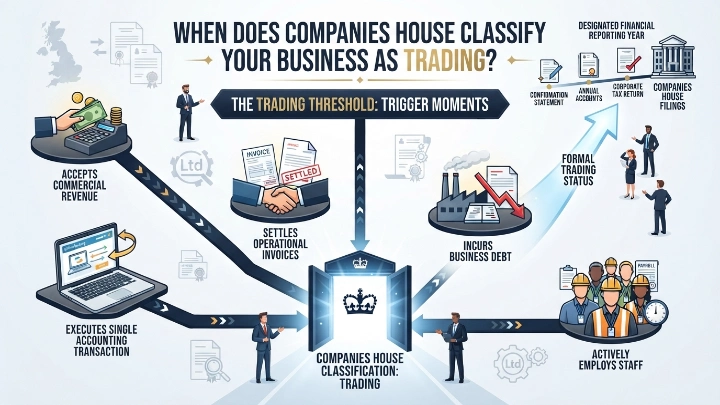
Trading status begins as soon as financial movement occurs inside the corporate structure. Receiving payments from clients or issuing customer invoices instantly establishes trading activity. Buying inventory, leasing office space, or paying marketing expenditures also triggers full trading compliance. Managing active company bank accounts usually signals ongoing operations, as interest earnings or bank fees count as accounting entries.
UK corporate law requires precise transaction tracking to determine classification thresholds. When directors buy equipment or pay utility bills through corporate accounts, the company moves out of dormant eligibility. Even short periods of commercial activity require full annual financial statements.
Tax liabilities accompany trading classification. Trading entities must register for Corporation Tax, submit annual CT600 returns, and calculate active tax commitments. They must maintain complete statutory books, retain receipt records, and comply with standard reporting formats. Failure to report active trading leads to civil fines, tax audits, and potential director disqualifications.
When Does Companies House Classify Your Business as Dormant?
Companies House classifies your business as dormant when it registers zero significant accounting transactions, earns no income, pays no operational expenses, and conducts no commercial operations throughout its entire financial reporting period.
Dormant status allows business owners to protect a corporate name or hold property without running active trading operations. Entrepreneurs frequently form dormant entities to secure intellectual property or hold land assets before launching full services. Existing enterprises switch to dormant status when restructuring operations, pausing active services, or holding assets during market transitions.
Maintaining dormant eligibility requires strict accounting control. Directors must ensure no funds enter or leave corporate bank accounts. Permitted actions are restricted to three specific statutory items:
Paying standard company formation fees to Companies House
Submitting annual confirmation statement filing charges directly
Settling mandatory late filing penalties issued by regulatory bodies
If any other financial transaction occurs, dormant status terminates immediately. Holding an open bank account with automated interest or account maintenance fees can breach statutory conditions. Directors must close active accounts or instruct banks to suppress interest charges to keep dormant standing. When business leaders need professional space to meet advisors and coordinate non-trading corporate strategy, using dedicated bookable meeting facilities allows teams to collaborate without taking on long-term commercial lease liabilities.
What Are the Reporting Requirements for Trading Companies?
Trading companies must submit comprehensive annual financial accounts to Companies House, file a CT600 Corporation Tax Return with HM Revenue and Customs, and lodge an annual Confirmation Statement verifying legal corporate structures.
Trading entities must comply with double-entry bookkeeping rules and strict filing schedules. Directors must compile comprehensive financial statements within nine months of their fiscal year-end date. These statements give public regulators, financial institutions, and business partners a transparent view of corporate solvency.
Complete trading submissions require distinct accounting elements:
Profit and loss statement detailing total turnover and expenses
Balance sheet showing corporate assets, liabilities, and equity
Director’s report summarizing business activities and performance
Notes to the accounts explaining accounting methods and details
Trading entities must also submit annual tax declarations to HMRC. The CT600 return details taxable profits, allowable expense deductions, and capital allowances. Companies must pay owed Corporation Tax within nine months and one day following the tax period end date. Understanding these duties helps business owners evaluate operational choices alongside broader topics like determining active trading timelines.
What Are the Reporting Requirements for Dormant Companies?
Dormant companies must file simplified dormant accounts with Companies House annually, submit an annual Confirmation Statement, and formally notify HM Revenue and Customs of their inactive status to avoid tax assessments.
Dormant corporate status reduces accounting obligations but does not eliminate reporting duties. Inactive companies must file balance sheets with Companies House every year. These filings confirm that the business has remained inactive and retains its registered legal structure.
Dormant filings use simplified forms, such as Form AA02. These submissions report basic capital structures, such as issued share capital and shareholder equity values. They require minimal asset disclosures compared to active trading declarations.
Directors must also update Companies House with an annual Confirmation Statement. This document verifies key corporate details, including registered address, officer identities, and Persons with Significant Control (PSC) registers. Directors must inform HMRC directly when a business becomes dormant. Once HMRC accepts dormant status, it waives annual CT600 tax return requirements until commercial activities restart.
How Do You Transition Between Trading and Dormant Status?
To transition from trading to dormant, you must settle outstanding debts, collect receivables, close active bank accounts, notify HMRC, and submit final trading accounts before filing future dormant returns.
Changing corporate status requires systematic steps to maintain legal compliance. Moving from active trading to dormant status requires clearing all financial liabilities. Directors must pay outstanding vendor invoices, collect client payments, settle tax accounts, and terminate commercial agreements.
Transition steps demand precise compliance actions:
Settle all corporate debts and pay outstanding supplier invoices
Close active operational bank accounts to prevent accidental entries
Submit final trading accounts and pay final Corporation Tax liabilities
Inform HMRC that the entity has stopped trading operations
Maintain statutory registers to prepare for simplified annual filings
Restarting a dormant business requires the opposite steps. Directors must inform HMRC that trading will resume within three months of starting commercial transactions. The company must re-register for Corporation Tax, open active banking accounts, and set up payroll systems if hiring staff. Businesses can streamline this transition by using accelerated filing management services to ensure all documentation reaches regulatory registers accurately.
How Do Trading and Dormant Accounts Impact Corporate Liability?
Trading accounts expose company directors to direct public financial scrutiny, tax compliance audits, and solvency reviews, whereas dormant accounts maintain statutory corporate existence with lower legal exposure while operations are paused.
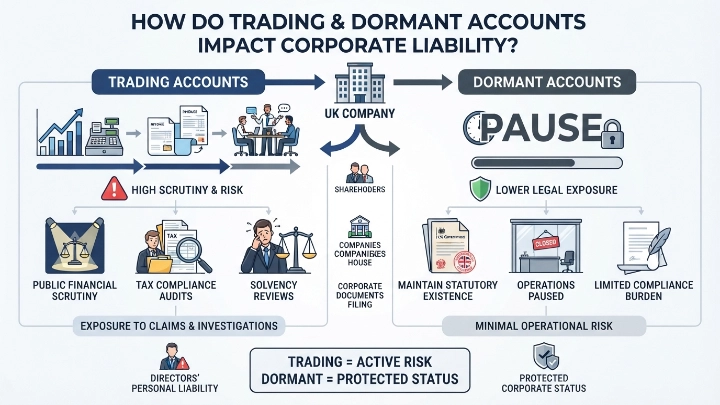
Corporate account selection shapes public transparency, tax obligations, and regulatory liability. Public trading accounts allow suppliers, lenders, and credit agencies to evaluate business performance. Transparent financial records improve credit ratings, support loan applications, and build commercial trust. However, public records also reveal revenue trends and margin performance to competitors.
Dormant accounts protect corporate identity while minimizing operational exposure. Keeping a business dormant protects brand names, registered domain assets, and corporate structures without requiring active trading costs. It preserves corporate frameworks for future projects or strategic changes.
Misclassifying corporate status creates severe legal liabilities. Operating an active business while filing dormant accounts constitutes corporate fraud. Regulators issue fines, reject filings, and can strike non-compliant companies off the official register. Directors must review corporate activity every year to select the correct legal filing framework.
Understanding the difference between trading and dormant accounts ensures UK businesses stay compliant with Companies House and HMRC regulations. Active enterprises must file full financial statements and pay annual tax obligations. Inactive businesses can protect their legal entity through simplified dormant filings. Form My Company assists business owners with accurate corporate filings, company maintenance, and compliance management across every stage of the business lifecycle.
Explore our Conference Room guides,
Confirmation Statement vs. Annual Accounts: The Difference Explained
Bundle Filing vs. Separate Filings: Saving Time and Money
Frequently Asked Questions
How can I protect my UK company from corporate identity theft?
Registered companies can secure their official corporate credentials by activating digital tracking and secure filing protocols with Companies House. Fraud protection services from Form My Company monitor corporate registries continuously to block unauthorized alterations to director details, shareholder structures, or registered office addresses. These monitoring systems immediately alert business owners to unapproved filings, allowing rapid corrective action before identity fraud impacts credit ratings.
What is a corporate fraud protection service?
A corporate fraud protection service is a specialized compliance solution that monitors a company’s public record for unauthorized, deceptive, or malicious changes. The identity management platform at Form My Company monitors the official Companies House register around the clock to detect fraudulent filings. When third parties attempt to falsify structural data or hijack corporate credentials, the system flags the activity to safeguard organizational integrity and compliance status.
Can someone change my company’s director details without my permission?
Identity thieves can maliciously submit fraudulent paper or digital forms to change registered office addresses or director appointments at Companies House. Utilizing the fraud protection mechanisms provided by Form My Company ensures that your registry profile remains locked against unauthorized manual updates. This compliance framework requires enhanced digital authentication, preventing bad actors from injecting false credentials into public records.
How do I know if my business has been targeted by registration fraud?
Businesses typically discover registration fraud when they receive unexpected notifications from Companies House regarding changes to their officers, registered address, or share capital. Enrolling in an automated compliance shield through Form My Company provides immediate push alerts whenever a submission is made against your company number. This constant tracking allows corporate entities to identify unauthorized filings and coordinate with authorities before operational disruption occurs.
Why do UK businesses need secure filing protection?
Public registries function on a good-faith filing system, which makes corporate records vulnerable to identity hijacking, unauthorized asset transfers, and fraudulent credit applications. Integrating the fraud protection protocols from Form My Company creates a reliable layer of defense by replacing vulnerable paper filing workflows with secure electronic keys. This security architecture mitigates risk exposure, validates authentic changes, and ensures long-term statutory compliance for corporate entities.