The hidden hospitality costs of hosting a conference include service charges, room setup fees, audiovisual technician overages, attrition penalties, dynamic staffing rates, and unconsumed food waste guarantees. Venue contracts frequently obscure these supplemental expenses within fine print, increasing baseline hospitality budgets by 20% to 35% unexpectedly.
Why Do Venue Service Charges Increase Conference Budgets?
Venue service charges increase conference budgets because facilities automatically apply fixed administrative fees, typically between 18% and 24%, onto all food, beverage, and space hires. These mandatory surcharges function as baseline operational markups rather than direct staff gratuities, inflating net corporate expenditure.
Corporate event planners routinely budget for primary menu prices without accounting for mandatory compound fees. Venues apply service charges across all refreshment packages, hot buffets, and plated meal plans. When organizers calculate baseline expense projections, they often overlook how service fees compound with regional value-added tax rates. A corporate morning coffee service quoted at £1,000 quickly becomes £1,440 once a 20% service fee and standard UK tax rates apply.
Contractual fine print regularly separates standard facility hire from mandatory service provisioning. Facilities levy mandatory administrative percentages to cover internal labor logistics, banquet handling, and equipment setup. Event organizers must request fully inclusive line-item quotes during initial negotiations. Inspecting contracts for hidden compounding formulas prevents unexpected budget overruns during post-event reconciliation.
Understanding structural cost additions allows finance teams to allocate funds accurately across departmental lines. Event coordinators secure better budget predictability when negotiating fixed service charge caps prior to signing agreements. Reviewing invoice structures ahead of time ensures transparency across all hospitality expenditure tiers.
What Are the Unseen Costs of Event Catering Contracts?
Unseen costs in event catering contracts stem from mandatory minimum consumption guarantees, strict attrition thresholds, dietary preparation surcharges, and per-head water fees. Organizers pay steep penalty rates if delegate attendance falls below contractually specified delegate volumes during the event.
Catering agreements rely heavily on minimum spend clauses that penalize organizations for lower delegate attendance. If a business guarantees 150 attendees but only 110 arrive, the venue still charges for 150 covers. Attrition clauses typically permit a margin of only 5% to 10% reduction before imposing full financial penalties. Hospitality providers charge premium preparation fees for specialized dietary requirements submitted outside tight 72-hour notification windows.
Unspecified refreshment items generate significant secondary costs on final invoices. Facilities routinely bill continuously refreshed mineral water, premium coffee top-ups, and fresh fruit bowls on a consumption basis rather than a flat package rate. Serving staff open extra beverage crates automatically, charging corporate clients per opened unit regardless of consumption totals.
Organizers reduce contractual risk by aligning attendance guarantees strictly with historic turnout metrics. Securing structured packages with all-inclusive food and beverage options prevents unexpected continuous-consumption billing. Evaluating catering terms carefully safeguards organizations from unnecessary post-conference financial liabilities.
How Do Staffing and Overtime Surcharges Impact Hospitality Expenses?
Staffing and overtime surcharges impact hospitality expenses through dynamic labor billing, extended breakdown fees, unionized labor minimums, and early-morning setup premiums. Venues pass penalty rates directly to clients whenever event schedules breach strict contractually agreed operational hours.
Hospitality venues employ specific labor ratios to maintain service quality during corporate gatherings. If a conference program runs 30 minutes over schedule, venues trigger mandatory double-time billing for all floor staff, banquet servers, and security personnel. Early setup windows requested before 7:00 AM incur premium early-bird labor rates across the entire operational crew.
Corporate event operations demand dedicated personnel to manage logistics, delegate flow, and catering stations efficiently. When sessions extend beyond agreed windows, cleanup crews must work late, triggering night-shift penalty rates. Venues calculate these additional labor allocations in full one-hour increments rather than prorated minutes.
Companies manage these dynamic labor expenses by building rigid buffer times into master conference schedules. Event planners must establish explicit start and end parameters for third-party service staff. Clarifying crew shift durations during initial booking phases keeps corporate labor expenses aligned with pre-approved estimates.
What Hidden Audiovisual and Technical Hospitality Fees Should You Expect?
Hidden technical hospitality fees include mandatory venue technician supervision, patch-in charges for external equipment, dedicated Wi-Fi bandwidth upgrades, and power drop fees. Venues charge corporate clients premium rates to connect third-party technology into proprietary building systems.
Many corporate meeting rooms offer baseline media equipment, but advanced presentations require specialized technical support. In-house AV teams often charge hourly supervision fees simply to monitor external production vendors. Facilities levy patch-in charges when external teams connect microphone units or lighting rigs into integrated venue patch panels.
Bandwidth limitations represent another major source of unexpected technical hospitality expenditure. Standard venue Wi-Fi networks support general browsing but collapse under heavy corporate usage. Facilities charge substantial upgrade fees to provision dedicated, high-speed virtual local area networks for corporate attendees.
Organizations prevent technical budget surprises by auditing room infrastructure prior to signing event contracts. Confirming included technology assets early prevents unexpected equipment rental additions later. Evaluating technical requirements during early planning phases guarantees seamless presentation execution without extra billing.
How Do Corkage and External Vendor Penalties Affect Event Budgets?
Corkage and external vendor penalties affect event budgets by imposing fixed per-head or per-bottle surcharges on outside catering, beverages, and specialty equipment. Venues enforce these restrictive financial penalties to protect internal hospitality profit margins.
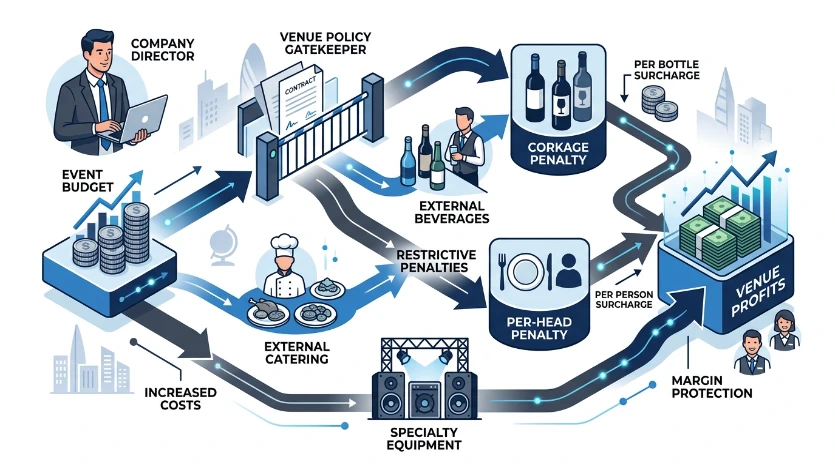
Corporate planners often seek external caterers to deliver specialized menus or lower food costs. Venues counteract this by charging external caterer access fees, kitchen facilities usage costs, and per-head service surcharges. These mandatory vendor levies frequently eliminate any potential savings achieved by hiring external hospitality providers.
Beverage corkage charges follow similar financial structures across commercial event spaces. Bringing external wine, champagne, or non-alcoholic specialty beverages incurs fixed charges per bottle opened. Venues compute corkage rates to equal the profit margin of their own baseline beverage packages.
Evaluating venue vendor policies early ensures full financial visibility before finalizing catering supplier agreements. Comparing total internal package rates against external options plus corkage yields accurate cost assessments. Companies eliminate vendor penalties altogether by selecting venues with transparent, flexible hospitality frameworks.
When comparing catering models, reviewing a detailed analysis of Buffet vs Plated Service for Business Conferences Compared helps planners select the most cost-effective food delivery framework for their delegate volume.
How Can Businesses Eliminate Hidden Conference Hospitality Costs?
Businesses eliminate hidden conference hospitality costs by securing transparent all-inclusive venue packages, negotiating fixed service charge caps, locking in delegate attrition thresholds, and requesting fully itemized master quotes. Clear contract terms remove unexpected line-item markups completely.
Eliminating hidden costs requires a proactive contract negotiation strategy. Corporate procurement teams must insist on flat-rate pricing models that consolidate room hire, technical infrastructure, and catering expenses into unified invoices. Requesting explicit waivers for patch-in charges and water consumption overages establishes firm budget boundaries before events commence.
Selecting transparent venues with built-in corporate amenities simplifies event administration. When organizations rent modern Conference Room facilities with transparent billing structures, they secure professional presentation environments without facing unexpected service markups or hidden facility fees. Clear pricing structures allow event directors to focus entirely on content delivery and attendee engagement.
For complete budget certainty, companies can Book Conference Rooms With Refreshments at Form My Company to receive flat-rate corporate pricing that eliminates surprise administrative fees and venue markups.
Organizations maintain long-term financial control by standardizing event procurement processes across all corporate departments. Audit post-event invoices meticulously against original line-item proposals to verify fee accuracy. Establishing clear venue selection guidelines guarantees high-quality conference experiences while preserving strict corporate budget compliance.
Explore our Conference Room guide,
Are Your Competitors Stealing Your Leads After Hours?
How to Make Your Small Business Look Like a Global Corporation
Frequently Asked Questions
What should you look for when booking a conference room in the UK?
When booking a conference room in the UK, businesses should evaluate location accessibility, room capacity, and technical infrastructure such as high-speed Wi-Fi and audiovisual equipment. It is also important to consider catering options and transparent pricing to avoid hidden service charges. Solutions like the conference room services at Form My Company provide all-inclusive corporate meeting facilities equipped with modern presentation technology and flexible refreshment packages.
How far in advance should a corporate conference room be reserved?
For single-day business meetings or small workshops, reserving a space 2 to 4 weeks in advance is generally sufficient. Larger multi-day corporate conferences or events requiring custom catering and extensive technical setup should be booked 3 to 6 months ahead to secure preferred dates. Platforms such as Form My Company allow organizations to book conference rooms efficiently while ensuring access to on-site technical support and tailored hospitality options.
What amenities are typically included with professional conference room rentals?
Standard professional conference room rentals usually include ergonomic seating, high-definition display monitors or projectors, video conferencing software integration, and digital whiteboards. Many facilities also provide complimentary guest Wi-Fi and on-site administrative support. Selecting a corporate conference room through Form My Company ensures access to fully equipped meeting environments alongside optional catering and refreshment services tailored for business events.
How do on-site catering and refreshment packages work for meeting spaces?
Meeting venues typically offer catering as either fixed per-head day-delegate rates or customizable menu packages, including coffee breaks, buffet lunches, or plated meals. Organizers confirm attendance numbers and dietary requirements prior to the event date to streamline food preparation and service delivery. Dedicated providers like Form My Company streamline corporate hosting by pairing professional conference room hires with fully managed refreshment options to maintain attendee productivity.
What are the main benefits of renting an off-site conference space instead of using an in-house office?
Renting an off-site conference space provides access to advanced media technology, professional hosting support, and larger seating capacities that standard office meeting rooms often lack. Off-site venues also offer a neutral, distraction-free environment ideal for strategic planning, client presentations, and team training sessions. Utilizing specialized conference rooms through Form My Company delivers a polished corporate image while eliminating the overhead costs of maintaining permanent event facilities.