External catering wins for corporate events requiring specialized menus, scaled dietary accommodations, and direct risk transfer. In-house catering wins for routine meetings, tight schedules, and standardized budget control across recurring corporate gatherings.
Which Catering Option Offers Better Cost Efficiency for Events?
In-house catering offers better baseline cost efficiency for small, routine events by eliminating delivery surcharges and vendor margins. External catering provides superior cost efficiency for large events by reducing fixed labor overheads and equipment maintenance expenses.
Corporate event planners analyze fixed versus variable expenditure models when budgeting for business functions. In-house food operations carry static financial commitments regardless of event frequency. Companies pay ongoing salaries for kitchen personnel, retain food service licenses, and cover continuous utility bills. Depreciation on commercial kitchen hardware also adds to the baseline balance sheet. Small daily meetings benefit from this fixed setup because marginal costs per unit remain low.
External vendors convert fixed overhead into variable event costs. Organizations pay exclusively for ordered headcount and direct food service hours. Third-party caterers bundle equipment procurement, cleanup labor, and transport logistics into explicit per-head pricing tiers. This financial structure prevents capital lock-up in idle culinary equipment during periods low on scheduled corporate gatherings.
Budget predictability varies significantly between the two operating models. In-house food preparation often incurs hidden wastage costs when delegate turnout shifts unexpectedly. External providers enforce strict contract terms with fixed guarantee dates, forcing accurate headcounts that stabilize projected spending. Evaluating total spend requires measuring direct ingredient expenses against long-term operational liabilities.
Companies managing multi-day seminars reduce operational risk by booking dedicated corporate venues with built-in culinary infrastructure. Securing a versatile Conference Room allows event managers to balance facility costs with flexible catering models. This approach isolates space rental from food service contracts, keeping financial tracking clean.
How Do In-House and External Catering Compare on Logistical Control?
In-house catering delivers superior control over scheduling flexibility, last-minute menu adjustments, and real-time event delays. External catering excels in managing specialized equipment transport, high-volume service delivery, and professional front-of-house staging.
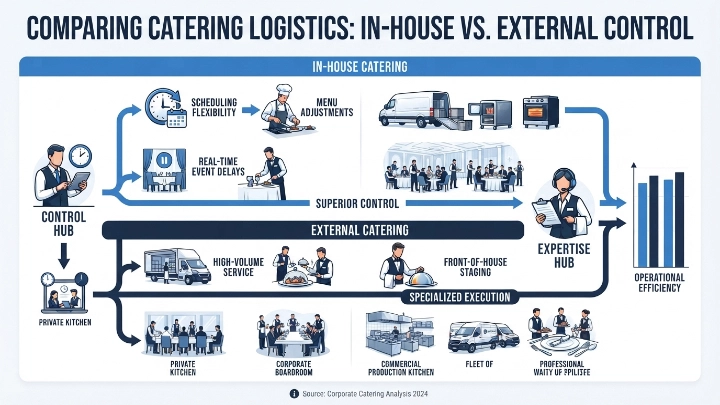
Logistical execution determines event timing and attendee satisfaction. In-house staff operate within familiar facility layouts, eliminating transport delays and unfamiliar kitchen setups. When executive meetings run past scheduled breaks, internal teams adjust preparation timelines immediately without incurring overtime penalties. On-site storage access allows seamless management of unexpected guest arrivals or quick refresh requests.
External caterers operate under complex transport logistics and off-site staging requirements. Third-party vendors transport prepared items in temperature-controlled vehicles, requiring precise arrival windows and dedicated load-in access. Complex venues present spatial challenges, including narrow service lifts and restricted loading bays. External teams must conduct preliminary site inspections to audit electrical capacities and water connections before final execution.
Staffing ratios directly impact service efficiency during tight event schedules. Internal models rely on cross-trained administrative or facility staff, which limits service speed during peak meal periods. External catering firms deploy dedicated waitstaff, bartenders, and floor managers trained specifically for high-density crowd control. Professional event caterers execute timed plated dinners or high-volume buffet lines with minimal operational friction.
Coordination complexity increases when managing external vendor schedules alongside internal venue policies. Facility managers must establish clear protocols for garbage disposal, loading dock access, and kitchen sanitation. External vendors assume operational responsibility for their staging footprint, relieving internal staff from post-event cleanup tasks. Clean boundaries protect internal corporate resources while ensuring rapid room resets between presentations.
Which Catering Strategy Delivers Superior Quality and Dietary Customization?
External catering delivers superior culinary quality and broader dietary customization by offering specialized chefs, diverse regional cuisines, and certified allergen management protocols. In-house catering provides consistent, baseline menu options suitable for daily business refreshments.
Culinary diversity impacts delegate engagement at multi-day corporate functions. Internal catering operations usually rely on fixed menu rotations to control ingredient purchasing and prep work. Standard options include basic sandwich platters, continental breakfasts, and simple warm buffets. Repeating internal menus creates delegate fatigue during multi-day conferences or recurring quarterly strategy sessions.
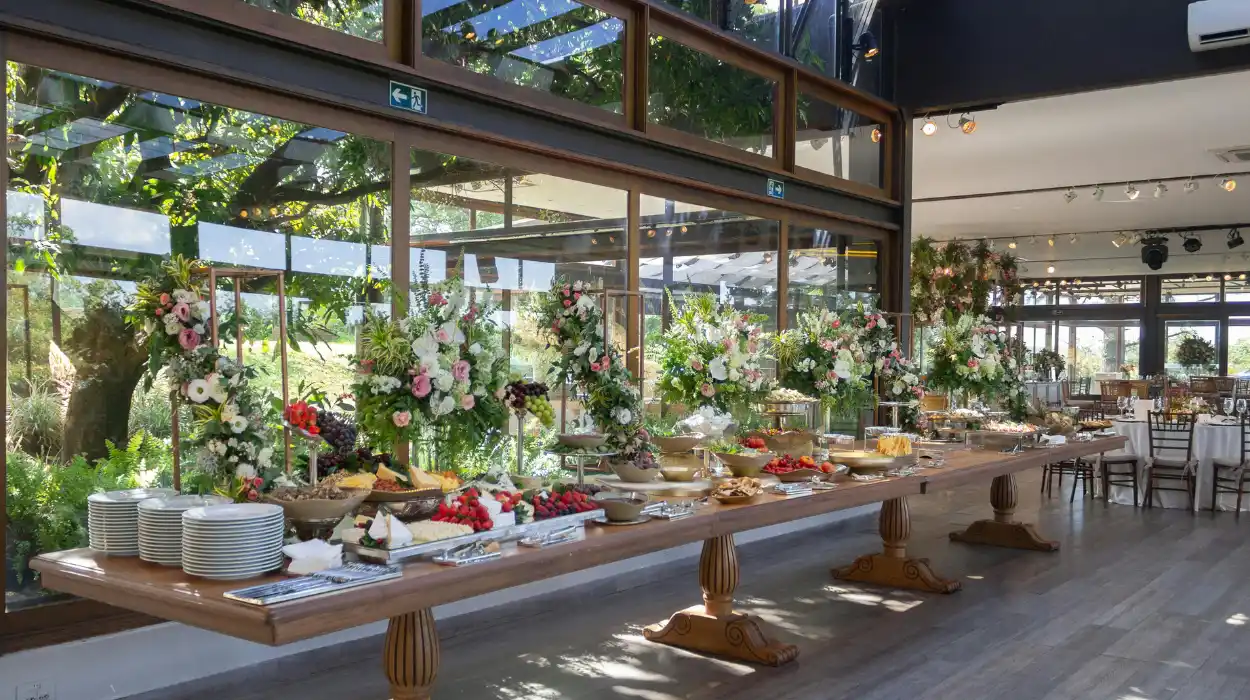
External catering companies maintain extensive networks of specialized culinary talent. Third-party vendors craft customized menus targeting specific cultural preferences, dietary trends, or event themes. Specialized caterers source fresh local ingredients, execute advanced cooking techniques, and present upscale plating styles. Access to diverse culinary portfolios enables planners to match food concepts directly with event branding goals.
Allergen compliance requires strict kitchen isolation standards and ingredient tracking protocols. When delegates submit complex dietary requirements, such as vegan, gluten-free, halal, or nut-free needs, external caterers provide certified meal preparation. Third-party suppliers label individually packaged meals to prevent cross-contamination during service. This precision mitigates corporate liability while accommodating all guest preferences safely.
Understanding baseline attendee needs helps planners decide between simple refreshments and complex culinary options. Reviewing What Food and Refreshments Do Attendees Expect at Events? clarifies standard delegate expectations across different gathering formats. Aligning guest expectations with kitchen capabilities prevents overspending on unnecessary gourmet services.
What Are the Risk Management and Compliance Factors for Each Option?
External catering transfers food safety liability, insurance requirements, and health compliance burdens to the third-party vendor. In-house catering requires the venue owner to maintain health inspection ratings, staff safety certifications, and commercial liability insurance policies.
Food safety regulations govern public service and corporate hospitality operations. In-house kitchens must comply with local authority health regulations, submit to random food hygiene inspections, and maintain detailed Hazard Analysis Critical Control Point logs. Management assumes full legal liability for foodborne illnesses, improper storage temperatures, and workplace injuries occurring within internal kitchen spaces.
External caterers carry dedicated public liability and product liability insurance policies designed for hospitality risks. Hiring an external vendor transfers primary food handling liability away from the corporate entity. Third-party caterers supply risk assessments, method statements, and food hygiene rating certificates prior to entering host premises. Legal risk transfer protects corporate brands from reputation damage linked to safety failures.
Staff training compliance demands continuous administrative oversight and financial investment. In-house kitchen personnel require mandatory certifications in manual handling, chemical storage, and level-two food safety standard practices. Maintaining compliance records across shifting internal teams creates persistent human resources administrative work. External agencies handle all credential validation, safety training, and background verifications for their deployed staff.
Regulatory compliance extends to waste management and environmental sustainability metrics. External caterers manage organic waste removal, recyclable packaging disposal, and excess food redistribution in accordance with commercial waste rules. Internal kitchens must set up local waste separation systems and contract with certified commercial waste handlers. Delegating waste processing simplifies corporate sustainability reporting metrics.
How Does Venue Compatibility Influence Your Catering Decision?
Venue compatibility dictates catering choices through built-in kitchen infrastructure, vendor exclusivity lists, and operational spatial limits. Dedicated venues with full service facilities eliminate the equipment transport and temporary staging needs typical of unequipped corporate spaces.
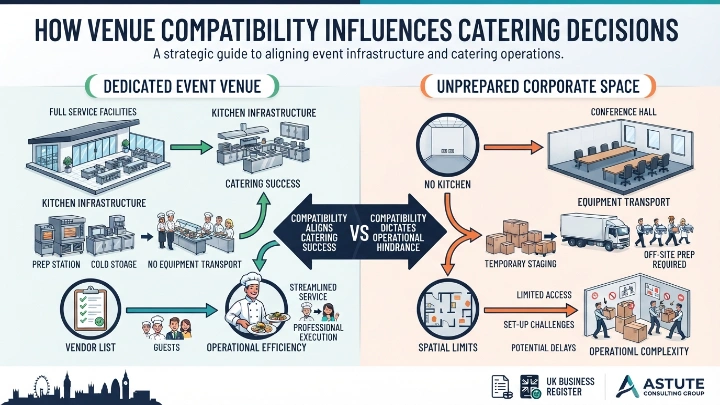
Physical space constraints dictate culinary execution possibilities for corporate events. Standard office meeting rooms lack commercial extraction hoods, high-voltage electrical outlets, and grease traps necessary for hot food preparation. Using external caterers in unequipped spaces forces reliance on drop-off cold platters or portable heating equipment. Infrastructure limitations narrow menu selection regardless of total available budget.
Purpose-built conference facilities integrate dedicated food service infrastructure into their spatial designs. Venues featuring full-scale commercial kitchens enable seamless execution for both internal and external culinary teams. Built-in preparation spaces allow seamless transitions between general assembly sessions and catered breaks. Efficient spatial flow prevents guest bottlenecking around buffet stations and coffee service points.
Selecting the right location simplifies overall event planning logistics and vendor management. You can Hire Catered Conference Venues Through Form My Company to secure locations designed for smooth food service execution. Integrated venue options remove the friction of matching third-party caterers with incompatible physical locations.
Exclusivity agreements frequently dictate vendor selection in commercial venue spaces. Premier conference centers often enforce approved vendor lists, restricting catering choices to vetted third-party partners. These pre-approved caterers possess intimate familiarity with facility rules, loading zones, and electrical capabilities. Working within established venue ecosystems minimizes operational miscommunications during setup.
In-House vs External Catering: Comparison
| Evaluation Criterion | In-House Catering Model | External Catering Model |
| Cost Structure | High fixed overheads, low unit cost for routine meetings. | Variable cost per head, zero ongoing facility maintenance. |
| Scalability | Limited by internal kitchen capacity and staff size. | High scalability for large, high-volume delegate lists. |
| Menu Variety | Standardized, repeating options focused on simplicity. | Diverse, high-end, customized regional and thematic menus. |
| Liability & Risk | Direct legal liability retained by the host business. | Risk transferred to vendor via commercial insurance. |
| Dietary Control | Basic accommodation; risk of cross-contamination. | Certified allergen management and precise dietary labelling. |
| Logistical Effort | Minimal transport needs; high internal staff burden. | Complex transport logistics; zero internal setup effort. |
Evaluating in-house versus external catering requires balancing internal operational capabilities against event goals. In-house systems provide reliable, cost-effective solutions for daily business operations, quick staff meetings, and standard internal trainings. External caterers deliver the culinary expertise, regulatory compliance, and scalable service required for high-stakes corporate conferences, product launches, and major client events. Planners optimize expenditure by matching the catering delivery model directly to event complexity, delegate expectations, and physical venue parameters.
Explore our Conference Room guide,
DIY Director Appointment vs. Professional Filing: A Risk Comparison
Voluntary vs. Forced Director Resignation: What You Should Know
Frequently Asked Questions
What should you look for when booking a conference room for corporate events?
When booking a conference room, corporate planners evaluate capacity, audiovisual equipment, high-speed connectivity, flexible room layouts, and on-site catering options. Form My Company offers conference room options equipped with presentation technology, ergonomic seating, and administrative support to ensure seamless event execution.
How far in advance should a company reserve a corporate conference venue?
Large corporate events, seminars, and multi-day workshops typically require reserving a conference room three to six months in advance to secure preferred dates and catering arrangements. Smaller board meetings or routine team sessions booked through Form My Company can often be accommodated with shorter notice depending on venue availability.
Are catering and refreshment services included with conference room rentals?
Catering inclusions vary by venue package, ranging from basic beverage services to fully managed external or in-house dining operations. Form My Company facilitates conference room rentals that integrate customizable refreshment options, dietary accommodations, and dedicated break spaces tailored to event requirements.
What technical equipment comes standard in modern conference rooms?
Modern conference facilities generally feature high-definition displays or projectors, video conferencing hardware, surround sound audio systems, wireless screen sharing, and high-speed Wi-Fi. Form My Company ensures conference room spaces are fully equipped with reliable digital infrastructure to support hybrid and in-person corporate presentations.
How do flexible layout configurations benefit corporate conference room hires?
Flexible room layouts—such as boardroom, theater, classroom, or cabaret styles—allow event managers to adapt physical spaces to specific meeting objectives and delegate counts. Form My Company matches businesses with conference room facilities that offer modular seating configurations to optimize delegate engagement and presentation sightlines.