
Digital statutory registers suit most UK limited companies due to real-time updates, automated cloud backups, and seamless remote access, while physical registers remain valuable for businesses requiring tactile legal records during physical audits or traditional board meetings.
The Companies Act 2006 mandates that every UK limited company maintains statutory registers to record official corporate governance details. Choosing between physical books and digital software shapes your long-term legal compliance, administrative workload, and data security.
What Are Physical Statutory Registers and How Do They Work?
Physical statutory registers are paper-based ledger books or loose-leaf binders stored at a company’s registered office to manually record officer details, shareholder transactions, and company charges in accordance with traditional UK corporate governance standards.
UK directors traditionally maintained statutory records using bound leather books or hardcopy loose-leaf binders. These physical registers remain located at the registered office or a designated Single Alternative Inspection Location (SAIL address). When share transfers or director appointments occur, a company secretary manually writes or prints the updated information directly into the physical ledger.
Maintaining hardcopy books requires strict physical security measures to prevent damage, loss, or unauthorized tampering. Members of the public and company shareholders hold a legal right to inspect these paper records during official business hours. Manual entries demand meticulous handwriting or careful filing to prevent transcription errors during official updates. Physical books offer a tangible record that functions without digital infrastructure or internet access.
What Are Digital Statutory Registers and How Do They Function?
Digital statutory registers are cloud-based software systems that electronically record, update, and store corporate compliance data while automatically syncing changes with Companies House filings and generating real-time digital share certificates.
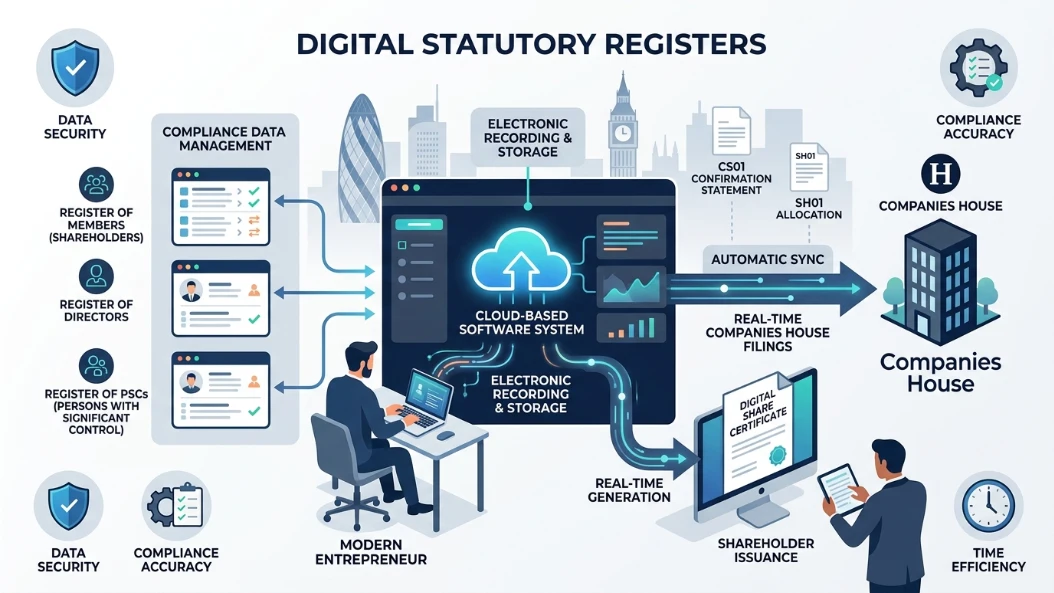
Modern cloud compliance platforms store statutory records on secure remote servers with encrypted access controls. When corporate changes take place, administrators update the digital dashboard to instantly reflect new shareholder details, PSC updates, and director resignations. These digital systems integrate directly with Companies House software to stream compliance filings and maintain precise timestamped audit logs.
Digital registers eliminate paper storage requirements and reduce physical space needs at your registered office. Authorised officers access compliance records from any location using secure login credentials. Automatic data validation reduces human input errors by cross-referencing information across all statutory sections. Digital systems generate instant PDF exports of registers for legal advisors, accountants, and financial auditors.
How Do Physical and Digital Registers Compare on Legal Compliance?
Both physical and digital statutory registers fulfill Companies Act 2006 requirements equally when maintained accurately, but digital registers streamline compliance by automating Companies House filing updates and reducing human error.
The Companies Act 2006 allows UK companies to maintain statutory registers in hardcopy or electronic form under Section 1135. Both formats fulfill legal obligations provided the records remain accurate and accessible for inspection. When legal disputes arise, courts examine the accuracy of entries rather than the physical medium of the register.
Maintaining physical registers requires manual cross-referencing whenever you submit filings to Companies House. If an administrator updates the public register without updating the physical statutory book, the internal paper record becomes legally inaccurate. Digital registers reduce this risk by synchronizing internal entries with external statutory submissions.
Certain corporate actions require specific documentation formats during official audits. Traditional lenders or overseas investors occasionally request bound physical registers during complex corporate transactions. Conversely, digital systems maintain continuous revision histories that demonstrate exact compliance timelines to legal advisors.
Which Option Offers Superior Data Security and Disaster Recovery?
Digital statutory registers offer superior data security and disaster recovery through end-to-end encryption, multi-factor authentication, and automated cloud backups, whereas physical registers face irreversible loss from fire, flood, or theft.
Physical paper registers carry permanent vulnerability to physical hazards like fire, water damage, and accidental destruction. A single incident at your registered office can permanently destroy decades of unbacked corporate history. Reconstructing lost physical registers requires costly court applications, extensive historical research, and expensive legal representation.
Physical books also present security risks regarding unauthorized access and physical theft. Anyone with physical access to your office storage can view confidential shareholder addresses or director details without leaving an access trail.
Digital compliance systems protect statutory data using 256-bit encryption standards and strict access permissions. Multi-factor authentication prevents unauthorized users from viewing or modifying sensitive corporate records. Automated cloud backups store identical copies across multiple secure data centers. If a local computer fails, authorized users recover complete statutory records instantly through secure web browsers.
How Do Costs Compare Between Physical and Digital Registers?
Physical registers carry low upfront costs but higher long-term labor expenses, whereas digital registers require ongoing subscription fees but significantly lower administrative overhead and record reconstruction costs.
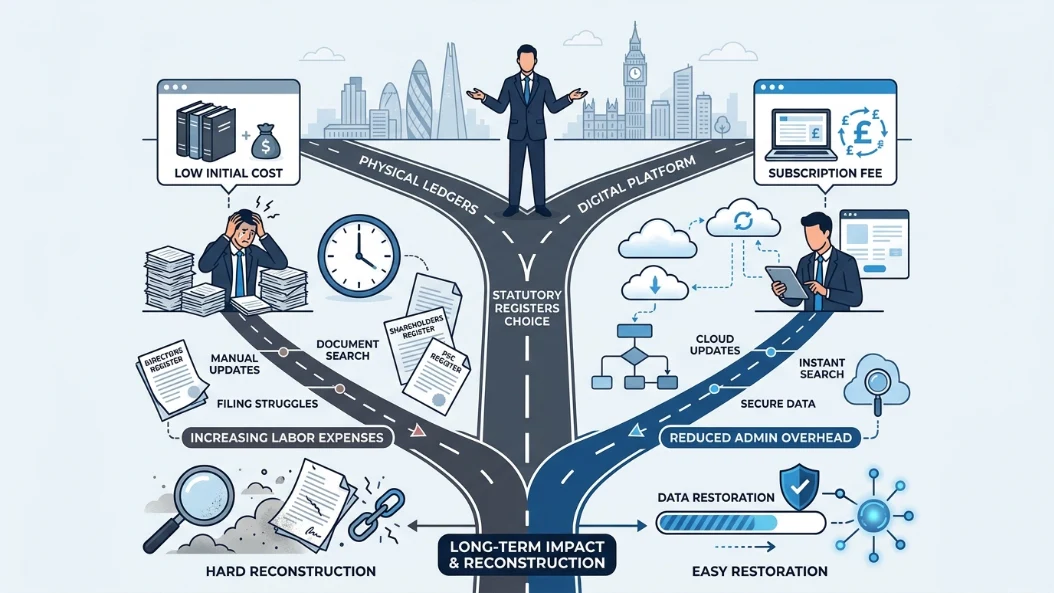
Purchasing a physical loose-leaf register or bound statutory book costs between £30 and £80 as an initial one-off expense. However, the hidden costs of physical registers accumulate through manual labor hours spent typing, printing, and physically filing updates. When structural changes occur, administrative staff spend hours updating multiple paper pages manually.
Digital statutory registers operate on annual subscription models or packaged corporate services ranging from £40 to £150 per year. These platforms reduce internal labor costs by automating routine data entry and share certificate generation.
Corporate restructuring events highlight the true cost differences between both formats. When a company issues new share classes to 50 investors, updating physical books requires hours of manual printing and physical signing. A digital system processes the same corporate action in minutes. Companies managing complex capital structures save significant administrative expenses by transitioning to electronic record-keeping.
How Do Inspection Rights Work for Physical vs Digital Registers?
Physical registers require in-person public inspection at the registered office during business hours, whereas digital registers enable secure remote inspection via encrypted view-only links or direct Companies House central register selection.
Section 1136 of the Companies Act 2006 gives shareholders and the public the right to inspect statutory registers. For physical registers, inspectors must visit your registered office or SAIL address during normal business hours after providing proper notice. Company officers must supervise these physical visits to protect the physical integrity of the books.
Digital registers simplify public inspection obligations while maintaining strict security controls. When an authorized party requests an inspection, administrators generate temporary, view-only digital links that display required statutory data. This remote access eliminates the need to host external visitors at your primary business premises.
UK companies can also elect to keep statutory information on the public register at Companies House under Small Business, Enterprise and Employment Act provisions. Choosing central filing removes the duty to maintain separate internal inspection facilities entirely. Digital compliance systems prepare data directly for central register synchronization.
Which Option Suits Your Specific Business Structure Best?
Digital registers suit fast-growing SMEs, multi-shareholder companies, and remote teams needing instant updates, while physical registers suit simple single-director businesses seeking traditional hardcopy record storage.
Selecting the optimal register format depends on your company’s operational model, ownership complexity, and growth trajectory.
| Business Feature | Physical Registers | Digital Registers |
| Ideal Company Type | Single-director businesses, inactive holding companies | Fast-growing SMEs, startups, multi-director firms |
| Shareholder Changes | Rare, manual updates | Frequent, automated allocations |
| Access Model | Single physical location | Remote multi-user access |
| Disaster Recovery | None (unless physically photocopied) | Automated real-time cloud backups |
| Inspection Method | In-person office visits | Secure digital link or central sync |
Single-director limited companies with stable, unchanging share structures often find physical registers simple and sufficient. The low volume of updates means manual entries create minimal administrative burden.
Conversely, venture-backed startups and active trading companies benefit significantly from digital systems. When managing multiple funding rounds, option pools, and frequent board changes, digital registers prevent administrative backlogs. If your team operates remotely, digital systems ensure officers update compliance records without visiting a physical office.
When you purchase a complete Company Pack service, you secure the essential official documentation required to establish legally sound corporate governance from day one.
How Can You Transition From Physical to Digital Registers Seamlessly?
Transitioning from physical to digital registers involves auditing existing paper books, verifying current shareholdings against Companies House records, digitizing historical entries, and formally adopting electronic record-keeping via a board resolution.
Migrating statutory records to a digital environment requires systematic validation to ensure legal continuity.
Audit existing physical books to identify missing entries, unsigned share certificates, or unrecorded officer changes.
Reconcile historical paper data with official public filings currently held at Companies House.
Draft a formal board resolution approving the adoption of electronic statutory registers pursuant to Section 1135 of the Companies Act 2006.
Input accurate corporate records into your chosen cloud compliance software platform.
Verify digitized entries against original hardcopy share transfers and board minutes.
Archive physical ledger books in secure, fireproof storage for historical reference.
Understanding why every UK limited company needs statutory registers helps directors maintain legal compliance regardless of whether they choose paper or cloud systems.
Once digitized, your electronic register becomes the primary legal record of company ownership and management. You must maintain continuous updates within the software whenever future corporate changes occur.
Making the Final Decision for Your Company
Choosing between physical and digital statutory registers comes down to balancing operational convenience against your preferred administrative workflow. While physical books provide a traditional paper record, digital systems offer superior security, automated accuracy, and remote accessibility for modern business operations.
Businesses seeking a premium physical solution can get a premium bound statutory register with Form My Company to maintain hardcopy compliance records. Form My Company provides professional statutory register solutions that help UK limited companies maintain legal compliance across every stage of corporate growth.
Explore our Company Pack guide,
How to Calculate the ROI of Professional Interview Rooms
How to Complete PSC Identity Verification Step by Step
Frequently Asked Questions
What is included in the Form My Company Company Pack?
The Form My Company Company Pack provides all essential official corporate governance documents required for a UK limited company, including a premium bound statutory register, official share certificates, and bound copies of the Articles of Association. It ensures newly incorporated businesses maintain complete legal compliance with the Companies Act 2006 from day one.
Is a physical statutory register required for a UK limited company?
While the Companies Act 2006 permits electronic record-keeping, every UK business must maintain accurate statutory registers containing director details, shareholder allocations, and PSC records. Obtaining a physical statutory register through the Form My Company Company Pack ensures company officers have tangible, audit-ready compliance books available at their registered office.
How do I get official share certificates after registering a UK business?
Official share certificates are issued to members following the initial allocation or transfer of company shares. The Form My Company Company Pack includes professionally printed share certificates alongside a structured register of members to ensure accurate historical ownership tracking.
Why do banks and investors ask for bound statutory registers?
Financial institutions, traditional lenders, and legal advisors frequently inspect bound statutory registers during business bank account setups, loan applications, and corporate due diligence. Using the Form My Company Company Pack delivers professionally bound hardcopy records that demonstrate transparent corporate governance to external auditors and investors.
How does the Company Pack help with Companies House compliance?
The Form My Company Company Pack equips business owners with pre-formatted registers designed to track director appointments, shareholder changes, and statutory filings accurately. This structured layout simplifies internal record-keeping and ensures alignment between internal company registers and public filings submitted to Companies House.