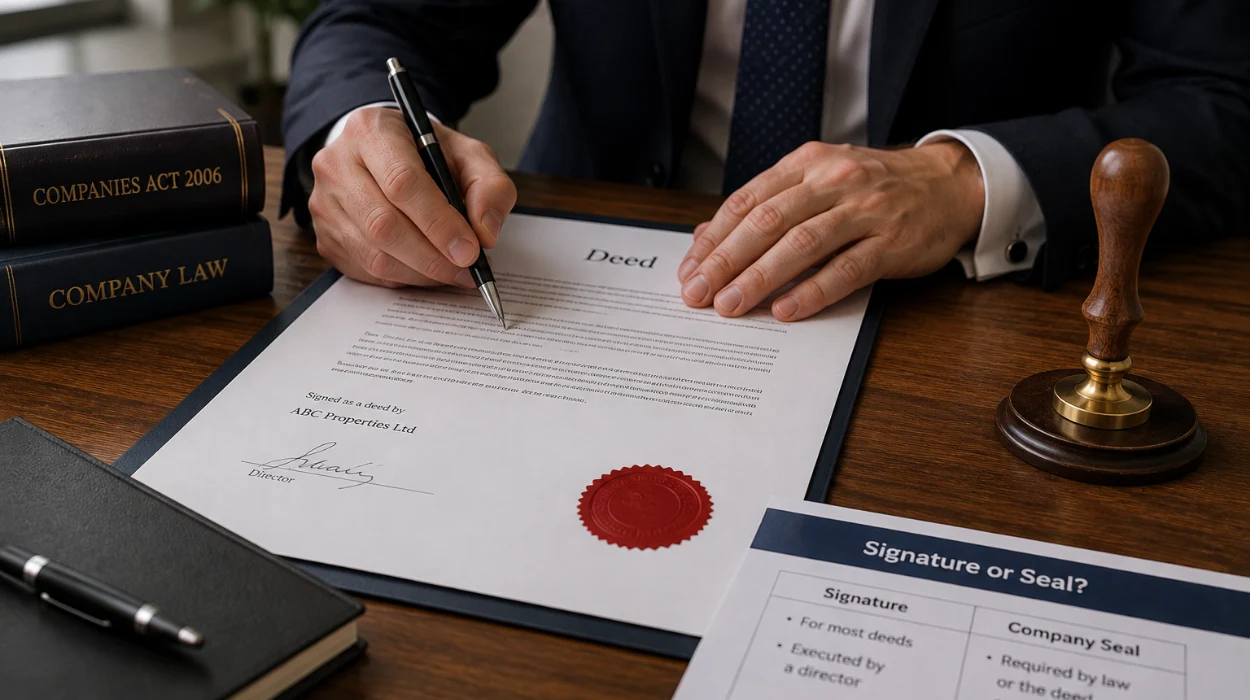
A company seal is legally required for executing specific corporate documents like deeds in international jurisdictions, whereas a signature suffices for standard UK domestic contracts. Directors must execute deeds correctly using signatures and witnesses to ensure legal validity under the UK Companies Act.
What is the legal difference between a company seal and a signature on a deed?
A company seal acts as a formal corporate signature stamped onto physical paper, while a manual signature involves officers signing a document in ink. Both methods validate corporate intent under English law, though international registries often demand the physical seal for authority.
Corporate governance frameworks recognize two distinct mechanisms for binding a registered entity to legal obligations. A manual signature executed by two authorised directors or one director in the presence of a witness satisfies standard execution requirements under the Companies Act 2006. This modern approach speeds up domestic transactions across 4,500,000 active UK enterprises.
A company seal, historically known as a common seal, serves as the official embossing instrument of the corporation. When applied to a deed, it physically impresses the company name into the paper medium. Overseas authorities and foreign jurisdictions frequently mandate this physical impression because local legal traditions view unsealed documents with skepticism.
Corporate boards maintain control over this embossing tool through strict internal bylaws. Two designated officers typically witness the application of the metal die onto the paper surface. This dual-authentication process prevents unauthorised binding of corporate assets.
When do international transactions require a company seal instead of a signature?
International transactions require a company seal when foreign civil law jurisdictions demand physical embossing to verify corporate authority. Overseas legal systems often reject standard ink signatures unless an official seal authenticates the document.
Cross-border commerce introduces complex regulatory hurdles for UK enterprises expanding into foreign markets. Civil law countries across Europe, Asia, and South America rely heavily on formalized physical instruments rather than modern electronic or simple ink executions. When a UK business acquires property abroad or establishes a foreign subsidiary, local notaries frequently refuse documents lacking an embossed corporate mark.
Foreign corporate registries examine foreign deeds with rigorous scrutiny before recording property titles or share transfers. Legal officers in these foreign institutions check for the official corporate impression to confirm that proper governance protocols occurred. Without this physical verification, foreign courts may declare international contracts void or unenforceable.
International trade agreements often stipulate specific evidentiary standards for cross-border disputes. Operating across these diverse legal landscapes requires reliable authentication tools that satisfy foreign evidentiary rules instantly. Utilizing an official corporate die eliminates administrative delays during multi-jurisdiction negotiations.
How does the UK Companies Act regulate the execution of deeds?
The UK Companies Act regulates deed execution by permitting corporations to sign via two authorised officers or one director with a witness. Companies may also use a physical common seal to execute formal instruments validly.
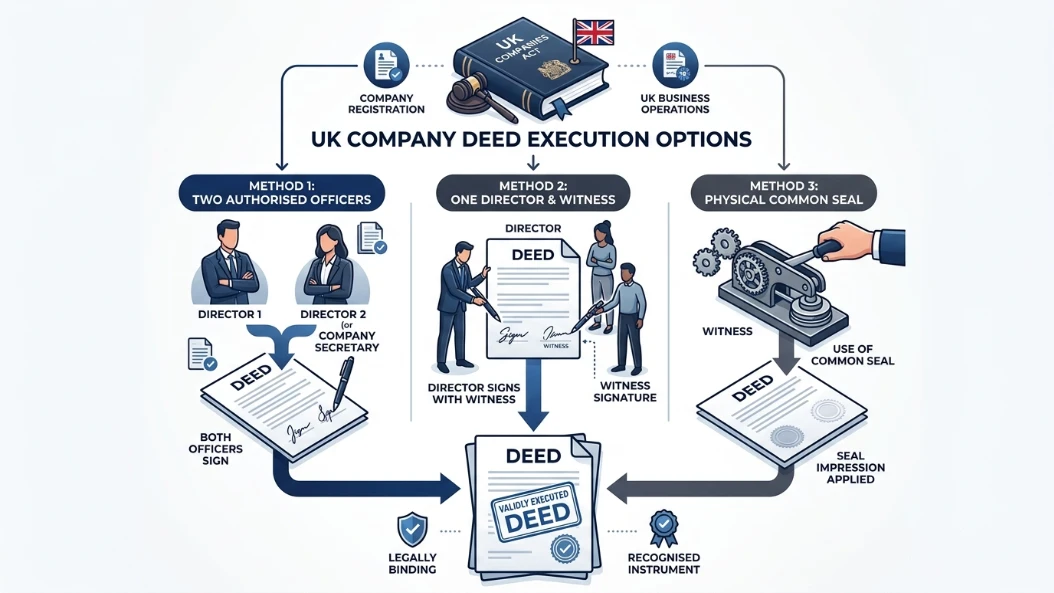
Section 44 of the Companies Act 2006 establishes clear statutory guidelines for how registered entities execute binding deeds. A document is validly executed as a deed by a company if it is signed by two authorised signatories, such as two directors or a director and the company secretary. Alternatively, a single director can execute the instrument if their signature receives attestation from an independent witness.
The statute explicitly preserves the option for corporations to use an official common seal as an alternative execution method. If a company chooses to use its embossing die, the application must follow the exact procedural rules outlined in its articles of association. These internal governance rules dictate who must be present when the metal die touches the document.
Compliance officers must maintain detailed records of every instance where officers execute formal instruments. Regulatory audits examine corporate registers to confirm that all signed deeds align with board resolutions. Proper adherence to these statutory frameworks protects corporate officers from personal liability.
Which option provides better security and compliance for business agreements?
A manual signature accompanied by proper witness attestation provides superior audit trails for modern UK transactions. A company seal offers enhanced legal certainty for international trade and specific foreign regulatory submissions.
Evaluating security mechanisms depends heavily on the geographic scope of your commercial operations and your administrative workflow. Domestic commercial transactions benefit immensely from digital efficiency and traditional ink signatures witnessed by impartial third parties. These signatures leave clear evidentiary trails that UK courts accept without hesitation.
Global transactions present unique risks that demand robust physical security measures against document forgery. Sophisticated fraud prevention strategies often incorporate traditional embossing tools alongside digital verification protocols. Corporations investing in a comprehensive Company Pack secure essential governance items required for secure global expansion.
Managing corporate documentation efficiently requires balancing speed with absolute legal compliance. Businesses operating primarily within domestic markets rarely encounter situations where an embossed die is strictly mandatory. Companies venturing into global trade must assess foreign regulatory demands before choosing their execution format.
How can businesses implement proper document execution protocols?
Businesses implement proper document execution protocols by updating their articles of association and training administrative staff. Corporations must establish strict internal controls governing who accesses the embossing tool and who witnesses signatures.

Establishing robust administrative protocols prevents costly legal challenges regarding contract enforceability. Corporate boards must review their articles of association to determine whether maintaining an official embossing die is mandatory for their specific industry sector. If foreign trade represents a significant revenue stream, acquiring a durable corporate stamp is an essential operational step.
Training administrative personnel on statutory execution rules reduces human error during high-stakes contract finalization. Staff members must verify that every deed contains the correct number of signatures and independent witness details before filing. For deeper insights into operational compliance, review our guide on When Is a Company Seal Legally Required in the UK?.
Maintaining organized registers ensures that all executed deeds remain accessible for future corporate audits and legal reviews. Companies executing cross-border agreements should also explore strategies detailed in Buy a Company Seal for International Deals With Form My Company. Form My Company delivers reliable corporate solutions that help enterprises navigate complex legal execution standards effortlessly.
Executing corporate documents accurately safeguards your enterprise against legal disputes and regulatory penalties. UK domestic transactions rely primarily on authorised signatures and independent witness attestation, while international commerce frequently demands an official embossed die. Form My Company provides essential governance tools and expert guidance to ensure every corporate document complies with domestic and global legal standards seamlessly.
Explore our Company Pack guide,
Step-Free vs Assisted Access Venues: What to Check Before Booking
Interview Room Amenity Checklist Before You Book
Frequently Asked Questions
What physical items are included in the Company Pack from Form My Company?
Answer: The Form My Company [Company Pack] includes a statutory company register binder, printed certificate of incorporation, share certificates, a self-inking company stamp, and an official embossing seal. These items provide the tangible corporate administration tools required for a newly registered UK enterprise.
Why do UK businesses need a statutory company register binder?
Answer: A statutory company register binder is a mandatory legal requirement under the UK Companies Act 2006 to record directors, members, and People with Significant Control. Form My Company includes this structured register in the [Company Pack] to help corporate officers maintain compliant internal records.
Can I use the contents of the Company Pack to open a business bank account?
Answer: Yes, the official printed certificates and structured register supplied within the Form My Company [Company Pack] help verify corporate legitimacy to high-street banks. Presenting physical documentation streamlines anti-money laundering checks during commercial account setup.
What is the difference between a company stamp and an official company seal?
Answer: A company stamp uses self-inking ink for routine document marking, whereas an official company seal embosses the corporate name directly into paper. Form My Company bundles both physical authentication tools inside the comprehensive [Company Pack] for versatile contract execution.
How are the physical documents from the Company Pack delivered?
Answer: Form My Company dispatches all physical accessories contained in the [Company Pack] directly to your designated address via Royal Mail tracked delivery. This secure shipping ensures your bespoke stamps, seals, and registers arrive safely alongside your digital incorporation documents.